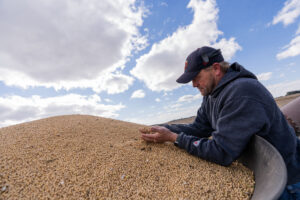

Long before a single seed goes into the ground, farmers spend months mapping out their plans for the growing season. Running a successful farm demands a wide range of supplies and services — from fertilizer and seed to fuel, equipment, labor, land costs, and taxes. But right now, those costs are climbing fast while soybean prices are moving in the opposite direction.
Global tensions are making things worse. Conflict in the Middle East has disrupted the global fertilizer market, pushing up prices for fertilizer and diesel fuel along with many other goods and services that farmers depend on every day.
Planning and Planting
With production costs more unpredictable than ever, many farmers have been forced to rethink what they plant this season. Illinois farmer and ASA Director Roberta Simpson-Dolbeare, who works the land alongside her husband Eric, says those rising costs are influencing decisions on their operation.
“We stay pretty much to a 50/50 rotation between corn and beans,” she said. “It’s hard to predict what market prices may do, but those do factor into our final decision of how many acres of corn and beans we’ll plant. However, we generally don’t vary a great deal from a fairly balanced rotation.”
Even as some producers consider switching what they grow based on what things cost, Simpson-Dolbeare says the bottom line is what really drives the decision.
“The price of inputs comes into play, certainly, but the expected income and the relative value of the end result is what we focus on,” she said.
Rising Input Costs
The upward pressure on farm expenses has been building for several years now, touching nearly every category — fertilizer, equipment, seed, and fuel. ASA Economist Jacquie Holland explained the trajectory: “Input prices spiked in 2022 to 2023 following the Russian invasion of Ukraine and pandemic supply chain issues. Prices came down but remained elevated above pre-pandemic levels leading up to the Iran War.”
One telling sign of how farmers are coping can be seen in their equipment purchases. ASA Chief Economist Scott Gerlt put it plainly: “In good years, farmers buy new equipment, and in bad years, they put it off. Farmers aren’t purchasing much new equipment right now. In the long run, they may start looking at their land. If they have rental agreements, they may have to renegotiate lower prices or let some leases go. Farmers will reevaluate their operation a lot more closely, seeing what is profitable and what isn’t. They can’t do anything speculative.”
Simpson-Dolbeare says her operation has responded by being more careful with maintenance. “We’ve always tried to keep our equipment in good working order, so with rising input costs, I think we are even more diligent about making sure we do necessary maintenance in caring for equipment,” she said.
Crude oil prices have added another layer of pressure. However, Gerlt noted there is a potential upside: “High crude oil prices have driven up all costs, but they have also pulled up soybean oil demand, which creates value. It’s a double-edged sword.”
Fertilizer and Countervailing Duties
Fertilizer costs have been a persistent concern in the soybean industry, but the situation has worsened significantly due to conflict involving Iran and restrictions on transit through the Strait of Hormuz. Holland described the broader forces at work: “Global dynamics largely shape fertilizer prices both at home and abroad. Reductions and pauses in China’s phosphate export volumes has had a major impact on global pricing. Tariff barriers imposed by the U.S. in the form of countervailing duties and International Emergency Economic Powers Act (IEEPA) tariffs also added extra layers of costs to input pricing.”
Countervailing duties placed on Russia and Morocco — two of the world’s biggest phosphate exporters — have further tightened the fertilizer supply. Despite those duties, the U.S. has continued to import phosphates from Russia because supplies are so constrained. The American Soybean Association has been pushing for those countervailing duties to be eliminated, arguing that importers are simply passing those added costs along to farmers. Holland said removing the duties could bring “unencumbered access to available supplies reducing global scarcity and sending prices lower as a result, all other factors equal.”
Even if the underlying causes of the price surge were resolved today, it would still take months for costs to come down — and potentially years before farmers feel meaningful relief. In the meantime, Simpson-Dolbeare described the tough choices her farm has already made: “We reduced our fertility to nutrient removal level as a cost saving measure. Yet even with these measures, we still spent more on inputs than we typically have in the past. To sum it up, we applied, on average, 1/3 less and paid 50% more.”
The Need for Open Markets
The soybean export market has taken a major blow this year. China, the single largest buyer of U.S. soybeans, has cut its typical purchases in half. That drop in demand has left farmers struggling to generate enough revenue to cover their costs. A 10% tariff China placed on U.S. soybeans has compounded the damage, and many in the industry say policy changes are urgently needed.
Gerlt highlighted China’s outsized importance to the market: “China is by far the largest export concern because the tariff rate has gone up on U.S. soy. Historically, soy has had good market access to other countries. Over the next few years, what China does for U.S. beans will be a big driver for exports.”
Farmers have been speaking out, urging both the administration and Congress to pursue open export markets rather than imposing additional tariffs or simply offering financial assistance. Simpson-Dolbeare summed up the sentiment shared widely across the industry: “From our viewpoint, reducing tariffs will help us the most. Tariffs are hurting demand for U.S. soy, and tariffs are negatively impacting our input costs. Our greatest concern is how our long-term profitability is affected if tariffs stay in place. We don’t want ongoing aid, we want open trade markets.”
The American Soybean Association’s Executive Committee and board have echoed that message over the past year. While farm assistance programs are appreciated, the industry’s preference is to rely on open, competitive markets to keep operations viable. Tariffs have pushed potential soybean buyers toward other countries, adding even more strain on farmers already struggling with rising costs.
The ASA says it will continue advocating on behalf of farmers — pushing to eliminate countervailing duties on phosphate fertilizer imports and working to educate policymakers in Washington, D.C., about how these input costs affect American agriculture.