
American soybean farmers are taking an active role in making it cheaper to move their crops from fields to customers — both at home and abroad. The strategy, described by leaders in the industry as “subtraction math,” focuses on reducing the cents-per-bushel cost of transportation at each stage of the supply chain, from farm trucks to ocean-going vessels.
The Soy Transportation Coalition (STC), the American Soybean Association (ASA), and other soybean farmer groups argue that profitability in agriculture isn’t just about growing a good crop and finding buyers for it. The roads, bridges, railroads, waterways, and ports that connect farmers to their customers play an equally important role. Every dollar saved in moving soybeans is a dollar that can go back into the farmer’s pocket.
One ongoing effort to reduce transportation costs involves pushing for more efficient trucking. An amendment introduced by Congressman Dusty Johnson (R-SD) was included in the BUILD America 250 Act — formally known as the Building Unrivaled Infrastructure and Long-term Development for America’s 250th Act — that would allow states to voluntarily participate in a pilot program permitting six-axle, 91,000-pound semis to travel on federal interstates. The ASA has long supported this type of heavier truck configuration as a way to move more grain per trip and reduce per-bushel hauling costs.
Rising diesel fuel prices have added further financial pressure on farmers. According to the STC, a farmer working 1,000 acres — split evenly between soybeans and corn — who hauls grain 40 miles to a delivery point is now paying $2,000 more per year in fuel costs alone. A grain elevator handling six million bushels annually with a similar haul distance faces nearly $100,000 in additional fuel expenses each year. These figures underscore how fuel prices ripple through the entire agricultural economy.
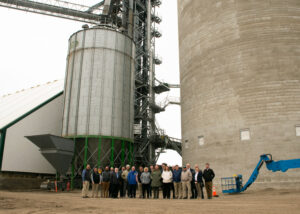
Soybean farmer leaders also made a direct investment in port infrastructure to help expand export capacity. On March 31, 2026, those leaders traveled to Milwaukee to present a ceremonial check for $200,000 toward pre-engineering, design, research, and analysis work tied to the Phase II expansion of the Agriculture Maritime Export Facility at Port Milwaukee. The facility, owned and operated by The DeLong Company, first opened in 2023. The Phase II expansion — which increased the port’s ability to ship U.S. soybeans and soybean meal to international buyers — was completed on April 2, 2026.
The ASA and other farmer groups also backed the facility’s application for federal funding through the U.S. Maritime Administration. That support paid off: the Phase II project received a $9.3 million grant through the Maritime Administration’s Port Infrastructure Development Program (PIDP). Industry leaders say investments like this help build a more resilient and diversified export network for American soybeans.
A similar effort took shape on the West Coast. AGP, an Omaha-based cooperative that owns and operates 11 soybean processing plants in the Midwest, announced in March 2022 a major expansion of its export terminal at the Port of Grays Harbor in Aberdeen, Washington. The project added storage at AGP’s Terminal 2 and a new ship loader at Terminal 4, boosting the terminal’s annual soybean meal export capacity from 3 million to more than 6 million metric tons.
Soybean farmer leaders contributed $1.3 million toward pre-engineering, design, and site development costs for the Port of Grays Harbor Terminal 4 expansion. They also supported the port’s application for federal assistance, which resulted in a $25.5 million PIDP grant from the U.S. Maritime Administration.
Industry leaders say that while U.S. soybeans are widely regarded as the highest-quality and most dependable supply in the global market, staying competitive ultimately comes down to cost — not just what it takes to grow the crop, but what it takes to deliver it. By working to trim transportation expenses at every point in the supply chain, the STC, ASA, and allied organizations say they are giving American soybean farmers a stronger footing in an increasingly unpredictable marketplace.