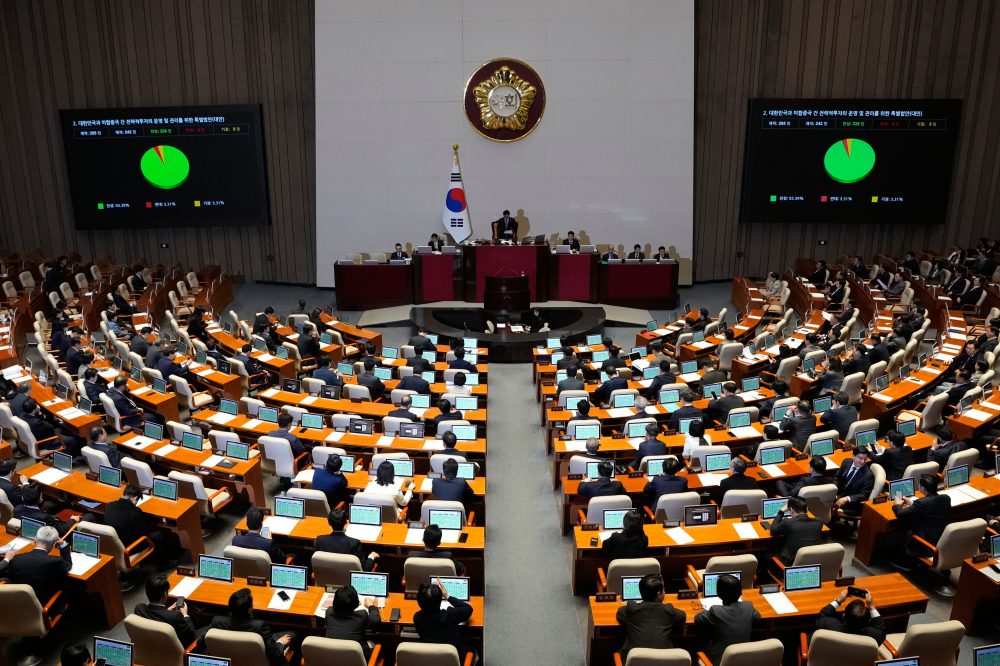

SEOUL, South Korea (AP) — Legislators in South Korea approved new legislation Thursday designed to oversee the nation’s commitment to invest $350 billion in American projects, a deal struck last year to prevent the highest tariffs threatened by the Trump administration.
Government leaders had pushed for swift approval of the controversial legislation, first introduced in November, as concerns grow over the country’s export-reliant economy. Officials worry about President Donald Trump’s protectionist policies and potential economic consequences from his conflict with Iran.
The legislative vote occurred just hours after Trump’s administration escalated trade tensions by launching a fresh probe into manufacturing practices in several nations, including China and key allies South Korea and Japan. This investigation could lead to additional import duties if American officials determine these practices are unfair.
Trump and his advisors have indicated they plan to implement new tariffs to recover revenue losses following the U.S. Supreme Court’s decision to strike down his broad emergency tariffs.
The Korean legislation, which received approval by a vote of 226 to 8, establishes a government-controlled entity to oversee the promised American investments. This organization will evaluate and choose projects using guidance from both Korean and American trade officials.
Several legislators voiced opposition before the vote, citing concerns about Trump’s latest trade investigations and potential effects from Middle Eastern conflicts. These issues have highlighted South Korea’s economic vulnerability due to its dependence on exports and imported energy.
“We cannot be the money machine Trump wants us to be,” said Son Sol, a member of the minor opposition Progressive Party. She argued the legislation fails to provide lawmakers adequate authority to examine and block investments that might harm Korean business or public welfare.
After months of difficult negotiations, South Korea reached a final agreement with the United States in November. The deal commits Seoul to investing $200 billion in American semiconductor and other advanced technology sectors, plus an additional $150 billion in shipbuilding. In return, Washington agreed to reduce reciprocal tariffs on Seoul from 25% to 15%.
The arrangement, which emerged from a breakthrough during an October meeting between Trump and South Korean President Lee Jae Myung, also limits Korean investments to $20 billion annually to safeguard the nation’s foreign currency reserves.
Lee’s liberal Democratic Party introduced the bill in November but encountered opposition from lawmakers concerned about economic consequences. The legislative delay angered Trump, who threatened in January to restore tariffs on Korean automobiles, pharmaceuticals and other products to 25%, putting additional pressure on opposition members to advance the legislation.