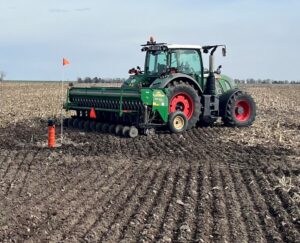

For South Dakota farmer and state senator Brandon Wipf, the conversation around monarch butterfly conservation goes beyond protecting a single species. He sees voluntary conservation practices as a way to benefit the environment while also strengthening the financial health of farm operations.
Earlier this year, the South Dakota Legislature passed Senate Concurrent Resolution 605, sponsored by Wipf, acknowledging the significance of monarch butterflies and promoting cooperative, voluntary conservation efforts statewide. Wipf represents District 22 in the South Dakota State Senate, farms soybeans and row crops near Huron, South Dakota, and serves as a director with the American Soybean Association.
The resolution comes at a critical time, as the U.S. Fish and Wildlife Service is weighing whether to list the monarch butterfly as a threatened species under the Endangered Species Act. When the resolution was being considered, Wipf stressed that any conservation work should remain voluntary and guided by local communities.
“Monarch butterflies are an important part of our natural heritage and our agricultural landscape,” Wipf said. “This resolution affirms that conservation efforts in South Dakota can and should be voluntary, locally driven, and respectful of private property rights and our state’s strong agricultural tradition.”
Because monarch butterflies depend entirely on milkweed plants for laying eggs and feeding larvae, access to that habitat is essential for the species to survive. The resolution calls on state agencies, local governments, and land managers to protect existing milkweed where feasible and to include pollinator-friendly native seed mixes in restoration and conservation planting projects when appropriate.
Wipf also connected the issue to farm economics, pointing out that low-producing acres can drag down a farm’s overall production history and reduce the revenue guarantees available through federal crop insurance programs.
“Every farm has them,” Wipf said. “The sandy ridge that burns up in July. The low spot that drowns in June. The salty patch that never keeps up.”
Rather than continuing to pour money into acres that rarely turn a profit, Wipf highlighted conservation programs and pollinator habitat as a smarter alternative. Programs like the Conservation Reserve Program can deliver steady conservation payments while cutting input costs on chronically underperforming ground. Meanwhile, perennial habitat plantings can improve soil health, limit erosion, retain moisture, and provide habitat for pollinators and wildlife.
“At the same time, you’re building resilience,” Wipf said. “Pollinator habitat and other perennial covers improve soil structure. It reduces erosion. It helps hold moisture. It supports pollinators and wildlife.”
The resolution also calls on federal agencies — including the U.S. Fish and Wildlife Service and the U.S. Department of Agriculture — to work alongside producers and landowners by focusing on technical support, flexibility, and voluntary participation rather than imposing new regulatory requirements on the agricultural sector.
Wipf said the path forward depends on cooperation between farmers, landowners, and conservation partners working together toward shared goals.
“Through collaboration and voluntary efforts, our state’s farmers, ranchers, and landowners can support monarch conservation while maintaining the thriving, productive agricultural operations that are the backbone of South Dakota,” he said.