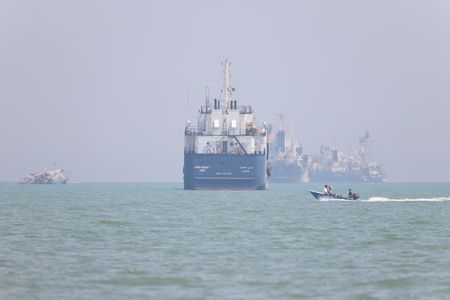

Shipping companies across Asia and Europe are holding off on resuming passage through the Strait of Hormuz, saying it could take weeks to rebuild confidence in the route — even after the United States and Iran reached a framework agreement to reopen the critical waterway.
U.S. and Iranian officials are expected to sign a memorandum of understanding on Friday that would end their war, lift the U.S. blockade of Iran, and reopen the strait. Global oil prices dropped roughly 5% on Monday in response to the news.
While shippers have welcomed the agreement, many are waiting for more specifics — particularly around mine clearance operations in the strait before committing to any voyages.
“Initial reactions in the shipping industry are muted. AIS data shows no wave of ships heading towards Hormuz this morning,” Jyske Bank analyst Haider Anjum wrote in a note to clients.
“The shipping companies probably want to wait until it is clear that the agreement holds, as we have already had Hormuz ‘open’ for a very short time twice before,” Anjum added.
The U.S.-Israeli war with Iran, which began on February 28, has largely shut down shipping through the strait — a passage that normally handles roughly one-fifth of the world’s oil and liquefied natural gas supply, as well as key commodities like aluminium and urea.
Traffic through the waterway remains minimal. India’s Petronet sent the LNG tanker Disha through Hormuz on Monday, making it the only visible shipment so far, according to data from Kpler and LSEG. The tanker had loaded its cargo at Qatar’s Ras Laffan facility on March 1-2 and had been waiting west of the strait since then, with India’s Dahej terminal as its final destination. Petronet did not respond to a request for comment.
Shipping association BIMCO said Monday that it still views transits through the strait as highly risky, with mines remaining a top concern.
“The next step is for shipowners to be reassured that transiting the Strait of Hormuz is not only permitted but also safe,” said Jakob Larsen, BIMCO’s chief safety and security officer.
A spokesperson for the Japanese Shipowners’ Association said the group welcomed the peace agreement but wanted to “wait a little longer for more concrete information” before making any decisions.
“Given the situation, we cannot simply say, ‘Right then, let’s go’ based on news of the agreement alone,” the spokesperson added.
Nippon Yusen, the country’s largest shipper, said it hoped operations would return to normal as soon as possible. Mitsui O.S.K. Lines said it would only resume navigation once safety has been fully confirmed.
Germany’s shipowners’ association VDR described itself as “cautiously optimistic” about whether the deal could effectively reopen the strait. German shipper Hapag-Lloyd expressed hope that vessels would be able to cross the strait by this week.
As of June 15, an estimated 155 tankers carrying oil and chemicals were in the Middle East Gulf area, down from 201 at the end of May, according to Kpler shiptracking data. Oil Brokerage put its own estimate at 215 tankers. Under unrestricted navigation conditions, the backlog on both sides of the strait could be cleared in 8 to 10 days, according to Anoop Singh, Oil Brokerage’s global head of shipping research.
While some tankers have been quietly moving cargo along Oman’s coastline for weeks — sailing without broadcasting their location and with U.S. Navy support — experts say meaningful traffic won’t resume for some time. David Jorbenaze, global oil market leader at ICIS, said it would take weeks of de-mining operations and a normalization of insurance rates before significant shipping activity could return.
“Returning to full pre-conflict volumes is realistically a 2027 story, and only if the agreement holds without incident and production recovers at pace,” Jorbenaze said.