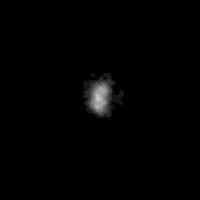

Scientists announced Wednesday that Neptune’s distant moon Nereid might be the final remaining original companion of the planet that managed to survive an ancient cosmic collision.
Neptune is surrounded by 16 known moons, making it the eighth and furthest planet in our solar system. The planet’s largest moon, Triton, arrived from the cold outer regions of the solar system billions of years ago, disrupting Neptune’s original moons and sending them on paths that led to their destruction.
Researchers from the California Institute of Technology utilized NASA’s Webb Space Telescope to examine Nereid. Their findings indicate that Nereid is not an intruder like Triton and probably survived by moving into its unusual, elongated orbit around Neptune.
“What we know about Nereid is very limited. For its size, Nereid is extremely understudied,” said study author Matthew Belyakov, of Caltech.
Only one spacecraft has ever visited Neptune – NASA’s Voyager 2 in 1989. Nereid was found 40 years before that mission by Dutch astronomer Gerard Kuiper, who gave the moon its name based on the sea nymphs from Greek mythology.
Measuring approximately 220 miles (350 kilometers) in diameter, Nereid follows an unusually eccentric path for a moon. The moon requires nearly a full Earth year to complete one orbit around Neptune, coming within less than 1 million miles (1.4 million kilometers) of the massive icy planet at one point in its oval-shaped journey and traveling as far as 6 million miles (9.6 million kilometers) away at the opposite end.
Similar to many other moons in the outer solar system, Nereid was previously thought to have traveled to Neptune’s vicinity from the cold distant region called the Kuiper Belt. However, using the Webb telescope, researchers found that Nereid’s makeup was different from Kuiper Belt objects – containing too much ice. This discovery suggests it belonged to Neptune’s system from the beginning.
“We don’t have all that much evidence left around Neptune — the system doesn’t have very many moons left,” Belyakov said in an email. But the latest observations “strongly rule out” that Nereid wandered by like so many others and got ensnared by planetary gravity.
The research was published in the journal Science Advances.
This is “an exciting result,” said Carnegie Science planetary astronomer Scott Sheppard, who was not part of the study.
The observations demonstrate for the first time that Nereid’s unusual orbit aligns with “the history we might expect from a moon that originally formed close to Neptune and was later pushed outward from the capture of Triton,” Sheppard said in an email.
According to Belyakov and his research team, Neptune’s closest moons probably developed from the broken pieces of the original moons that were destroyed when Triton arrived.
The solar system’s other three giant planets all have more moons than Neptune, with Saturn leading with 292.
According to scientists, a future spacecraft mission could confirm the origin story of Neptune’s moon system, though no such missions are currently scheduled.