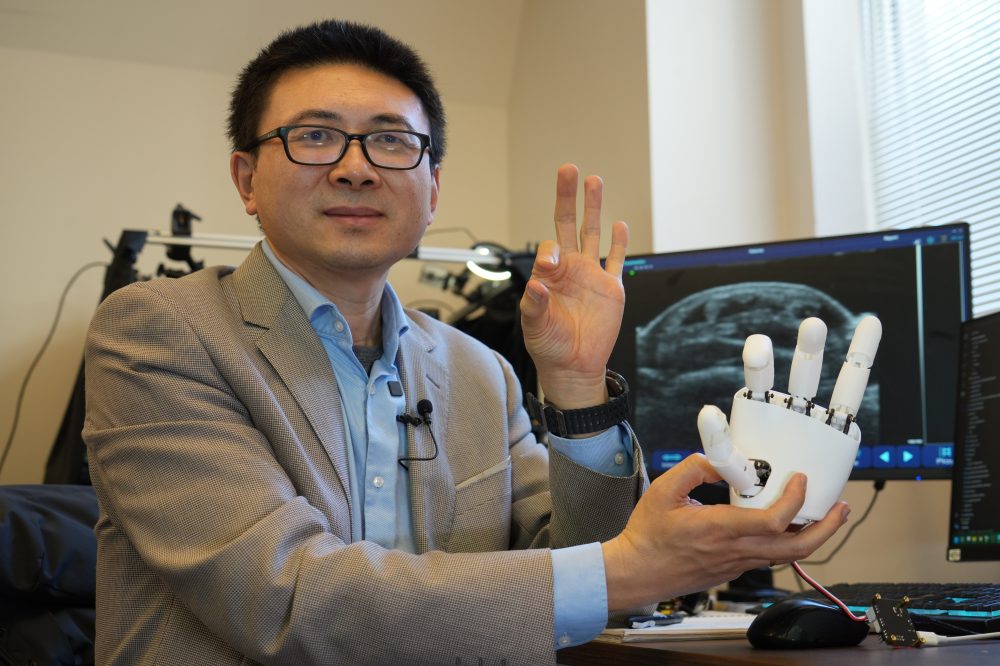

CAMBRIDGE, Mass. — Scientists have created a breakthrough solution for robots that have trouble with simple tasks like picking up a coffee mug — an innovative ultrasound wristband that records the motion of muscles, tendons and ligaments under the skin.
The Massachusetts Institute of Technology team behind this innovation designed the device to gather information about human hand movements that could one day help robots develop the fine motor skills that have long challenged machines.
“Imagine people doing housework,” said Xuanhe Zhao, an MIT professor of mechanical engineering. “We can use the data obtained by our system to train a robot to do exactly (that) housework with this dexterous hand motion.”
While much of the technology industry remains focused on artificial intelligence programs handling computer tasks, Zhao belongs to a group of researchers working to give AI access to more physical world information through sensory input.
The applications extend beyond household chores to include other activities requiring precise finger and hand coordination, including surgical procedures.
The device employs high-frequency sound waves to penetrate the user’s skin and observe what lies beneath. It transmits pictures of muscle and tendon activity to a computer system that employs AI to allow a robotic hand located nearby to copy the movements.
An artificial intelligence program learns to interpret the pictures produced by the equipment into what scientists refer to as degrees of freedom — the particular ways joints can move or turn. Human hands contain 22 such movement possibilities.
Previous systems faced major difficulties tracking even a small portion of these motions.
During laboratory testing involving eight participants, the research team demonstrated that the wristband could accurately replicate hand movements — including every letter of American Sign Language — in under 120 milliseconds.
The device functions without wires, which means the person controlling it and the robot receiving commands don’t need to be located in the same space.
Looking beyond direct control applications, the research group envisions using the wristband to create extensive collections of human movement information that could someday allow humanoid robots to master complex manual tasks independently.