
FORT WORTH, Texas — After touring a Catholic school, Maria Contreras desperately wanted to enroll her 7-year-old son. But she had a pressing question for the principal first: Her second grader struggles to stay focused, doesn’t follow teacher instructions, and can’t seem to stay in his seat. Would he be at risk of expulsion?
Families across the United States are increasingly exploring private school options as states — and soon the federal government — roll out taxpayer-funded scholarships designed to steer children away from public education. Within the near future, roughly half of all American schoolchildren could be eligible to apply for government money to fund a private education, with many states making those funds available even to higher-income households.
While these programs are designed in theory to open doors for children who otherwise couldn’t access private schooling, an AP analysis reveals a different reality: the students most likely to benefit are those who are already enrolled in private or home schools.
The reasons behind this trend are layered. Many public school families simply aren’t aware these scholarship programs — commonly called vouchers or education savings accounts — even exist. Others face transportation challenges. Some parents worry their children won’t adapt to stricter disciplinary environments at private schools. And in places like Texas, the newest addition to what is already a $10.5 billion school choice movement, the law itself is structured in ways that favor families already experienced in navigating complex educational systems.
Contreras and her husband both grew up Catholic in Mexico before relocating to Texas, where he found work as a welder. Over time, the couple obtained green cards and were largely satisfied with the Fort Worth public schools their three older children attended.
Their youngest, Ian, was a different story. He was reading well below his grade level, and Contreras asked his teacher in the fall to have him tested for a learning disability — not realizing there was a formal, legally required process for making that request.
Months passed without any testing. Ian wasn’t alone in falling through the cracks. At his elementary school, where nearly all students come from economically disadvantaged homes and most are still learning English, only 4% of students have been identified with learning disabilities — far below the 14% districtwide rate.
What Contreras didn’t know at the time was that without a documented disability, her options for funding a different school for Ian would be severely limited.
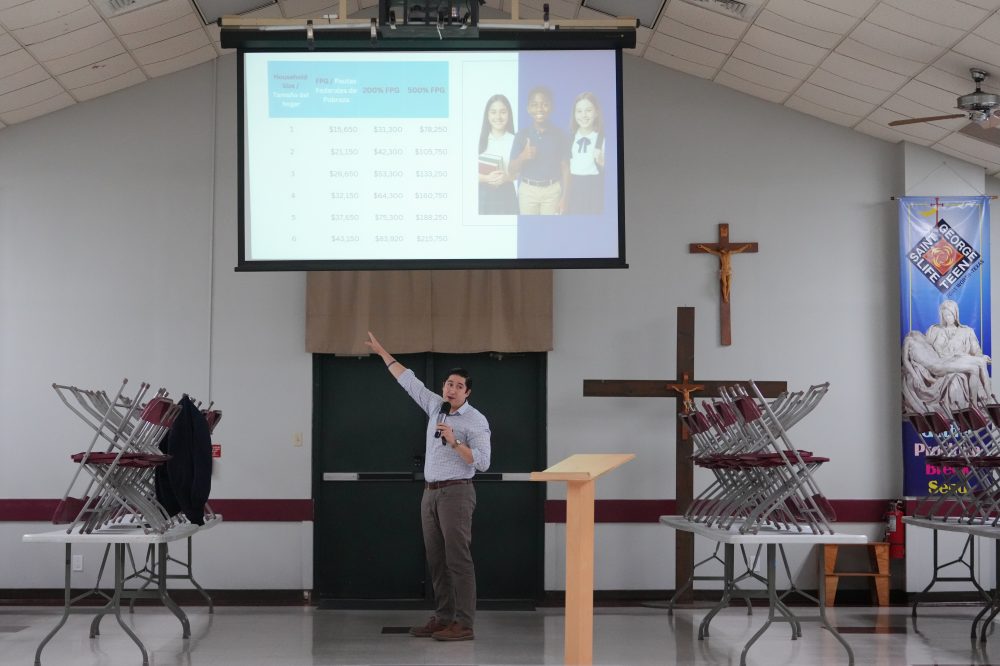
She first heard about private school scholarships at church. During a Mass announcement, a man asked in Spanish whether anyone wanted $10,000 to attend Catholic school. Ian raised his hand.
Texas is launching its sweeping new program this fall, committing approximately $1 billion in public funds to help cover private school and homeschooling costs. The program uses education savings accounts — a broader type of scholarship that covers not just tuition, but also textbooks, music lessons, transportation, and technology.
Republican-led states including Indiana, Florida, and Arizona have offered taxpayer-backed private school scholarships for years. But the movement has gained major momentum under President Donald Trump, who has tapped into rising public skepticism toward traditional public education.
Texas had long resisted such a program, with Democrats and rural Republicans blocking earlier attempts over fears that public school funding would be drained. Gov. Greg Abbott, a Republican, accelerated the creation of Texas Education Freedom Accounts last year, with backing from Trump, who personally called Republican lawmakers to push for the legislation.
To secure enough votes, Texas Republicans dropped a provision that would have directed 80% of first-year Freedom Accounts to students transferring out of public schools. Without that safeguard, evidence from other states strongly suggests the majority of scholarships will go to students already in private or home school settings.
In Alabama last year, for example, former public school students accounted for just 13% of scholarship recipients, according to the AP analysis. Fewer than half of public school students offered a scholarship actually used it, compared with 94% of students already attending private schools.
Alabama intends to eliminate income limits on its scholarship program next year, following states like Arizona that have opened eligibility to all income levels. In Arizona, the AP found that scholarship usage is nearly three times higher in wealthy ZIP codes than in lower-income areas.
In the final version of the Texas law, priority went to students with documented disabilities and their siblings — provided their family income falls below $165,000 for a family of four. The next priority tier covers lower-income families earning less than $66,000 for a family of four.
Ian’s family, earning around $70,000 per year, landed in the third group — effectively near the back of the line. To move up, Ian would need a documented disability, a growing focal point in state voucher programs. Nine states now offer taxpayer-funded scholarships specifically targeting students with special needs.
But special education advocates have long cautioned against families leaving public schools for private ones. Private schools are not legally required to admit students with disabilities, and Contreras was surprised to discover they also aren’t obligated to provide the same support services that public schools must offer by law.
Despite decades of school choice research, there is little academic study on how students with disabilities are actually faring in traditional private schools under these voucher arrangements.
During Contreras’s tour of Saint Rita Catholic School, she paused the conversation mid-tour to tell staff about Ian’s difficulties sitting still and paying attention. Principal Kindra Johnston, a former counselor who brings her golden retriever to school each day, responded without hesitation.