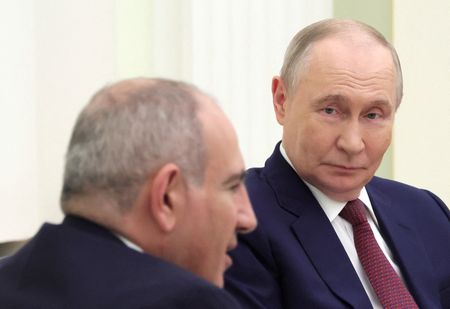

Western intelligence and government officials report that Russia has escalated secret operations aimed at sabotaging Armenia’s leader ahead of next month’s election, concerned that his success could cement the former Soviet nation’s shift toward Western allies.
According to interviews with five Western intelligence officials and documents reviewed by Reuters, Moscow’s strategy before the June 7 election includes spreading false information to benefit pro-Russian candidates and an ambitious plan to bring tens of thousands of Russian-Armenians to influence the outcome.
Armenia, a nation of 3 million people without ocean access, has largely stayed within Moscow’s sphere of influence since the Cold War ended and continues to house Russian military forces. However, Prime Minister Nikol Pashinyan, who leads in polling, has strengthened ties with Europe and NATO, becoming an ally of U.S. President Donald Trump, who endorsed Pashinyan’s re-election campaign on Wednesday.
U.S. Secretary of State Marco Rubio traveled to Yerevan this week, finalizing a minerals agreement and a deal for the Trump Route for International Peace and Prosperity – a planned transportation corridor through Armenia that could weaken Russian regional influence.
Armenia, which belongs to a Russian-led economic alliance, halted its involvement in Moscow’s regional security partnership in 2024. This month the country welcomed NATO’s leader at a European leaders summit.
Russian President Vladimir Putin has openly expressed his dissatisfaction with Pashinyan’s Western turn. Recently, Moscow has threatened that Armenia could lose access to affordable natural gas and has limited imports of Armenian goods including fruit, vegetables, flowers and brandy.
“What Pashinyan is trying to do is a threat to Russia,” said Thomas de Waal, senior fellow with Carnegie Europe. Diversification “means Russia loses the virtual monopoly it’s had in Armenia.”
Three Western officials identified Moscow’s favored candidate as Samvel Karapetyan, a billionaire facing trial for allegedly advocating government overthrow.
Karapetyan, who holds Armenian-Russian citizenship, rejects the accusations. His attorney, Robert Amsterdam, told Reuters his client was unaware of any Russian backing.
Europe has repeatedly charged Russia with election interference, including recent cases in Moldova and Hungary. Russia claims that the EU and United States meddle in neighboring countries to draw them into Western influence.
Russia’s foreign ministry did not reply to requests for comment, but told reporters Thursday that allegations of Russian interference in Armenia’s domestic matters represented “spymania.”
Armenia’s government communications department refused to address the specific claims in this report, but described steps being implemented to combat false information and guarantee free, fair, and transparent elections.
In October, the Kremlin created a department called the Directorate for Strategic Cooperation and Partnership, which four sources say is directing influence operations in Armenia. The sources, like others in this report, requested anonymity.
Russian officials have discussed in recent months sending Russia-based Armenians to vote against Pashinyan, five sources reported.
Armenians form a substantial worldwide diaspora, including a Russian population that some estimates place above 2 million. Armenians cannot cast ballots in elections from overseas.
One source, a senior U.S. official, said the number of people Moscow could successfully transport remained debated within the intelligence community. However, the source noted, intelligence officials consider the concept seriously. Armenians regularly travel between the countries, with dozens of daily flights.
Russian authorities estimated approximately $50 million to transport 100,000 voters, three sources said. By mid-May, the Kremlin had assigned quotas of Armenians each region should send and asked administrators to report preparation updates, those officials added.
Reuters could not determine whether such a plan was active or if it would be sufficient to narrow the substantial gap between leading candidates.
A poll from earlier this month indicated Pashinyan’s Civil Contract party would place first with approximately 30% of votes.
The same poll showed Karapetyan’s Strong Armenia party at roughly 6%, placing second in a competitive field.
Pashinyan assumed office in 2018 when demonstrations removed his Moscow-friendly predecessor. Relations worsened after Russian peacekeepers stationed in Nagorno-Karabakh, an ethnically Armenian separatist territory within neighboring Azerbaijan, could not prevent its capture by Azerbaijan in 2023.
In August, Pashinyan signed a U.S.-mediated peace agreement ending the decades-long dispute between Armenia and Azerbaijan over the contested region. The agreement would establish the transport route through southern Armenia, enabling goods to move eastward toward Central Asia, while providing Azerbaijan direct access to its exclave of Nakhchivan and to Turkey. Moscow cautiously supported the agreement.
Washington has indicated U.S.-supported security personnel could supervise the narrow land strip, which would follow the Iranian border, a prospect intelligence officials say Russia considers unacceptable.
If Pashinyan loses power, major components of Trump’s peace initiative would likely collapse, two Western officials said.
In a video circulated online in May, masked individuals speaking an Armenian dialect threatened to kill Pashinyan. Reuters could not verify if the threat was genuine or identify those responsible. The matter is under investigation in Armenia.
Three sources, including a senior U.S. official, described serious and continuing concerns about the Armenian leader’s safety, without providing details.
Parts of the U.S. government, including the C.I.A., have recently provided covert assistance for Pashinyan’s personal security, according to a current U.S. official, a former U.S. official and a third person familiar with the arrangement. One source said the assistance included sharing information about potential threats.
The White House, State Department, U.S. Office of the Director of National Intelligence and Pashinyan’s office did not respond to requests for comment about the prime minister’s security situation. The CIA declined to comment.
Russian officials have intensified existing online false information campaigns to damage the Pashinyan government, officials said.
In one case, a Russian-supported online campaign falsely claimed a corrupt land transaction involving Pashinyan with Jeanne Shaheen and Thom Tillis, two U.S. senators who publicly raised concerns in April about Russian disinformation, the U.S. official said. Shaheen and Tillis did not respond to requests for comment.
One European official said the campaigns involve a Kremlin-connected bot network called “Storm-1516”, which participated in attempts to interfere with recent U.S. elections.
Three sources said the Kremlin had recruited Russian political consulting firms and think-tanks, including the Social Design Agency (SDA), sanctioned in the European Union and the United Kingdom for spreading disinformation to weaken support for Ukraine.
Reuters examined five Russian-language documents that sources said were created by SDA. The news organization could not independently confirm that SDA produced the documents.
One document suggested establishing a media outlet named Yerevan1 for Russia’s Armenian diaspora to foster a “negative attitude” toward Pashinyan with a “core narrative” that “Armenia can only prosper in a close alliance with Russia and under its protection.” Neither SDA nor Yerevan1 responded to comment requests.
The document concluded that Russian-Armenians could influence the election decisively if “high turnout among them can be ensured”.