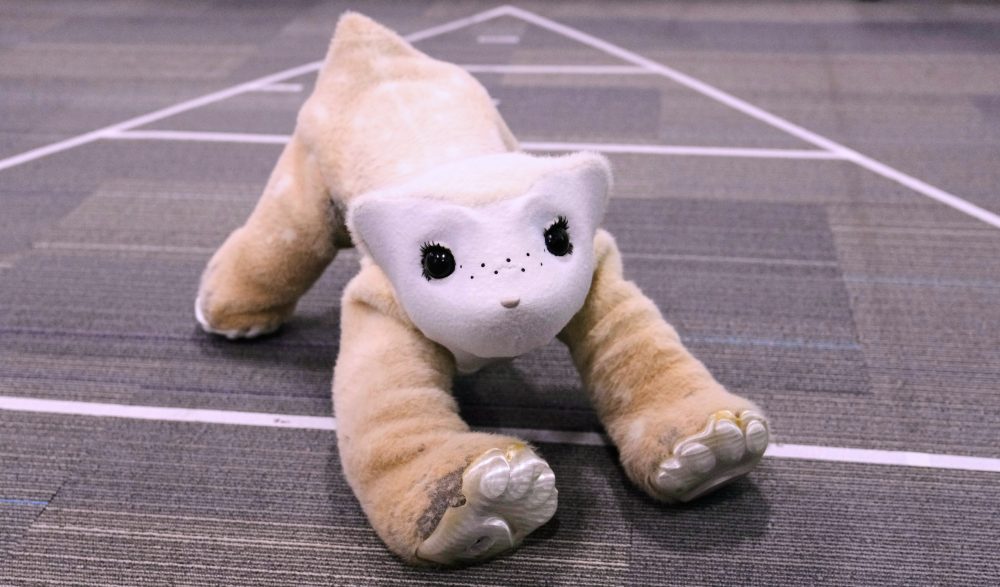

The entrepreneur who brought the Roomba vacuum into millions of homes is now working on his next breakthrough: an artificial intelligence-powered robotic companion that could serve as an alternative to traditional pets.
Colin Angle introduced his four-legged prototype, named the Familiar, during a presentation on Monday. The device resembles a bulldog-sized creature featuring gentle eyes and bear-like ears and paws, designed with touch-responsive synthetic fur that encourages interaction through petting and hugging.
“We chose a form factor that’s not a human, not a dog, not a cat, because we wanted to steer away from all of those preconceptions,” explained Angle, who now heads Familiar Machines & Magic after serving as the long-time chief executive of iRobot, the company behind Roomba.
This type of realistic robotic companion would have been impossible when Angle helped establish iRobot in 1990 or when the original Roomba debuted in 2002, thanks to recent advances in artificial intelligence technology.
While other companies have attempted similar projects – including Sony’s Aibo robotic dog from the late 1990s that was revived in 2018 – Angle believes his creation offers capabilities that “simply hasn’t existed before.”
“The challenge is to make something that’s not a watch-me toy,” Angle explained during an Associated Press interview. “This is about having something that you want to hug, you want to pet. When it’s happy, that makes you happy. And it is large enough or mobile enough to follow you to the kitchen or drag you off the couch and take a walk.”
The robotic companion produces emotional, animal-like vocalizations without speaking words. However, it features audio sensors that function as “ears” and an AI system capable of understanding and learning from human speech. The technology leverages recent breakthroughs in generative artificial intelligence similar to ChatGPT, allowing the robot to modify its responses based on interactions with its human companions.
“I couldn’t have done this six months ago,” Angle noted.
Angle guided iRobot for twenty-five years, transforming Roomba into the first mainstream household robot. However, fierce competition, particularly from Chinese manufacturers, eventually challenged the company’s market position. Angle resigned from his leadership roles in 2024 following Amazon’s decision to abandon its acquisition plans for the struggling Massachusetts-based company.
Familiar Machines emerged shortly afterward and operated secretly in Woburn, Massachusetts until Monday, when Angle demonstrated one of his Familiar prototypes in New York at The Wall Street Journal’s Future of Everything conference.
While commercial availability remains distant, Angle sees retired individuals as a primary market, particularly those who have moved beyond the typical pet-owning years.
“Not because people suddenly stop enjoying pets, but the fear and obligation of caring for them are such that people are very reluctant to get new pets at older ages,” Angle observed.
Unlike most robotics engineers who draw inspiration from science fiction, Angle’s concept stems from folklore traditions, including witches’ cats, wizards’ owls, and the animal companions featured in Philip Pullman’s “His Dark Materials” book series.
“It’s an archaic, ancient word,” Angle said. Surprisingly, he discovered he could also secure trademark protection for the name.
Angle has assembled a team of distinguished robotics experts, including Marc Raibert, who pioneered robot movement and established Boston Dynamics, creator of the four-legged Spot robot, and Cynthia Breazeal, who developed the robot head Kismet and later the desktop speaker robot Jibo, early experiments in giving robots social capabilities.
Many of these collaborators studied together at the Massachusetts Institute of Technology and share doubts about the current trend toward sleek humanoid robots designed to walk and move like people but currently lack practical physical capabilities.
Among these advisers is Maja Matarić, a computer science professor at the University of Southern California who helped establish the field of socially assistive robotics twenty-five years ago, focusing on robots that could provide social and emotional support to people.
Upon first encountering Angle’s prototype, she reported that she “immediately got down on the ground near it and had to hug it and pet it, then started to play with it to see what it would do.”
The robot’s ability to appear endearing rather than unsettling will be crucial. Matarić explained that decades of human-robot interaction research demonstrate that a robot that is “cute, personalized and vulnerable is much more appealing and lovable than the alternative.” She suggested it could prove especially valuable in nursing facilities or for mental health emotional support.
Matarić added that AI developments have made it more feasible to expand the technology’s reach to general consumers.
“Before generative AI, robots could not readily understand what people were saying,” she explained.