
Bringing your own container to fill with soap or shampoo instead of tossing empty bottles has gained traction as an environmentally-friendly practice — offering individuals a concrete way to tackle broader ecological concerns.
However, the actual environmental benefit of these refill systems varies based on implementation and what traditional practices they’re replacing. Numerous zero-waste retail locations have launched nationwide in recent years as both business owners and consumers explore innovative approaches to minimize packaging waste. Several companies have also introduced specialized recycling initiatives for difficult-to-process materials.
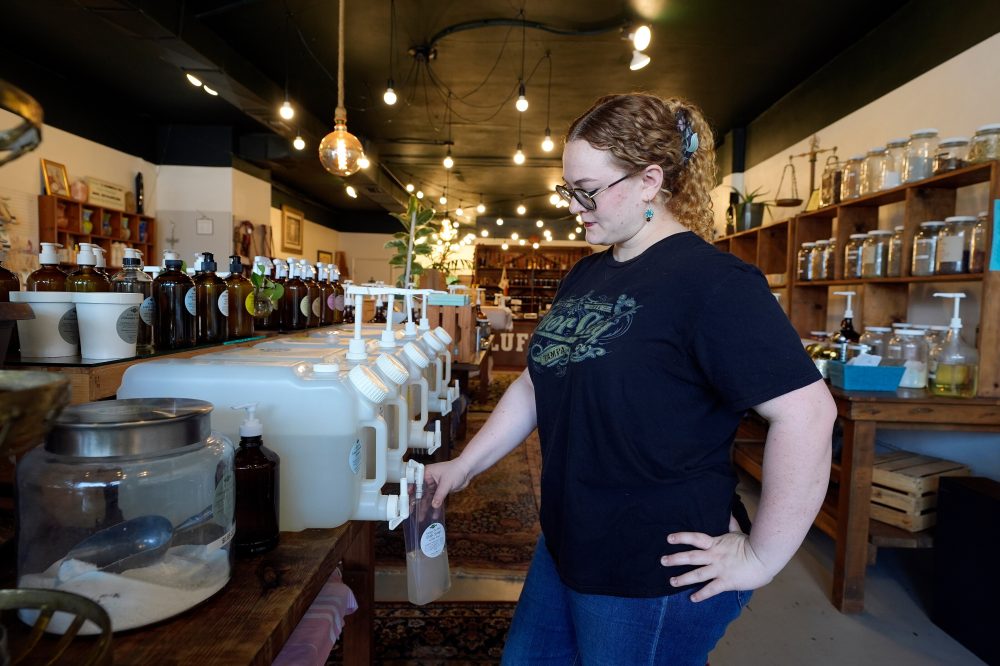
The Lufka Refillable Zero Waste store in Tampa operates on a simple premise: shoppers arrive with their own reusable containers to purchase soap, shampoo and household cleaners without any single-use packaging. This approach aims to minimize packaging waste by utilizing containers customers already possess.
The process involves weighing empty containers first, then filling them with products. Customers pay based on the quantity of product dispensed. This repeated container use can accumulate significant waste reduction over time.
Julie Hughes, a regular customer, finds the refilling process personally satisfying. Hughes first visited Lufka two years ago searching for skincare items and has become a loyal customer, motivated by the opportunity to reuse containers rather than dispose of them.
“When you do something positive, you get a little bit of like a dopamine hit and you feel good,” Hughes said on a recent trip to buy liquid hand soap. “There are so many big problems in the world, but we can’t solve all of the big problems, but we do have control over our choices.”
According to Lufka founder Kelly Hawaii, certain customers have continuously refilled identical containers for six years.
“Just imagine how much waste they’ve personally stopped consuming because they have that one container for that one product,” Hawaii said.
Rather than representing a novel concept, refillable packaging essentially revives historical distribution methods. Many sectors previously depended on refillable or returnable containers, with recognizable American examples including soda bottles, beer containers and milk jugs in earlier decades.
Research published in 2020 regarding reusable packaging revealed that the transition toward disposable packaging occurred primarily because single-use systems streamlined distribution processes and lowered handling expenses for manufacturers and retailers. This shift contributed to consistent growth in packaging production and waste accumulation as reuse infrastructure diminished, according to the study published in Resources, Conservation & Recycling: X.
Recently, renewed focus on reuse has emerged as part of expanding “circular economy” initiatives that extend product and material lifecycles to minimize waste. The Public Interest Research Group counts hundreds of refillable retailers nationwide, describing them as part of a “generation of new businesses” focused on reducing packaging waste.
Major retailers and brands are also introducing refillable alternatives and other innovations. Lush Cosmetics markets select products “naked” without any packaging and provides discounts for customers returning containers from other purchases. The reusable packaging platform Loop, operating in France, collaborates with major brands including Nestle and Coca-Cola to deliver products in durable containers that are retrieved, sanitized and refilled for continued use.
Despite this revival, refillable packaging represents a minimal portion of the total market. These systems encounter expansion challenges, including sanitation requirements and the necessity for container collection and processing infrastructure, according to research findings, which also highlighted that additional processing and cleaning expenses may increase costs.
Reusing containers for common products offers advantages over recycling disposable packages, provided consumers adopt a thoughtful strategy, according to sustainability experts.
University of Michigan professor Shelie Miller, who researches sustainability, advises consumers to view the phrase “reduce, reuse, recycle” as a hierarchy, indicating that reuse should typically precede recycling.
Nevertheless, reuse doesn’t guarantee reduced environmental impact. Durable reusable containers generally require more energy and materials during manufacturing, necessitating extended use to compensate for their production resources, Miller explained. This means environmental benefits only materialize after repeated usage distributes those initial impacts across multiple applications, what Miller describes as a “payback period.” The amount of water and electricity consumers use at home for cleaning reusable items also influences the equation.
A 2021 study conducted by Miller and a colleague analyzed reusable items including drinking straws, utensils and coffee cups, measuring their payback periods across categories like greenhouse gas emissions, water consumption and energy requirements. The research determined that ceramic coffee mugs must be reused between 4 and 32 times before surpassing disposable cups in those metrics, representing quicker paybacks compared to reusable coffee cups manufactured from metal or plastic.
Convenience factors also matter. When refilling necessitates special trips, additional transportation emissions can negate benefits, making refill systems most successful when integrated into existing habits.
“If you are making dedicated trips just to reduce packaging, it actually can be worse for the environment than if you use the single-use product,” said Miller.
Major beauty retailers including Ulta Beauty and Sephora have partnered with Pact Collective, a nonprofit organization that gathers difficult-to-recycle beauty packaging through store collection points.
Carly Snider, executive director of Pact Collective, explained the program targets packaging constructed from mixed materials that standard recycling programs cannot handle, plus small components under 2 inches (5 centimeters) — such as pumps, droppers and sample containers — that slip through recycling facility machinery.
“There’s specific things with beauty packaging that makes it really difficult,” said Snider.
Pact directs those materials through specialized processing, redirecting substantial material volumes from landfills, Snider noted.
Experts stress that refilling and recycling initiatives aren’t complete solutions, but when they substitute for single-use packaging and integrate into daily routines, they can contribute to waste reduction.
“Small things do add up,” Miller said. “And so when you have millions of people who are all doing small things, that really can make a difference, make a change.”