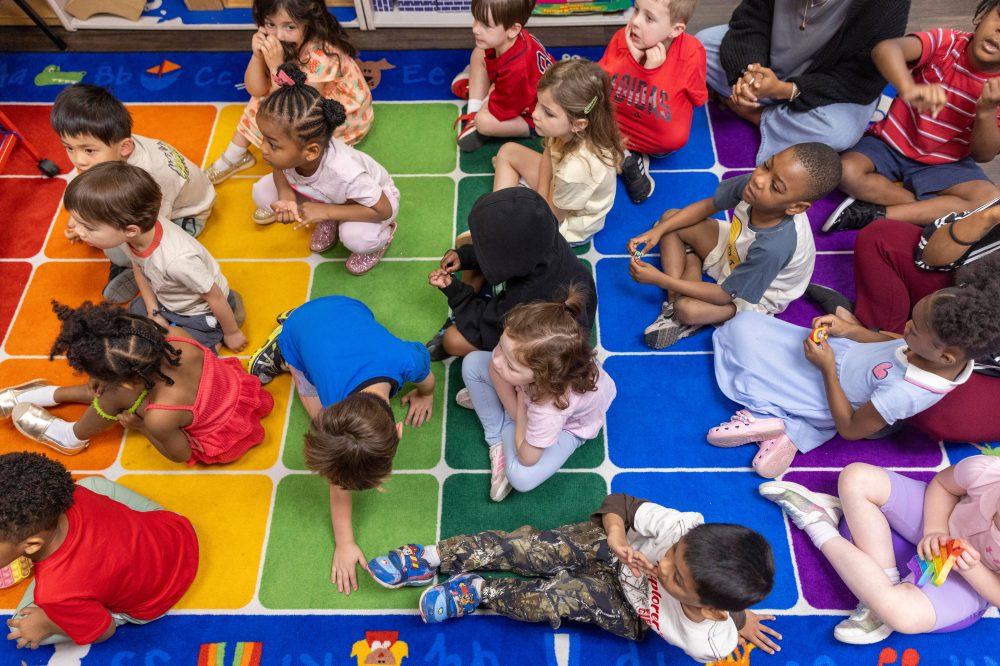

WASHINGTON — State-funded preschool programs welcomed a record number of young learners last school year, with enrollment climbing to historic levels thanks to unprecedented government investment of $14.4 billion.
According to a new study released Wednesday by the National Institute of Early Education Research, approximately 1.8 million children participated in state-funded preschool programs nationwide. This represents coverage for 37% of all 4-year-olds and roughly 10% of 3-year-olds across the country. The programs gained 44,000 new students compared to the previous year, though researchers noted this growth was slower than earlier increases and highlighted significant disparities between different states.
“If providing high-quality preschool education to all 3- and 4-year-olds were a race,” the authors wrote, “some states are nearing the finish line, others have stumbled and fallen behind, and a few have yet to leave the starting line.”
California accounted for more than half of the national enrollment increase, adding approximately 25,000 students through its expanded “transitional kindergarten” or “TK” initiative. This year, the state extended eligibility to all 4-year-olds in the program. However, the rapid expansion came with challenges. While the research institute established 10 quality standards covering areas like teacher preparation, classroom size, and educational content, California only satisfied two of these criteria during the most recent school year. Additionally, private preschool operators express concern that the influx of children into public programs could severely impact their operations.
“Universal TK … is a real win, but it’s also just the start of the work and not the end of it,” said Jessica Sawko of Children Now, which advocates on early childhood issues in California. She noted that the state will hit two more quality benchmarks in next year’s report, by lowering its student-teacher ratio to 10-to-1 and by requiring lead teachers to have early education training.
The findings demonstrate the challenging balance states must strike when rapidly expanding programs or operating with constrained budgets. Hawaii exemplifies this tension as one of only six states meeting all quality standards established by the institute, yet its program reaches just 10% of eligible 4-year-olds.
Research continues to demonstrate that quality early childhood education creates lasting benefits, helping children succeed in kindergarten, complete high school, and secure employment as adults. Educational experts increasingly view preschool as crucial preparation, as kindergarten teachers now expect incoming students to arrive with foundational skills.
“We have a lot of kids who still do not fulfill their potential,” said Steven Barnett, founder and director of the early education institute. “We have evidence — very strong evidence — that preschool programs substantially improved the foundation for later success.”
Many states also recognize that free prekindergarten programs can boost the broader economy by enabling parents to return to work while private childcare becomes increasingly expensive.
Heather Sufuentes observed these benefits firsthand as principal of Parkview Elementary in Chico, California, when the school launched its transitional kindergarten program. Students who completed the play-based, full-day program demonstrated greater confidence and frequently stepped into leadership roles in their classes.
“They’re well prepared to transition into that big elementary school setting,” said Sufuentes, now director of elementary education for Chico Unified School District. Chico has more than doubled the number of TK seats it offers since 2022.
Marisol Márquez, a secretary who works for the state, sends her daughter to transitional kindergarten at 1st Street Elementary in Los Angeles. She had been sending her for free to a learning center underwritten by COVID-19 relief funding. But she would have had to start paying tuition this year, and she’s not sure how she and her husband, a UPS driver, would have made it work. She was elated to hear 1st Street Elementary was offering free transitional kindergarten.
Teachers at the school quickly recognized her daughter’s academic abilities and began including her in kindergarten mathematics and reading instruction.
“If it hadn’t been for this program, we would have never found that out,” Márquez said.
While expectations for 5-year-olds have increased, no state requires preschool attendance, and only certain cities and states provide universal access for 4-year-olds. Program availability varies dramatically across the country. Families in Wyoming, which offers no state-funded preschool, could relocate to Colorado and access free part-time preschool for their 4-year-old. Washington D.C. provides two complete years of prekindergarten even for wealthy families, while nearby Virginia operates a much smaller program.
These geographic disparities can worsen existing inequalities. Affluent families typically can afford private preschool regardless of state offerings. Private childcare centers using preschool curricula charged an average of more than $12,000 annually for 4-year-olds in 2024, according to Child Care Aware of America.
Families unable to pay private tuition face limited alternatives. State-funded programs frequently maintain waiting lists.
Low-income families may qualify for programs like Head Start, which serves America’s most disadvantaged children. However, Head Start enrollment is declining partly due to staffing shortages. These families might also receive state or federal childcare subsidies for private preschool, but those programs also have expanding waiting lists.
Federal funding for early education expansion remains limited and decreasing. Recently, President Donald Trump said the federal government couldn’t afford to support child care while it was waging a war with Iran.
“We’re fighting wars. We can’t take care of day care,” Trump said. States, he added, “should pay for it. … They’ll have to raise their taxes.”
The distribution of high-quality public preschool programs might surprise political observers. Republican-controlled states pioneered universal prekindergarten, with Oklahoma launching its program in the late 1990s. Alabama and West Virginia also operate highly-rated preschool-for-all initiatives. Wealthier Democratic states have moved more slowly, though many liberal cities have advanced their own programs. New York state actually lost enrollment last year, even as New York City, which already provides universal prekindergarten, pursues plans for free childcare for younger children.
Georgia, under Republican leadership, became the first state to achieve universal preschool while meeting all quality standards set by the National Institute of Early Education Research.
Rebecca Ellis’s son John Patrick, 5, attends the private Capitol Hill Child Enrichment Center in Atlanta free of charge, thanks to the state’s preschool-for-all program. She said it saved her family a huge amount of money, and she is impressed by how much her son has grown socially and emotionally.
“They focus so much on just helping kids learn how to calm down, to make friends, to regulate their feelings, to solve problems,” Ellis said.
John Patrick and her older son, who attended the same preschool, have even given their parents advice. When they become agitated, the children urge them to take deep breaths.