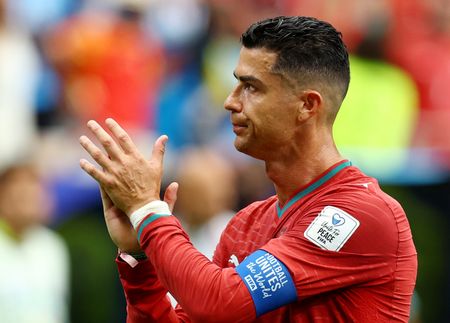

Portugal’s 2026 World Cup campaign began on a sour note Wednesday in Houston, where they were held to a 1-1 draw by the Democratic Republic of Congo — a result that raised serious questions about the team’s ability to compete for the championship.
The disappointing outcome is nothing new for Portugal at the World Cup. Since finishing fourth in Germany in 2006, the team has won just six of their 17 matches at the tournament, with victories coming against North Korea, Ghana (twice), Morocco, Uruguay, and Switzerland. Despite fielding rosters loaded with talented players, Portugal has failed to advance beyond the quarterfinals in that stretch, falling to Morocco at that stage in 2022, and suffering a shocking group-stage elimination in Brazil 12 years prior.
Portugal’s World Cup history before 2002 was limited to just two appearances — a third-place finish in 1966 led by Eusebio, and a group-stage exit in 1986. But after years of strong development, the team entered this year’s tournament with genuine hopes of claiming their first-ever World Cup title.
Coach Roberto Martinez had acknowledged before Wednesday’s match that a draw would be seen as a “disaster,” and while Portugal jumped out to a lead in the sixth minute, they faded from there and were largely second-best for the remainder of the game.
“I think it’s more the mentality of getting rid of the weight on the shoulders of the players of wanting to win the World Cup,” Martinez told reporters after the match. “Now we need to be calm, we need to assess, we need to highlight the good things that we did, and we did many good things. We need to improve the bad things and that’s what happens in a World Cup.”
Congo actually had more shots on goal throughout the contest, with Joao Neves’ headed goal standing as Portugal’s only shot on target during the entire match.
Martinez credited Congo for their performance, saying, “They were intense, confident. They played like a big final in a big tournament, and that shows incredible personality. We knew that Congo could do that. It wasn’t a surprise.”
What may be harder to explain is why Portugal failed to match that same level of intensity and determination — qualities they will certainly need when facing tougher competition down the road.
Portugal’s next match is Tuesday in Houston against Uzbekistan, a game that is quickly shaping up as a must-win for the team’s momentum and confidence. They are also scheduled to face Colombia on June 27.