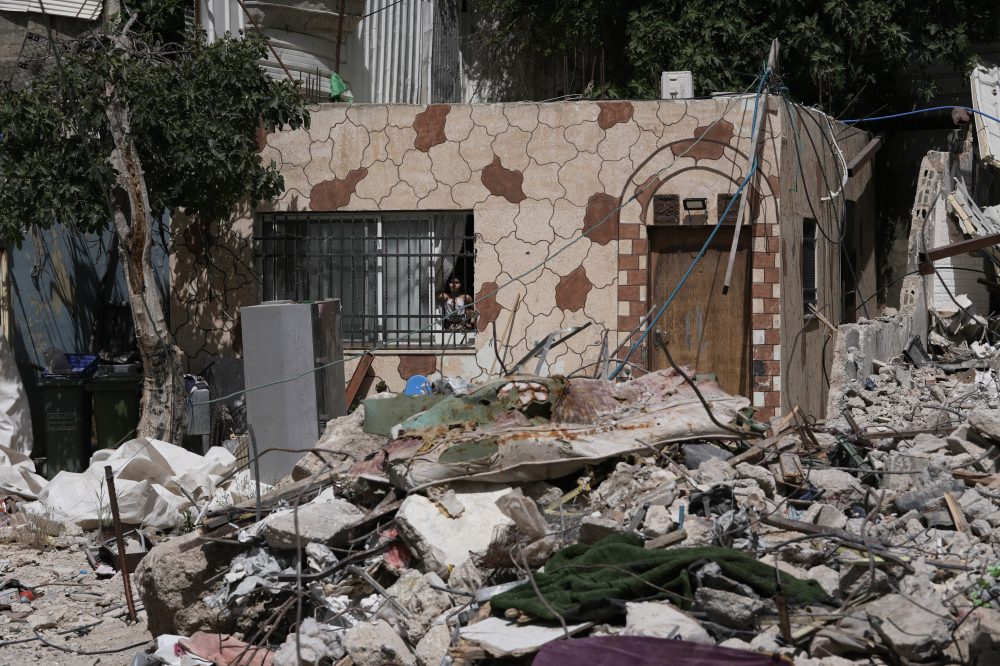

JERUSALEM (AP) — After fighting for decades to protect his residence, Fakhri Abu Diab watched helplessly as Israeli officials demolished his home with bulldozers two years ago.
Today, he and his spouse live surrounded by fragments of their past: a bicycle sits where their bedroom once was; a garden exists where he grew tomatoes during his childhood; a portrait of his deceased mother adorns a remaining wall, recreated from a photograph destroyed during the demolition. The temporary trailer they now occupy among the debris is also scheduled for demolition.
“They are trying to erase my memories, my childhood, my history,” he stated while tears streamed down his face.
For many years, Israel has pursued efforts to increase Jewish settlement in annexed east Jerusalem — the center of the Israeli-Palestinian dispute and location of significant Jewish, Christian and Muslim holy sites. Settlement groups have used discriminatory regulations and archaeological arguments to remove Palestinians from areas distant from active conflict zones.
According to activists, these initiatives have accelerated dramatically in recent years, as Israel faces reduced U.S. diplomatic pressure while global focus has turned toward Gaza, Lebanon and Iran.
More than 260 residential and other buildings were destroyed in 2025, representing a 70% rise compared to three years prior, with certain areas experiencing their highest eviction rates in decades, based on data from Ir Amim, an Israeli organization opposing settlements that monitors such policies closely. At least 116 demolitions have occurred so far this year, the group reported.
“This represents an intensity and scope that we have never seen,” stated Aviv Tatarsky, a researcher with Ir Amim. “Israel can decide, yes, this neighborhood, we want to erase it … No one is going to stop us.”
Israel seized east Jerusalem, together with the West Bank and Gaza, during the 1967 Middle East conflict. Palestinians seek all three territories for their planned state, while the U.N. and most of the international community regard them as illegally occupied.
Israel views all of Jerusalem as its unified capital and maintains that residents receive equal treatment under law.
Palestinians living in annexed east Jerusalem can apply for Israeli citizenship, but unlike Jewish residents, they must go through an application process — a lengthy, uncertain procedure. Most decline to apply because doing so would acknowledge Israel’s territorial claims. This leaves them with limited options to contest housing policies, which are primarily determined by Israel’s Parliament.
Human rights advocates report that beyond supporting major Jewish settlement development — which many Israelis consider regular neighborhoods — officials have strictly restricted Palestinian neighborhood expansion, making housing permit approval nearly impossible.
During the previous year, almost 9,000 permits received approval for Jerusalem’s Jewish population while fewer than 700 were granted to Palestinians, according to Bimkom, an Israeli human rights organization. Palestinians comprise approximately 40% of Jerusalem’s residents and are primarily located in the eastern section.
Israeli authorities explain the disparity by noting that Palestinians seldom submit permit applications. Many Palestinians describe the process as pointless.
Palestinians who construct buildings without permits face demolition threats. Meanwhile, settlement organizations use various legal provisions to acquire or seize Palestinian properties.
Earlier U.S. administrations urged Israel to reduce or halt settlement projects, considering them barriers to conflict resolution. U.S. President Donald Trump departed from this approach during his initial presidency, acknowledging Jerusalem as Israel’s capital.
The U.S. State Department indicated in a statement that Israeli authorities determine Jerusalem policy, and that it anticipates they will honor due process and legal standards.
Abu Diab’s community, al-Bustan, spreads through a valley adjacent to the Old City, with the Al-Aqsa Mosque’s dome visible above the towering walls. Named after orchards that previously flourished there, the area now consists of crowded low concrete structures and demolition sites.
The neighborhood belongs to the broader Silwan district, housing approximately 20,000 Palestinians and desired by settlers due to its proximity to important religious and archaeological locations. The mosque ranks as Islam’s third holiest site, while the hilltop where it sits represents Judaism’s most sacred location, known to Jews as the Temple Mount where two ancient Jewish temples once stood.
The Jerusalem municipality explained that al-Bustan homes face demolition because they were constructed without permits in areas not designated for residential use. A park and public parking facility will be created there to serve all residents, according to their statement.
The municipality reported proposing alternative housing plans for the neighborhood but said residents failed to demonstrate “serious intentions” toward reaching an agreement.
Abu Diab has contested demolition orders in court since 2004. Portions of his residence predated 1967, but his expanding family enlarged it without permits because obtaining them was impossible, he explained.
In February 2024, police provided him and his spouse only minutes to gather belongings before destroying their home. Since then, they have resided in the mobile home with packed suitcases.
They join approximately 1,500 Palestinians in al-Bustan whose homes face potential demolition at any moment.
Nearby, in the crowded Batan al-Hawah neighborhood, settlers are establishing residence as Palestinians face eviction.
Zuhair al-Rajabi and numerous extended family members received eviction orders in January, following Israel’s Supreme Court ruling against them after more than ten years of legal proceedings.
Reviewing documents in his living room, he displayed a 1966 paper confirming his property ownership. He must vacate by July but lacks alternative housing due to expensive Jerusalem rental costs. “The problem, in short, is that they don’t want us here,” he said.
March witnessed the neighborhood’s highest state-directed eviction rate in decades, with 15 families removed and hundreds more people facing risk, according to B’Tselem, an Israeli human rights organization.
Israeli legislation permits settlers to reclaim properties previously owned by other Jewish residents before the 1948 conflict surrounding Israel’s establishment. Palestinians who fled or were expelled from homes in present-day Israel during that war cannot return. Authorities have also transferred government-controlled land to settlement groups.
The Batan al-Hawah evictions demonstrate “the cooperation between settler organizations and state institutions, based on discriminatory laws, toward a shared goal — the Judaization of east Jerusalem and the replacement of Palestinian residents with Israeli settlers,” said Yair Dvir, a spokesperson for B’Tselem.
The Israeli judiciary stated in a response that courts decide cases based on individual merits, circumstances, applicable law and established precedent, and rejected claims of collaboration with private organizations.
Daniel Luria, executive director of Ateret Cohanim, a primary settler organization in east Jerusalem, said the group works to address a “monumental historical injustice” by assisting Jewish families in returning to what had been a Yemenite and Sephardic Jewish community until the early 20th century, when he claims they were forced out by Arabs and subsequently by the British.
Since 2004, approximately 50 Jewish families have relocated to the neighborhood with more seeking to join them, he reported. “There’s never going to be a Palestinian state,” he added.
An Israeli flag flies over the residence where Khalil Basbous faced eviction in January. The 68-year-old relocated to a relative’s home nearby but passes his former residence daily.
“It’s mine,” he declared, tears flowing as he gently touched an olive tree he had planted beside the entrance. “I have no doubt that I will return.”