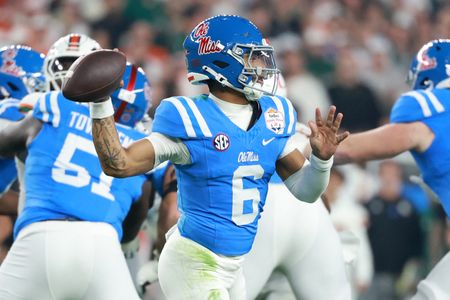

University of Mississippi quarterback Trinidad Chambliss has overcome another major legal obstacle in his fight to continue playing college football through the 2026 season.
The Mississippi Supreme Court rejected the NCAA’s request on Friday to challenge a previous state court decision that favored the player.
While the legal proceedings aren’t finished, attorneys familiar with the case believe it’s improbable the matter will reach a conclusion before Chambliss completes his upcoming season with the Rebels.
The NCAA had challenged a February decision from a Pittsboro, Mississippi judge who issued an injunction granting Chambliss an additional year of college playing time based on a medical redshirt he received in 2022 while at Ferris State.
In their 658-page appeal document, the NCAA requested the court reverse the injunction that allowed Chambliss to continue his college career instead of entering the 2026 NFL Draft.
The quarterback, who placed eighth in this year’s Heisman Trophy voting while guiding the Rebels to the College Football Playoff semifinals, initially saw his request for a sixth year of eligibility rejected by the NCAA on January 9.
Chambliss played his initial four collegiate seasons at Ferris State University. He took a redshirt year as a freshman in 2021, played only two games in 2022 due to injury, and served primarily as a backup with just 33 pass attempts in 2023 before leading Ferris State to the Division II national title in 2024.
After transferring to Ole Miss in 2025, he became the starting quarterback in Week 3 when Austin Simmons was injured. Chambliss guided the Rebels to a 13-2 record that concluded with a 31-27 defeat to Miami in the Fiesta Bowl on January 8.
During his Ole Miss campaign, Chambliss achieved a 66.1% completion rate, throwing for 3,937 yards with 22 touchdowns and only three interceptions. He also contributed 527 rushing yards and eight rushing touchdowns.
Although he secured a substantial NIL agreement to stay at Ole Miss, that deal faced uncertainty when his eligibility waiver was initially rejected.