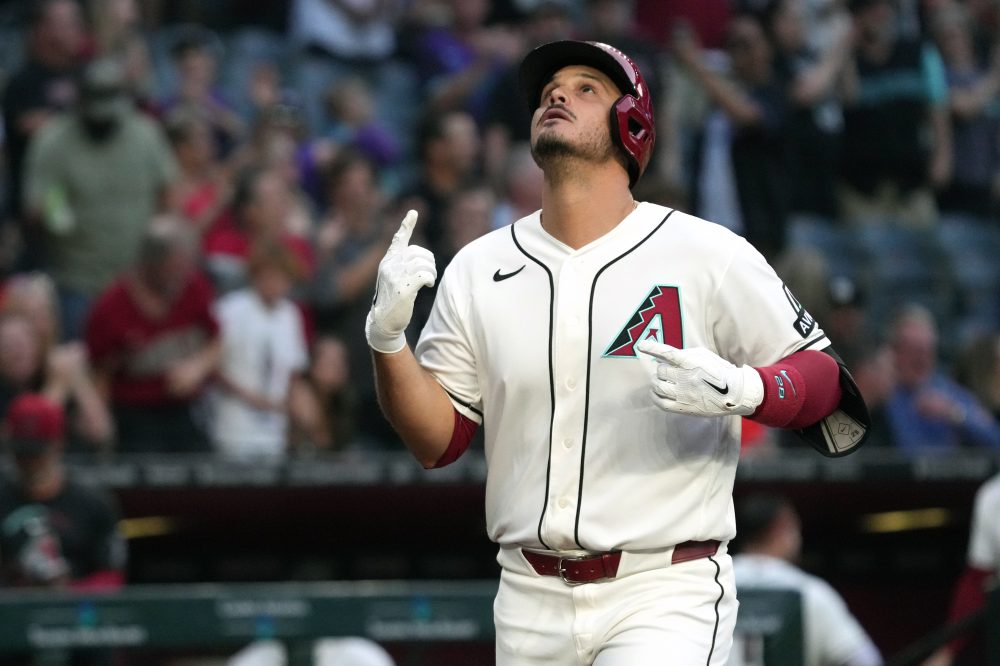

PHOENIX (AP) — During a productive May, Arizona Diamondbacks third baseman Nolan Arenado experienced something familiar to anyone who felt unstoppable in their twenties but has reached their mid-to-late thirties.
He woke up with back pain.
Nothing severe. Not enough to sideline him. But it represented one of those unexplained moments that accompany aging in Major League Baseball — potentially disrupting a strong performance streak for an eight-time All-Star who recently celebrated his 35th birthday.
“There’s more aches and pains,” Arenado said. “There’s just a little more work in the gym, getting prepared for the game, than there used to be. That’s a learning curve.
“I’ve always been in the gym, always did that stuff, but there’s definitely more maintenance.”
Arenado overcame the minor back problem and continues his recovery season in Arizona, hitting .256 with eight home runs and 30 RBIs through Monday’s contests. He’s part of a group of players 35 and older achieving decent offensive numbers, alongside Los Angeles Dodgers veterans Freddie Freeman and Max Muncy, plus Houston’s Christian Walker.
However, this is a limited group that has shrunk considerably during the last ten years.
Major League Baseball batters aged 35 or above have collectively contributed only 5.6 WAR (Wins Above Replacement, according to FanGraphs) through approximately the first third of the season, extending a pattern that has intensified over the past decade.
During the early 2000s, veteran stars dominated the major leagues. This reached its peak in 2003 when older batters accumulated 71.3 WAR combined, featuring a roster that included Barry Bonds, Frank Thomas, Kenny Lofton, Luis Gonzalez and Jeff Bagwell.
What has transformed?
Here are some explanations for why MLB is trending younger these days:
Baseball’s data-driven approach can be traced to Bill James’ work during the 1970s and 1980s, but statistics like WAR, wOBA, BABIP, and OPS+ didn’t gain widespread adoption in the major leagues until the late 2000s at the earliest.
All at once, visual assessment became insufficient for MLB general managers. Statistical evidence took precedence.
And — conclusively — those statistics demonstrated that peak performance years for major league batters typically occur from their mid-twenties through early thirties.
This directly connects to MLB franchises securing young talent with extended contracts. Arizona’s Corbin Carroll, Detroit’s Kevin McGonigle, Pittsburgh’s Konnor Griffin, Kansas City’s Bobby Witt Jr. and Seattle’s Julio Rodriguez represent dozens of talented players who received substantial deals long before reaching free agency.
Investment in veteran players has fallen out of favor. Walker — a three-time Gold Glove first baseman with nearly 200 career home runs — joined the Astros for a comparatively reasonable $60 million, three-year contract following the 2024 season at age 33.
“I think it has a lot to do with the ability to measure guys’ value on the field,” Walker said. “For a long time, WAR didn’t exist, wRC+ wasn’t a stat, right? So, you went off of the optics or this guy’s a good clubhouse guy or he’s got experience, he’s been to a World Series.”
Current young stars have developed in an environment where velocity dominates, but this wasn’t the case when Freeman and others emerged. The average MLB fastball in 2026 exceeds 94 mph, with 18 qualified pitchers averaging at least 96. When Freeman made his debut 17 years ago, the league-wide average stayed below 92 and no qualified pitchers averaged at least 96.
Arenado explained that among the first challenges for MLB veterans is handling elite fastballs — especially inside pitches. This creates difficult encounters against pitchers like Milwaukee’s Jacob Misiorowski, who consistently throws 100 mph.
“I feel like just the general age of the levels and the development is trending younger and younger,” Walker said. “And there might be something to that — like your best bullets might be when you’re 27 years old.”
Dodgers manager Dave Roberts features Freeman and Muncy in his starting lineup almost every day. He also competed in the major leagues until age 36, retiring in 2008, providing him with personal insight into the aging experience.
“The hardest part is to expect and want the same output you’ve always had, but not be willing to change the equation,” Roberts said.
Roberts noted the process varies for each player. Some require additional workouts. Others need less. Many need extra sleep. Nutrition becomes increasingly crucial. The challenging aspect is that the routines that brought success to the major leagues might differ from those needed to remain there during your mid-to-late thirties.
Walker, who didn’t establish himself as a regular starter in the majors until age 28, said he’s accepted getting older and enjoys examining his blood work that might reveal vitamin deficiencies or inflammation causes. The testing also demonstrates how alcohol consumption might impact his body or the value of quality rest.
“For myself, no real magic recipe, just chalk it up to being a late bloomer,” Walker said. “My age is older than most guys, but service time isn’t. I haven’t been in the big leagues for 20 years or anything like that. Just fortunate that I still can help the team.”
Diamondbacks manager Torey Lovullo identified two primary reasons for Arenado’s continued success in his 14th major league season. Initially, he credited the D-backs’ hitting coaches.
But perhaps most significantly, Arenado has heeded those coaches, welcomed change and discovered new methods for achievement.
“There’s an adjustment to work habits and mindset once you get to that level where things aren’t as easy as they used to be,” Lovullo said. “Some say ‘I’ve had my career, it’s not as easy as it once was, and I want to shut it down.’”
He later added: “It’s fun to watch Nolan Arenado have all this success, but he’s worked his butt off. He’s working as hard as any 22 or 23 year old we have on this team.”