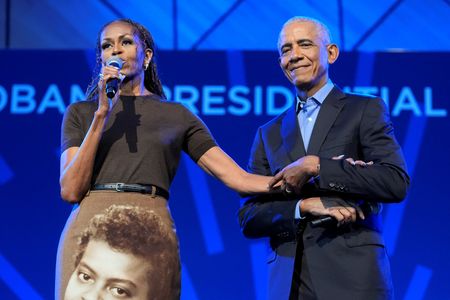

CHICAGO — A massive crowd of guests gathered at a lakefront park in Chicago on Thursday for the grand opening dedication of the Obama Presidential Center, a sweeping campus combining architecture, nature, and art intended to serve as a gathering place for civic life and culture in honor of the nation’s 44th president.
Former President Barack Obama and former first lady Michelle Obama were on hand to lead the ceremonial opening of the $850 million complex, which local historians describe as the largest single investment made in Chicago’s long-overlooked South Side in more than 100 years.
Funding for the project came entirely from private donations raised through the Obamas’ Chicago-based nonprofit, the Obama Foundation. The center opens its doors to the general public on Friday — which coincides with Juneteenth, the federal holiday marking the end of slavery in the United States.
The star-studded dedication ceremony featured performances from a lineup of major recording artists including Stevie Wonder, Bruce Springsteen, Jennifer Hudson, John Legend, Common, Christina Aguilera, Eddie Vedder, Bono, and the Roots.
While dignitaries and invited guests attended the formal dedication, additional ticketed attendees watched the proceedings on a large outdoor screen at a nearby park. The ceremony was also broadcast via a worldwide livestream.
The Obama Center spans 19.3 acres within the historic Jackson Park along the shores of Lake Michigan. The campus includes a playground, gardens, a concert hall, and a basketball court built to NBA specifications.
Much of the center highlights milestones in the civil rights movement and recognizes Obama’s historic role as the first Black politician elected president of the United States. The opening comes as his immediate successor, President Donald Trump, has moved to roll back civil liberties protections and diversity initiatives.
Valerie Jarrett, the longest-serving senior White House adviser during the Obama administration and the chief executive of the Obama Foundation, reflected on the significance of the moment. “At a time when there’s so much toxicity in the air, this kind of breathes new hope,” she said. “You can come here and be inspired and hope again.”
The word “hope” — a defining theme of Obama’s 2008 presidential campaign — is prominently featured in a sculpture near the entrance to the main building, a clear signal of the legacy the Obamas hope the center will represent.
Organizers anticipate the center, most of which will be free to the public, will attract between 750,000 and one million visitors each year.
The focal point of the campus is an eight-story museum dedicated to Obama’s personal journey and his two terms in the White House, from 2009 to 2017. The museum’s irregularly shaped granite tower has received mixed reactions from architecture critics in a city celebrated for its bold building designs. The structure has already picked up the nickname “the Obamalisk,” though others say it resembles four hands joining together and reaching skyward.
A passage from what Obama has called his favorite speech — delivered in Selma, Alabama, on the 50th anniversary of the “Bloody Sunday” civil rights march across the Edmund Pettus Bridge — is inscribed in large block text wrapping around an upper section of the building’s exterior.
Other features of the campus include a Great Lawn designed for summer picnics and winter sledding; a new branch of the Chicago Public Library; a fruit and vegetable garden named for Eleanor Roosevelt, wife of 32nd U.S. President Franklin D. Roosevelt and a significant Democratic Party figure in her own right; an outdoor plaza honoring the late civil rights leader and U.S. lawmaker John Lewis, who led the original “Bloody Sunday” march; an athletic facility called Home Court; and a multimedia event space known as the Forum.
The campus also showcases 28 original works of art, along with a network of walkways and green spaces featuring 900 native trees that connect to surrounding parkland.
The site is built upon the framework of Jackson Park, originally designed by renowned landscape architects Frederick Law Olmsted and Calvert Vaux in 1871 and later used as the grounds for the 1893 World’s Fair.
The architectural firm behind the Obama Center was led by Billie Tsien and Tod Williams, New York-based designers known for projects such as the Barnes Foundation in Philadelphia and the Logan Center for the Arts at the University of Chicago.