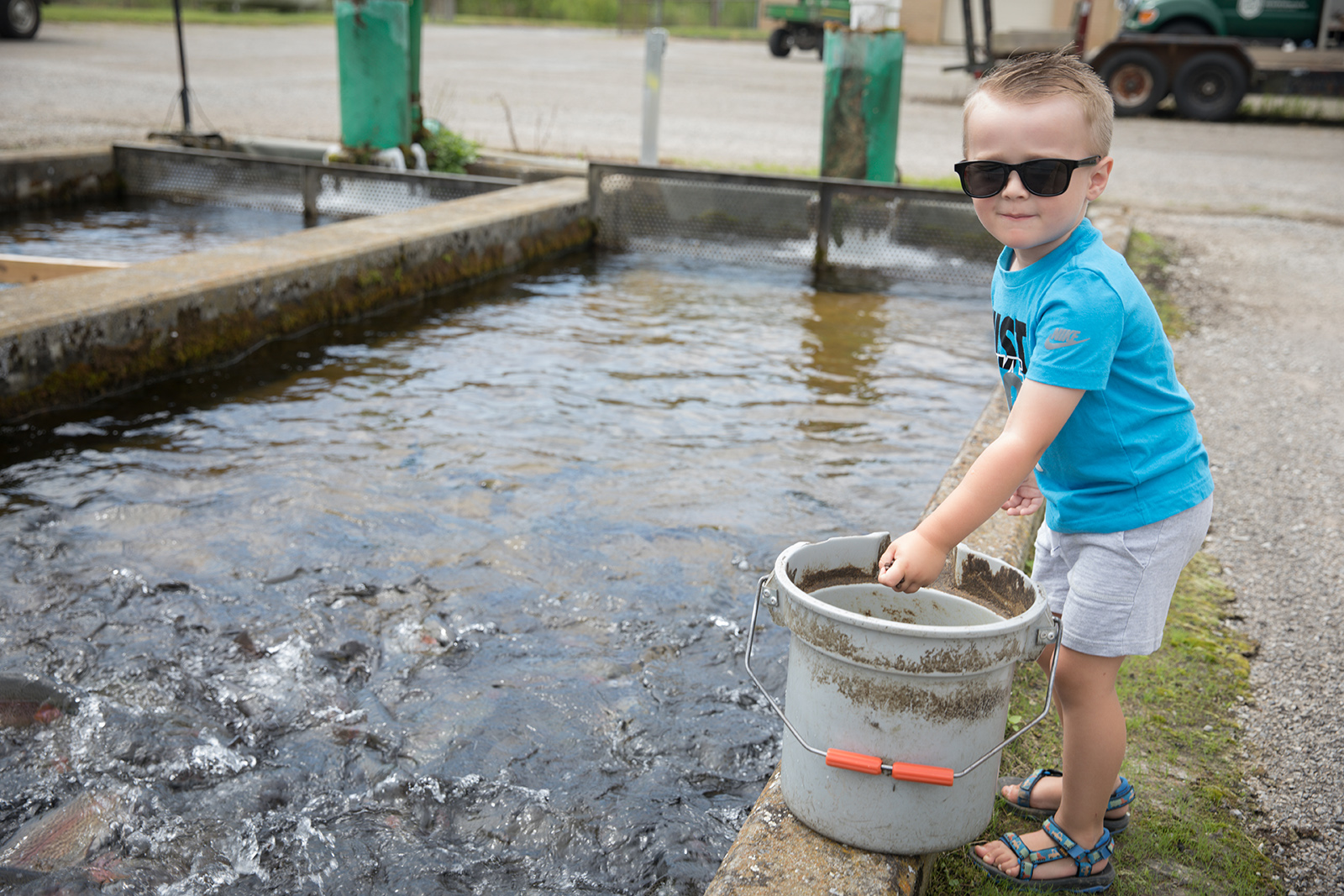

Virginia anglers—I wanted to share an article with all of you about the fish hatchery systems that support opportunities throughout member jurisdictions of the Northeast Association of Fish and Wildlife Agencies, of which Virginia is a member. Virginia has nine fish hatcheries that stock trout, striped bass, walleye, smallmouth bass, and sunfish. Most of them require significant upgrades to keep producing fish and support sportfisheries—a story that is not unique—and this article details many of the challenges. DWR is actively pursuing funding mechanisms to maintain and upgrade the hatchery system, but without additional financial support, the ability of the system to support fish production will decline significantly. Note that our hatcheries are open to visitors, and we are happy to arrange a tour for interested anglers. Please reach out to us at [email protected] and we will set something up!
– DWR Chief of Aquatics Dr. Michael Bednarski
Each year, approximately 50,000 people visit the Salmon River Fish Hatchery located in Altmar, New York. Many come to observe salmon migration from the viewing platform, while others enjoy the facility’s aquarium displays. The facility’s September open house welcomes guests into normally restricted areas, where staff members tend to roughly 3.5 million fish annually while children learn fishing techniques for when these fish are released into waterways across New York.
“It’s a really nice visitor experience,” brags Jim Daley, the superintendent of fish culture for the New York State Department of Environmental Conservation.
However, when Daley visits any of the dozen state hatcheries under his supervision, he encounters a different reality. “I walk around, I see an endless to-do list,” he says.
Deteriorating ponds, failing concrete structures, broken pipes and pumps create what Daley describes as “a tremendous backlog of infrastructure needs,” with “every hatchery is in the same boat.”
These observations align with findings from a recent Northeast Fisheries Administrators Association (NEFAA) study that evaluated 95 fish hatcheries throughout the Northeast, including 10 federal facilities. The assessment revealed over half the facilities were rated as “fair” or “poor,” with some “approaching the point of irreversible repair.”
The implications extend far beyond fish production.
According to Shawn Crouse, New Jersey’s chief of freshwater fisheries, fishing license and equipment sales create “an umbrella of funding for law enforcement, rare species conservation, habitat protections, and education programs.” He adds that “getting outside can open people’s eyes to caring about nature.”
Despite some recent funding successes, hatchery personnel throughout the region are voicing concerns about the critical need for investment in state fish hatchery infrastructure—essential not only for daily operations but for American conservation’s future.
Conservation Heritage
America’s first state fish hatchery opened in Caledonia, New York, in 1864. This preceded Congress’s 1871 authorization of the National Fish Hatchery System, designed to support commercial fishing and feed the growing population. During the early 1900s, hatcheries proliferated nationwide with expanded purposes: restoring ecosystems damaged by development and pollution while replenishing waters depleted by excessive fishing.
Today, state hatchery systems serve even broader functions, offering educational programs, conducting research to maintain aquatic ecosystem health amid climate change, and stocking premier fishing destinations. Since most conservation funding derives from hunting and fishing license sales plus federal taxes on fishing gear and boat fuel, producing fish that attract anglers remains essential to supporting this comprehensive mission.
These facilities also strengthen local economies. The sportfishing industry significantly benefits communities through hotel stays, early morning meals before fishing trips, and post-fishing refreshments. New Hampshire’s 200,000 anglers contribute approximately $150 million annually to state revenues. Pennsylvania’s sportfishing sector supports 14,000 jobs and generates $53 million yearly for the state’s general fund.
In New York, where 20 million angler days create $2.1 billion in economic activity, fisheries chief Steve Hurst emphasizes that monetary value isn’t everything. “Hatcheries put a lot of smiles on a lot of faces,” Hurst says.
Aging Infrastructure, Modern Challenges
Northeast government fish hatcheries average 80 years in age. “These hatcheries were created when labor was cheap and materials were cheap,” says Hurst, “but the world has changed.”
New Hampshire Inland Fisheries Chief Dianne Timmins identifies rising operational costs as a major change. “In the last three years, my costs have tripled,” she says. “We went from $200 thousand in feed to half a million. Water testing has increased from $23 thousand to $64 thousand.”
Timmins manages six facilities; four exceed 100 years old and show poor conditions. The NEFAA report indicates all of them “are on borrowed time and at risk of major catastrophic failure.”
“We try to fix things as they break, but because of the magnitude of what it costs to fix these things, we’re limited,” Timmins said.
Craig Lemon, who runs the Hackettstown Fish Hatchery in New Jersey, explains that cost isn’t the only obstacle in upgrading old infrastructure. “Every time we go for parts, everything is obsolete. It’s a struggle.”
When funding and equipment fall short, staff members bridge the gaps. “Hatchery staff are some of the most out-of-the box thinkers and problem solvers,” says Hurst. “They can fix just about anything and always come up with innovative ways to get the job done.”
“There’s almost nobody that works harder than a hatchery employee,” Lemon echoes.
However, even dedicated workers cannot overcome failures to meet current environmental regulations that many hatcheries cannot satisfy. “There were no water quality rules when these things were created,” says Timmins. “No one had thought of the Clean Water Act. No one had thought of the impacts these hatcheries might have.”
Furthermore, these older operations often depend on outdated heating and cooling equipment that lacks modern energy efficiency standards. Groundwater pumps consume substantial electricity. “We have not kept pace with the environmental movement in this country,” says Hurst. “We need to reduce our carbon footprint.”
Positive Developments
State agency leadership is beginning to recognize hatcheries’ urgent funding requirements.
New York recently approved a bond measure promising up to $75 million for hatchery improvements. “We need more to get our system modernized, but we haven’t had that kind of money in the past, and it’s a great start,” says Hurst.
Maine’s 2022 Jobs and Recovery Plan allocated $20 million for state hatcheries, while New Hampshire received $55 million through the American Rescue Plan Act to modernize one of six facilities. Originally, officials hoped these funds would repair two locations, but increased costs prevented that.
Timmins acknowledges the funding won’t address all New Hampshire hatchery needs but represents a welcomed beginning. Meanwhile, fishing popularity in her state has surged since the pandemic encouraged outdoor activities. In 2022, 150,000 anglers spent 3.5 million days fishing in New Hampshire, contributing $1.4 billion to the economy.
For regional hatchery staff, ensuring growing numbers of anglers have fish to catch represents their original motivation for entering aquaculture—and their reason for persevering despite job challenges.
“We provide 365 days of fishing for $33 in New Jersey,” says Lemon. “You can’t take your kids to McDonalds for 30 bucks.”
Crouse notes that in densely populated New Jersey, hatchery-stocked waters are vital for ensuring universal fishing access.
“We’re a very urbanized state, and so much of what we do overcomes those environmental obstacles of degraded habitat,” he says. “That gives people in an urban environment a chance to enjoy the outdoors.”
In New York, Hurst explains that fish hatcheries serve communities with the greatest needs, from rural tourism-dependent economies to disadvantaged populations with access to only small ponds or streams.
According to Hurst, these facilities’ true value transcends recreation opportunities and economic benefits; they cultivate important attitudes.
“The end result of the work hatcheries is to get people outside, enjoying an environment and pastime they might not otherwise be able to enjoy,” Hurst says. “That’s important because a majority of people in this country have lost their connection to nature—and you can’t have conservation without advocacy for the resource.”
Most state and federal fish hatcheries welcome visitors, with staff eager to educate the public about their work and its importance. Visit a hatchery soon to learn about fish cultivation and discover these facilities’ crucial conservation role. You’ll gain greater appreciation for keeping them operational to ensure fisheries resources continue providing restoration and recreation for the future.