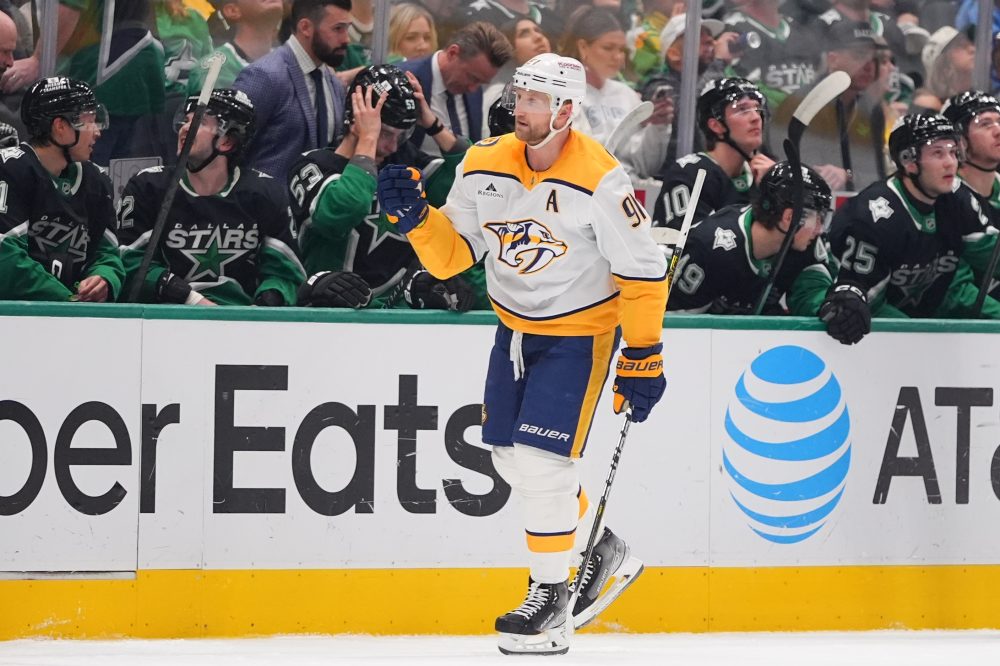

An All-Star caliber roster could be assembled from NHL players who many expected to change teams at the trade deadline but ultimately stayed put.
Between the pipes would be Sergei Bobrovsky. The blue line would feature Colton Parayko and Rasmus Ristolainen. Up front, Vincent Trocheck, Robert Thomas and Steven Stamkos would anchor the offense.
Many anticipated transactions, both major and minor, failed to come to fruition. Multiple factors including updated collective bargaining agreement salary regulations, no-trade provisions, and widespread competitive balance across the league combined to create an unusually subdued deadline day.
Friday’s 20 completed transactions marked the lowest total in five years, going back to the COVID-19 impacted 2021 campaign.
For the first time, general managers operated under restrictions preventing a third team from helping facilitate deals through salary retention – a mechanism eliminated under the new collective bargaining agreement. The previous “double retention” strategy that enabled numerous past transactions is now limited to occurring 75 days apart, making it more challenging to fit players under the salary cap.
“When you take that out, it’s probably why you saw, I don’t want to say as little trades, but not as many as the past,” New Jersey GM Tom Fitzgerald said. “Teams would’ve made more moves, I think, if prices were split in half twice. I do think that had something to do with it. I think it was obvious by looking at the past and how many double retentions there were and have been versus this year.”
While Florida wasn’t necessarily looking to move Bobrovsky, who helped lead the Panthers to consecutive Stanley Cup titles, the double retention mechanism would have enabled an acquiring team to obtain him at a $2.5 million cap impact instead of $5 million or his complete $10 million contract value.
New York Islanders GM Mathieu Darche, who had sufficient cap space to pursue Brayden Schenn from St. Louis, noted that the Tampa Bay Lightning – his former organization – “used that double retention quite a few times over the years.” The Lightning captured two Cup championships during that period.
Tampa Bay, Florida and other recent title winners also benefited from the absence of playoff salary cap restrictions, which permitted them to maintain players on long-term injured reserve during the regular season before activating them for postseason play. This loophole has been closed, as teams must now ensure their 20-player game roster remains cap compliant.
“With the new wrinkle of the playoff roster for calculations and things like that, you had to run the scenarios from a bunch of different viewpoints,” Colorado GM Chris MacFarland said following his team’s headline-grabbing reacquisition of Nazem Kadri from Calgary. “We’re on the phone with the different permutations and they got to be sharp in so many different ways, so there’s definitely different lenses this year.”
Several potential transactions reached advanced stages but ultimately collapsed because the players involved possessed no-trade or no-movement provisions and wielded control over their destinations.
Tyler Myers was reportedly headed to Detroit before Vancouver ultimately sent him to Dallas later in the week. Colton Parayko refused to waive his no-trade protection for a move from St. Louis to Buffalo.
“I’m not talking about Parayko alone, players negotiate their trade rights based on their status on the team and in the league and some players have full no-trade clauses, some have partial no-trade clauses,” Blues GM Doug Armstrong said. “To sign players, you have to provide those type of guarantees. And I respect when players, if they decide to invoke the right that they’ve earned, that’s great and that means they want to be here.”
At deadline time, six teams sat within four points of wild-card positioning in both conferences. Combined with the 16 clubs already in playoff spots, only 10 of 32 franchises found themselves completely eliminated from contention.
“There’s still so many more teams that are still in it or have a chance, so they’re thinking, ‘Well, even if I’m not sure I’m going to make it, I’m not going to sell the farm,’” Darche said. “There was probably less teams selling this year. It was probably more of a seller’s market because of that. It’s supply and demand, so I think that plays a factor, too.”
With significant playoff roster turnover from last season – teams that made the postseason now struggling while others have emerged as contenders – many front offices can rationalize poor performance as temporary setbacks caused by injuries and other circumstances.
“There are teams that are in playoff spots that probably they would admit that they didn’t think they’d get there this quick,” Fitzgerald said. “Then there are other teams that unfortunately aren’t, like us, but still believe in this group and don’t want to blow the whole thing up.”
Contributing to the parity is the salary cap’s record year-over-year increase. Most organizations now possess adequate financial flexibility to retain their desired players.
“It’s been really easy for teams to kind of go out there and re-sign their players, which doesn’t put anybody at the end of their contract and you saw that this year coming down the stretch,” Utah GM Bill Armstrong said. “Everybody got re-signed, and there wasn’t a lot of people and inventory into the market. It’s kind of what we’re going to see for the next few years.”