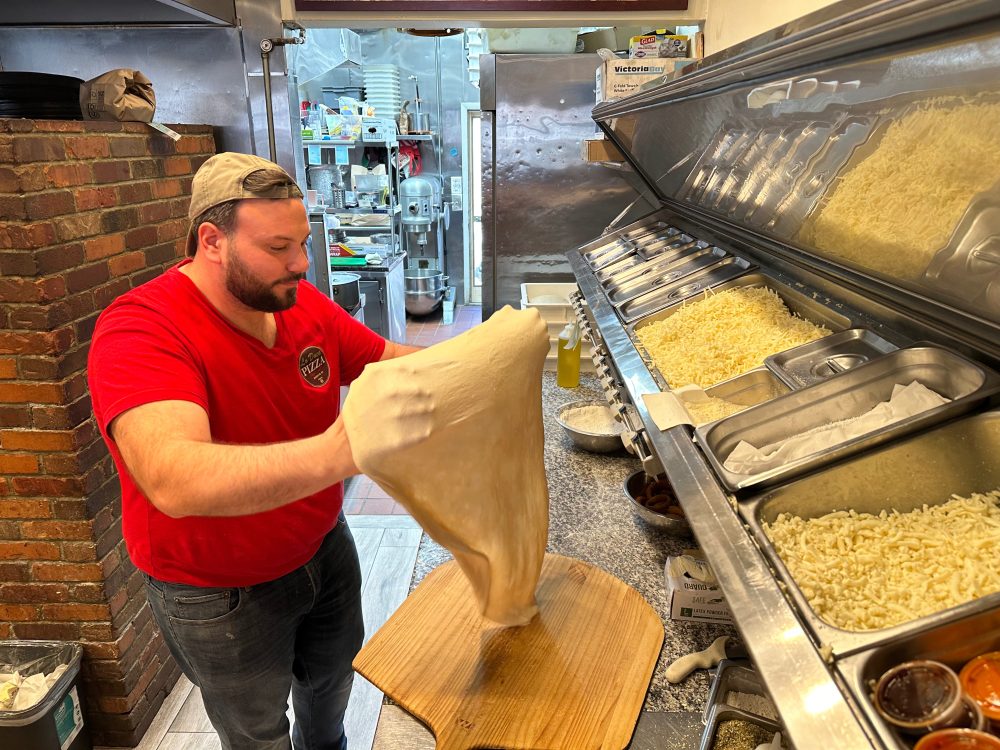

NEW YORK (AP) — Following more than ten years of preparing dough at his family’s Brooklyn pizza establishment, Salvatore Lo Duca recently learned something troubling: A crucial ingredient in their thin-crust pizzas, bromated flour, included a potential cancer-causing substance that’s already prohibited in most countries worldwide.
Working in the rear kitchen of Lo Duca Pizza, the 39-year-old started modifying the traditional recipe passed down from his parents — with surprising outcomes.
“When we started playing around with a different flour, I actually took a liking to it,” said Lo Duco, who runs the shop with his five brothers. “It’s a little more expensive, but the quality is there.”
An approaching prohibition on the chemical, potassium bromate, could soon compel thousands of pizza establishments and bagel stores throughout New York to undergo a comparable transformation.
The legislation, approved by state lawmakers and waiting for Gov. Kathy Hochul’s signature, has created divisions among dough-makers, sparking concerns that even a small modification to established baking methods could significantly impact the city’s most famous foods.
“This is an earth-shaking event for New York pizza,” said Scott Wiener, a pizza historian who leads tours of notable slice shops. “That ingredient is part of the identity of the slice.”
Workers at multiple establishments using bromated flour refused to provide comments for this report. However, Wiener calculated that approximately 80% of pizza and bagel businesses depend on flour containing the oxidizing substance, which shortens dough resting periods and helps create a stronger, chewier final product.
For many, the distinctive characteristics of New York bagels — their height and form, outer crispness and elastic texture — wouldn’t be achievable, or at least as widespread, without this chemical enhancement.
“You could achieve that same bagel texture, but it’s a lot more work and it’s going to be a lot more expensive,” lamented Jesse Spellman, the second-generation owner of Utopia Bagels.
In preparation for the potential prohibition, he’s also been modifying his family’s formula, testing different yeast amounts and rising periods.
“It’s going to take some time to get a product that we’re happy with,” Spellman said.
However, others view the suggested potassium bromate ban as overdue. The ingredient is currently forbidden throughout the European Union, China, India, Canada and — starting next year — California. Some researchers have suggested that its absence outside America might explain why many Americans find baked products in Europe and other places more digestible.
“From a consumer’s point of view, there’s nothing good about potassium bromate,” said Erik Millstone, a professor of science policy at the University of Sussex focused on the health impact of chemicals in food.
Dating back to the 1980s, he explained, research has demonstrated it can trigger cancer in laboratory animals, even at “perfectly reasonable” amounts.
“Most well-informed people would prioritize a long healthy life over a slightly softer and more soluble bun,” he said.
Currently, many of New York’s most acclaimed pizza restaurants, especially newer and more craft-focused establishments, promote their use of “unbromated” flour.
However, local slice shops continue to predominantly use a General Mills flour called All Trumps, a standard component since the city’s first quick-service pizza places opened almost a century ago, according to Wiener. General Mills now offers an unbromated flour for approximately the same cost, though other options are more expensive.
In Wiener’s opinion, the shift from bromated flour could eventually enhance slice quality citywide.
“Without such a fast turn around for dough production, you’re going to get more well-fermented doughs, which is going to lead to lighter pizzas that are easier to eat and leave you with less of a stomachache,” he said. “It will require more of a process. But everything will be built back better.”
Should the legislation become law, businesses will receive a one-year grace period to continue using the additive, plus extra time to finish unexpired supplies. A spokesperson for Hochul said she would review the bill.
Meanwhile, the possibility of the ban has created reactions beyond New York’s boundaries.
“Pizza in Florida is officially better than pizza in New York,” crowed Mario Mangilia, the owner of DoughBoyz in Florida in a recent Instagram post. He added that “my grandfather would haunt me” if the shop’s dough recipe were ever changed.
But after facing criticism from several prominent pizza accounts regarding the additive’s health risks, Mangilia seemed to reconsider his pro-bromate position.
“I’ll tell you what,” he replied to a Long Island-based pizza owner. “I’ll test some different flour out to check it out.”