
BORDEAUX, France — When wildfires began threatening his hometown in southwestern France last Friday, Mohammed Laabar didn’t hesitate. The 35-year-old truck driver grabbed his wife, their three-year-old son, and a pre-packed emergency kit and rushed toward the city of Bordeaux — only to find that the shifting winds soon carried smoke and fumes from the fires right into the city behind them.
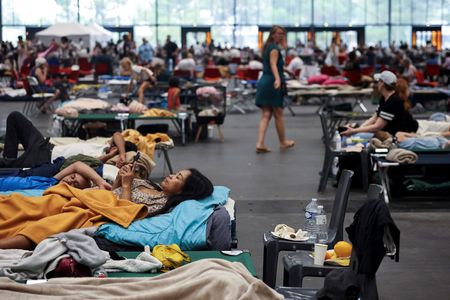
Laabar, who lives in the town of Salaunes, said the terrifying scenes unfolding across France this summer paint a grim picture of what lies ahead. “We’ll see this more often in the future, that’s for sure,” he said at a makeshift evacuation shelter in Bordeaux, where hundreds of displaced residents spent Friday night.
French authorities have now evacuated approximately 197,000 people from the southwestern part of the country after fires surrounded the Cap Ferret peninsula along the Atlantic coast — a popular tourist destination that has been overwhelmed by the disaster during peak summer season.
French President Emmanuel Macron has called in the military to assist exhausted firefighting crews battling what has become a catastrophic network of blazes. The fires follow a record heatwave that has been linked to nearly 6,000 excess deaths across the country.
Inside the Bordeaux evacuation center, emotions ranged from disbelief to deep anxiety about the future, as displaced residents waited with no clear timeline for when they might be able to return home.
Among them was 71-year-old Bernadette, who sat alongside her husband and two young grandsons. She had fled her home in Lège-Cap-Ferret in the middle of the night on Wednesday with, in her words, “very little time to leave.” “I left without any of my things, with nothing, with the two little children,” she said. “I forgot plenty of things, my eye medications, everything.”
Her neighborhood is one where firefighters have been working frantically to protect homes from the advancing flames. Bernadette, who chose not to share her last name, said she had been forced to relocate multiple times as the fires spread, and had barely slept. “I was at Lège, after that Andernos, and after that Bordeaux. And then now there’s fire here too,” she said, referencing the visible smoke hanging over the city. “I’m going to scream.”
By Saturday, the Cap Ferret fire had moved further inland, reaching an area roughly 30 kilometers — about 19 miles — from Bordeaux. French Interior Minister Laurent Nunez indicated the situation had grown somewhat calmer on Saturday, though he warned that winds were expected to intensify again in the afternoon.
Tourists were also caught up in the chaos. Henri Sauter, a 37-year-old visitor from Germany, had been vacationing in Cap Ferret with a large group — nine adults, five children, and a dog. “There were ashes in our drink while we were having dinner, so it was a very weird feeling,” he recalled. After receiving a text message ordering them to evacuate on Friday, the group faced heavy traffic as they slowly made their way out along the only road connecting the peninsula to the mainland. Sauter said they could see flames just 300 meters away as they inched forward.
The fires in France are part of a broader crisis gripping Europe this season. Three consecutive heatwaves have fueled wildfires that have already burned more land across the continent than the average annual total for the past two decades.
Many of those sheltering in Bordeaux expressed concern that this kind of disaster is becoming the new normal. Jean-Pierre, a 68-year-old retired computer engineer from Andernos, said he had lived in the region for most of his life but had never been evacuated before. He noted that while fires occurred occasionally when he was younger, they were rare. Over the past eight or nine years, he said, they have become far more frequent, with multiple fires often burning at the same time. “It’s catastrophic,” he said.