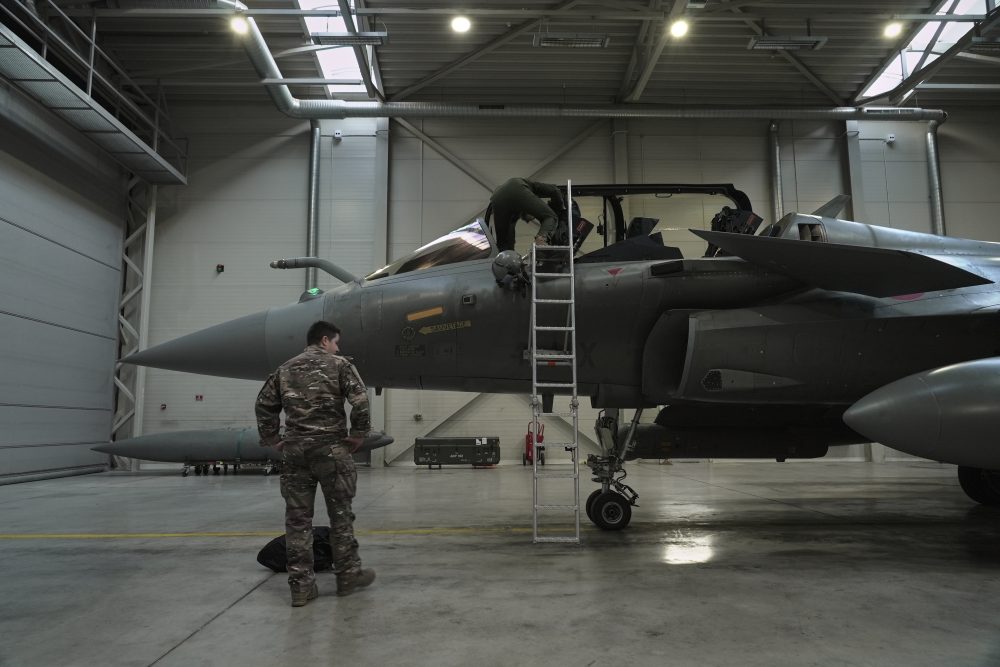

ŠIAULIAI AIR BASE, Lithuania — French fighter pilots rushed to their aircraft with well-rehearsed precision when the NATO alert sounded, already dressed in flight gear to cut down response time.
The aviators raced in vehicles to aircraft shelters where their combat-ready Rafale fighters waited, climbed into their seats and started the engines, which roared and shrieked to life.
Just minutes after departing from Lithuania’s Šiauliai Air Base, they were flying above the Baltic Sea, first encountering a Russian Il-20 spy plane and then following high-speed Russian bombers with their fighter protection that came close to several NATO nations’ airspace.
During wartime, such encounters could rapidly escalate. However, at present, with Russia and the Western military bloc in disagreement about Ukraine but not engaged in direct combat, aviators from both nations simply observed and recorded each other — maintaining separation like cautious predators with weapons ready but unused, their armaments clearly visible yet not fired.
Part of this strategic display — occurring in airborne choreography that happens beyond public view hundreds of times annually — aims to prevent the tension between NATO and Moscow regarding Russia’s comprehensive assault on Ukraine from escalating to direct military confrontation.
Military leaders and aviators conducting NATO air defense operations along the eastern border of the 32-member alliance state their objective is deterrence rather than aggression. They consider their deployment comforting to the Baltic nations — Estonia, Latvia and Lithuania — which share borders with Russia and its partner Belarus but lack their own air forces to repel potential Russian aggression.
“It’s a game of cat and mouse, or rather cat and cat,” said Lt. Col. Alexandre, commander of a French air force wing of four Rafales that is sharing the Lithuanian base with another fighter detachment from Romania. Citing security concerns, the French military withheld the commander’s surname.
“We watch each other, scrutinize each other and try to make sure that it doesn’t go any further,” he said.
Member nations rotate responsibility for monitoring Baltic airspace continuously, twenty-four hours daily throughout the week. The French took over the facility that currently houses their temporary command center from a Spanish unit. They will transfer it to Italian successors in August. Each rotating team adds commemorative patches and insignia to a display wall documenting their service.
NATO launches interceptor aircraft to verify identity and potentially take additional measures when Russian planes operate in Baltic airspace with disabled identification equipment and without submitting flight plans or maintaining radio contact with aviation authorities.
“There are plenty of times in which, on purpose or not, they’re not really respecting the ICAO — the International Civil Aviation Organization — rules, regarding flight plans and behavior,” said Col. Mihaita Marin, commanding the Romanian detachment of six F-16s.
“So obviously we are forced to take off and just make sure that they are who they say they are and their intention is peaceful,” he said.
Spring’s arrival, bringing improved weather for aviation operations, has kept French and Romanian pilots occupied since beginning their four-month NATO assignments in early April.
Marin said interceptions “are getting close to daily” and “that will definitely increase as the weather is getting better.”
French flight crews — observed by an Associated Press reporter covering activities at the base — experienced their most active day yet on Monday.
Launched under NATO direction, French Rafales encountered and monitored two Russian Tu-22M3 bombers carrying high-speed, anti-vessel missiles beneath their fuselages that Russia has also deployed in Ukraine, converting them for ground strikes, and which can be fitted with nuclear warheads.
The strategic bombers’ flight lasting more than four hours from a base near St. Petersburg, accompanied by Su-30 and Su-35 fighters, stayed in international airspace but passed the coastlines of NATO members Finland, Estonia, Latvia, Lithuania and Poland, turning around when they neared Denmark.
The French unit reported the Russian aircraft operated without active transponders, filed flight plans or radio communication. Fighter aircraft from Sweden, Finland, Poland, Denmark and Romania also launched to maintain surveillance, according to French sources. NATO didn’t respond to requests for comment.
French commander Lt. Col. Alexandre said the reasoning behind Russian pilots’ actions that could threaten other Baltic airspace users remains unclear.
“We don’t know if it’s lack of professionalism or just a means for them to test us,” he said.
“But what is sure is that we need to go every time,” he added. “We cannot say, ‘OK, that’s usual, this time we will just let them pass.’”