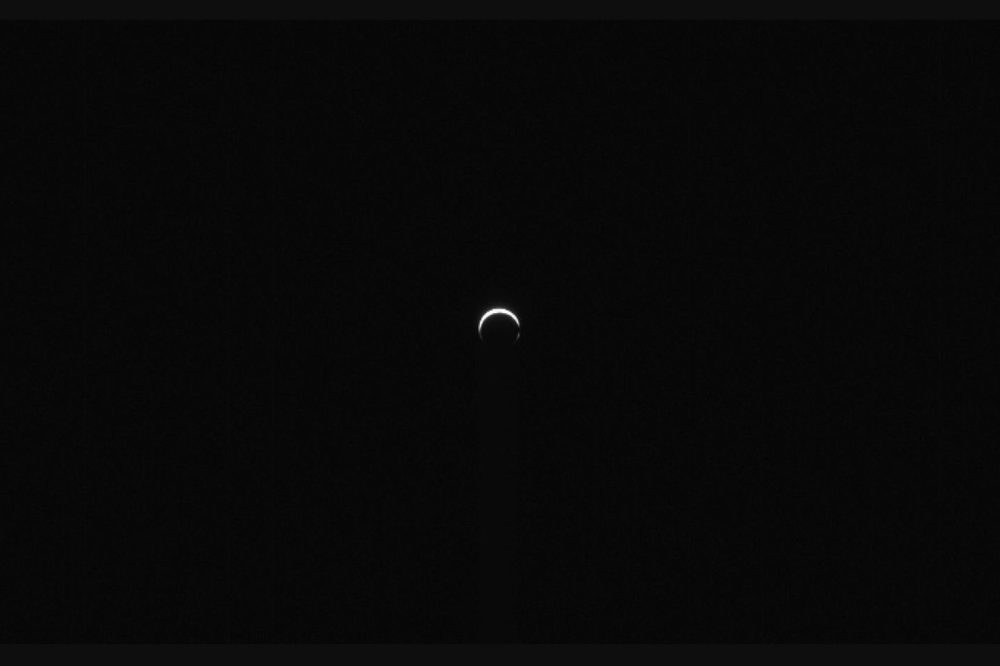

A robotic NASA probe pursuing an unusual metallic asteroid will make a close approach to Mars this Friday, using the planet’s gravitational pull to accelerate its journey while capturing thousands of photographs to prepare for its primary mission in 2029.
The spacecraft, which shares the name Psyche with its asteroid destination, will rocket past the red planet at speeds reaching 12,333 mph (19,848 kph) on Friday.
The flyby will bring Psyche remarkably close to Mars, passing just 2,800 miles (4,500 kilometers) away — roughly the same distance that spans from America’s Atlantic to Pacific shores. Following this maneuver, the probe will continue toward the asteroid belt situated between Mars and Jupiter, where its fascinating target awaits.
Every scientific instrument aboard the spacecraft will be active during the Martian encounter. Meanwhile, NASA’s pair of Mars rovers and several American and European orbital vehicles will simultaneously gather surface and atmospheric data for scientific comparison.
Psyche’s imaging systems have already begun photographing Mars, capturing it as a crescent shape while approaching and later as an almost complete sphere after passing by. These varied perspectives will serve dual purposes, helping mission controllers calibrate their equipment while producing “just plain beautiful photos,” according to Arizona State University’s Jim Bell, the imaging team leader.
Though the asteroid belt contains millions of celestial objects, the majority consist of rock or ice materials. Scientists believe only a small fraction are metal-heavy like Psyche, an irregularly shaped asteroid measuring approximately 173 miles long and 144 miles wide (278 kilometers by 232 kilometers).
Researchers theorize the asteroid could be the remaining nickel and iron center of an early planet that lost its outer layers through space collisions. Examining such a formation at close range may reveal insights about our solar system’s formation 4.6 billion years ago, including how and why Earth developed conditions for life.
The spacecraft, which departed Earth in 2023, has completed half of its six-year indirect voyage to Psyche, located in the asteroid belt’s outer regions — three times Earth’s distance from the sun. The probe is scheduled to reach its destination in 2029, where it will enter orbit around the asteroid for two years of detailed investigation. The van-sized vehicle operates using solar electric propulsion powered by xenon gas thrusters.