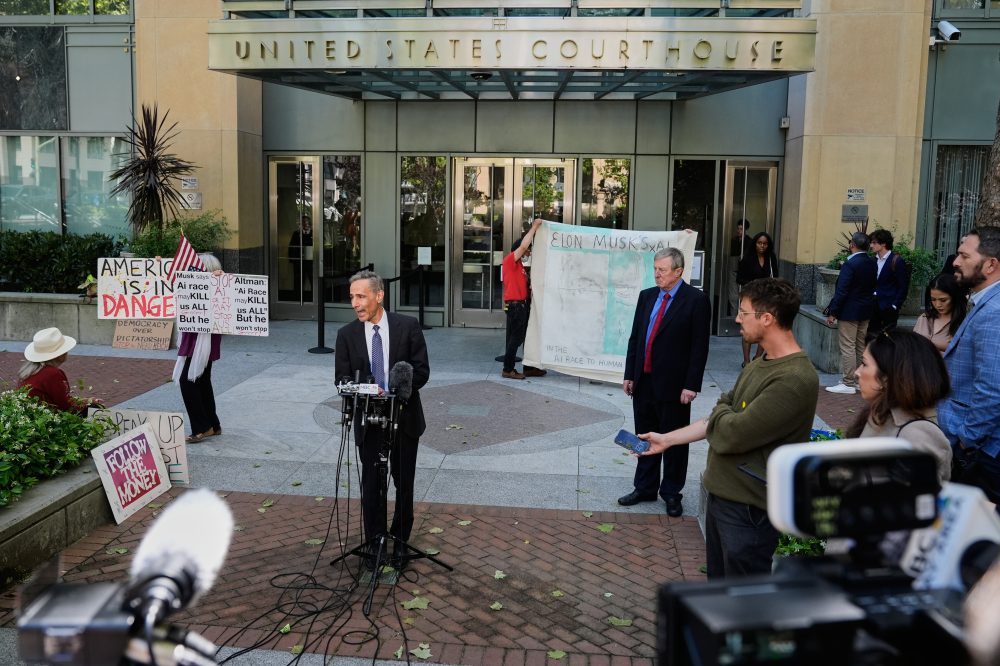

OAKLAND, Calif. — A bitter legal battle between tech billionaire Elon Musk and OpenAI’s leadership has brought urgent questions about artificial intelligence safety into a federal courtroom in Oakland, California.
The lawsuit stems from what Musk claims was a broken promise by OpenAI CEO Sam Altman to maintain the company as a nonprofit organization. Altman counters that Musk is attempting to damage the ChatGPT creator to benefit his own artificial intelligence venture.
While the judge has cautioned attorneys against getting “sidetracked” by AI safety discussions, testimony has nonetheless addressed concerns ranging from job losses to Musk’s warning that advanced AI could eventually pose an existential threat to humanity.
Expert witness Stuart Russell, a computer science professor at UC Berkeley who was paid $5,000 per hour for his testimony, warned that the current “winner take all” competition in AI development itself poses dangers to humanity. Russell outlined various AI risks including bias in hiring and lending, widespread job elimination, spread of false information, and psychological harm to users who develop unhealthy relationships with chatbots.
“Whichever company develops AGI first would have a very big advantage” and an increasingly big lead over everyone else, Russell told the court, referring to artificial general intelligence that could outperform humans across multiple tasks.
The dispute traces back to OpenAI’s founding in 2015 as a nonprofit startup with Musk as its primary financial backer. Both Musk and Altman have stated their original intention was to develop advanced AI safely for humanity’s benefit rather than for individual profit or control. Each side now accuses the other of seeking to dominate the technology.
A nine-member jury from the San Francisco Bay Area will determine which party is being truthful.
Before proceedings began, Judge Yvonne Gonzalez Rogers specifically instructed lawyers, especially those representing Musk, to avoid broader AI safety topics unrelated to the core claim about OpenAI abandoning its charitable mission.
“This is not a trial on the safety risks of artificial intelligence. This is not a trial on whether or not AI has damaged humanity,” Gonzalez Rogers told attorneys.
Despite this guidance, Musk managed to discuss his AI concerns during testimony last week. When asked to explain artificial general intelligence, Musk described it as AI that becomes “as smart as any human,” adding that “we are getting close to that point,” with AI potentially surpassing human intelligence within the next year.
Musk testified about his “extreme concerns” regarding AI, explaining he wanted to create a “counterpoint” to Google, which at the time possessed “all the money, all the computers and all the talent” for AI development without any competing force.
“I was concerned AI would be a double-edged sword,” he stated.
Throughout his testimony, Musk emphasized that he deliberately chose the nonprofit structure “for the public good,” despite having the option to establish OpenAI as a for-profit entity like his other companies.
Judge Gonzalez Rogers expressed some doubt about Musk’s motivations, noting to lawyers that despite his stated concerns about AI risks, Musk “is creating a company that is in the exact same space.” She was referring to xAI, Musk’s artificial intelligence company launched in 2023 and later merged with his space exploration firm SpaceX.
OpenAI’s representatives also claim their mission serves the public interest. Greg Brockman, OpenAI’s co-founder and president who is named as a defendant alongside Altman, described the technology his company develops as “transformative” — something bigger than individual corporations or people, concerning “humanity as a whole.”
Brockman testified this week that his primary focus has always been OpenAI’s “mission,” and that it was actually Musk who sought complete control over the organization. He recalled a meeting where Musk initially appeared receptive to Altman serving as CEO, but ultimately “said people needed to know he was in charge.”
Beyond seeking financial damages, Musk wants Altman removed from OpenAI’s board of directors. A victory for Musk could potentially disrupt OpenAI’s plans to go public through an initial stock offering.