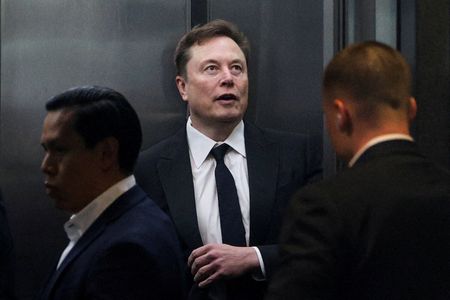

Tesla and SpaceX CEO Elon Musk spent more than seven hours on the witness stand across three days this week in an Oakland courtroom, defending his legal battle against OpenAI, the company behind ChatGPT. The world’s wealthiest individual framed his lawsuit as protecting charitable organizations everywhere.
Musk has filed suit against OpenAI CEO Sam Altman and President Greg Brockman, alleging they broke their commitment to him and society by departing from their original mission to serve as responsible guardians of artificial intelligence technology for all people.
Here are the major highlights from Musk’s court testimony:
DESCRIBING OPENAI AS A CHARITABLE ORGANIZATION
While the term ‘charity’ never appeared in OpenAI’s 2015 founding announcement as a nonprofit AI research organization, Musk consistently referred to it as such during his testimony. He stated that Altman and Brockman broke their original commitment to maintain the nonprofit structure.
“It was specifically meant to be for a charity that does not benefit any individual person. I could’ve started it as a for-profit and I specifically chose not to,” Musk stated under oath.
CLAIMING CREDIT FOR OPENAI’S CREATION
Developing an artificial intelligence research facility demands exceptional talent and substantial computational resources. According to Musk’s testimony, OpenAI depended on his professional network for both requirements.
“I came up with the idea, the name, recruited the key people, taught them everything I know, provided all of the initial funding,” Musk declared.
Musk testified that he successfully recruited top researcher Ilya Sutskever away from Google, despite persistent efforts by Google founders Larry Page and Sergei Brin to retain him.
“After I recruited Ilya to OpenAI, Larry Page refused to speak to me ever again,” Musk told the court.
Regarding computational resources, Musk claimed OpenAI benefited from his relationships with Microsoft CEO Satya Nadella and Nvidia CEO Jensen Huang. “The only one who could actually call Satya Nadella and have him pick up was me,” Musk testified. “The only reason he’s in this thing is because of me. Those are his words.”
DISCUSSING ARTIFICIAL INTELLIGENCE SAFETY CONCERNS
Musk described learning through conversations with Larry Page that the Google co-founder showed little worry about AI safety risks.
“I said, ‘What if AI wipes out all humans?’ He said that would be fine so long as artificial intelligence survives. I said that was insane, that’s just crazy. And then he called me a ‘speciesist’ because I care about humans more than AI. … The reason OpenAI exists is because Larry Page called me a ‘speciesist.’ … What would be the opposite of Google? An open-source nonprofit.”
DESCRIBING AN ALLEGED BRIBERY ATTEMPT
Musk testified about questioning Altman in late 2022 regarding Microsoft’s $10 billion investment in OpenAI, which Musk characterized as a “bait and switch” in text messages presented to the jury.
Altman replied, “I agree this feels bad.” Following this exchange, Altman proposed giving Musk a chance to purchase OpenAI shares, which Musk characterized as follows: “frankly, it felt like a bribe.”
DEFENDING HIS OWN AI VENTURE
When questioned about using OpenAI to develop his xAI company while simultaneously calling OpenAI’s technology dangerous, Musk responded: “It is standard practice to use other AIs to validate your AI.” When asked why his company operates for profit rather than as a charity, Musk answered, “For profit companies can be socially beneficial.”
COURTROOM TENSIONS
The cross-examination conducted by William Savitt, representing OpenAI, became heated at several points. Musk criticized Savitt for using misleading and suggestive questions, which the judge ruled acceptable. The judge reprimanded Savitt for interrupting Musk’s responses. “Few answers are going to be complete especially when you cut me off all the time,” Musk complained.
Additional tension arose before trial when Musk’s legal team sought permission to question an expert witness about AI extinction risks, which OpenAI’s lawyers opposed. “Extinction risk is a real problem. This is a real risk. We all could die,” argued Musk’s attorney Steven Molo.
The judge restricted the expert’s testimony scope and noted the contradiction, saying “it’s ironic that your client, despite these risks, is creating a company that’s in the exact space.”