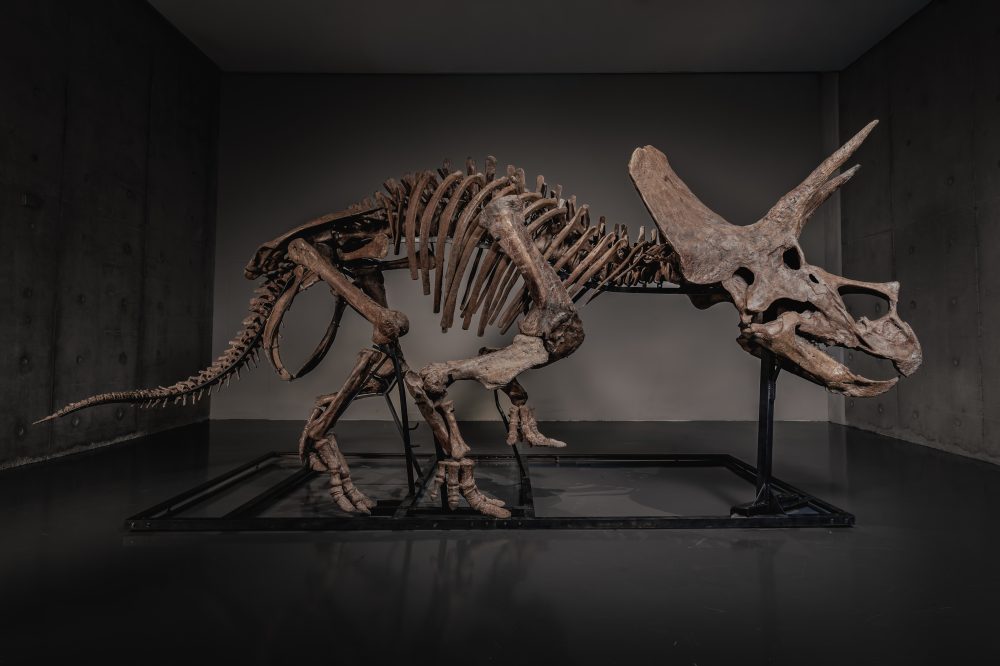

A massive triceratops skeleton that welcomed guests at a Wyoming museum for nearly 30 years is now heading to the auction house, marking an unusual case of a museum-displayed dinosaur entering the marketplace during a time when prehistoric fossil values have reached unprecedented levels.
The specimen, known as “Trey,” will be available for online bidding between March 17 and March 31 through Joopiter, a digital auction site created by Grammy Award-winning musician and producer Pharrell Williams. Auction organizers expect the fossil to sell for between $4.5 million and $5.5 million.
The ancient creature lived over 66 million years ago during the late Cretaceous era and was unearthed near Lusk, Wyoming, in 1993 by discoverers Lee Campbell and the late Allen Graffham, a professional fossil hunter known for making several important paleontological discoveries throughout his career.
Measuring 17 feet in length, the plant-eating dinosaur served as a centerpiece attraction when the Wyoming Dinosaur Center in Thermopolis opened its doors in 1995, remaining on display there through a loan arrangement until 2023.
Following a recent private sale, the skeleton has been relocated to Singapore, where potential buyers can schedule personal viewings through the end of March, according to Joopiter representatives.
Paleontologist Andre LuJan, who collaborated with Joopiter to ready the fossil for sale, noted that Trey “has this cultural aspect that a lot of fossils that go to auction these days just simply don’t have.” He added, “This one is connected to people and undoubtedly has inspired young children who’ve seen it to pursue a career in paleontology.”
What was once primarily the territory of academic institutions and museums has evolved into a thriving investment market for dinosaur remains.
Last year witnessed “Apex” the stegosaurus commanding $44.6 million at auction, breaking the previous benchmark of $31.8 million established in 2020 when “Stan,” a Tyrannosaurus rex skeleton, changed hands.
Demonstrating the continued strength of the fossil marketplace, another rare juvenile dinosaur skeleton exceeded its projected $4 million to $6 million Sotheby’s estimate in July, ultimately selling for more than $30 million amid intense competitive bidding, including additional fees and expenses.
According to Caitlin Donovan, Joopiter’s global head of sales, the growing enthusiasm represents a movement away from conventional collecting areas such as classic paintings toward items that possess “cultural resonance.”
“(Dinosaurs) have always captivated our imagination … and people are now starting to see the value in investing in these as assets,” LuJan explained.
However, the booming market has raised concerns among some paleontologists who worry that significant specimens might vanish into private ownership, limiting scientists’ access to valuable research materials. Public institutions are “getting totally priced out of an exploding market,” according to Kristi Curry Rogers, a paleontologist at Minnesota’s Macalester College.
“If a fossil goes into a private collection without guaranteed access forever, that data is essentially lost to science,” stated Curry Rogers, who has no connection to the current sale.
LuJan stressed that Trey has remained in private hands throughout its history, expressing optimism that it will eventually return to a museum setting, similar to Apex, which now resides at New York’s American Museum of Natural History following its buyer’s agreement to a long-term loan that permits scientific study.
“Because we’ve had this paradigm shift in what owning dinosaurs means to society, people are naturally gravitating toward these benevolent situations where they loan them long-term to museums or they end up donating them to a new museum that’s just being born,” LuJan observed.