
The speed of the modern baseball fastball just keeps climbing — and those who played the game years ago say they barely recognize what pitching looks like today.
As the league heads into its All-Star break, four-seam fastball velocity is on pace to break the record for the sixth year running. Through Saturday, pitchers were averaging 94.7 mph on their four-seamers, compared to 94.5 mph last season, 93.7 mph in 2021, and just 91.9 mph back in 2008 when Major League Baseball first began tracking pitch speed. The first-half average for 2025 came in at 94.4 mph, meaning the final number could tick even higher.
Boston Red Sox manager Chad Tracy, who last appeared in a big league game 13 years ago, described just how dramatically things have shifted. “You watch a Triple-A game, most everybody that’s coming out of the bullpen left-handed or right-handed is throwing 95-plus,” he said. “Back in the day, it was you’d get a lead and you’d get to the lower part of a bullpen and you’d see some guys coming out throwing 88.”
New York Mets infielder Marcus Semien, a three-time All-Star who broke into the majors in 2013 when four-seamers averaged 92.7 mph, says expectations among hitters have completely shifted. “Definitely expecting anybody you’ve never heard of to throw a 95-plus,” he said. “Before you’d know who the guys were who were throwing 98. Now, you just expect that this new guy is probably throwing 98. So that shows how everybody’s trained.”
To put the change in cultural context: the 2001 Pulitzer Prize-winning play “Proof” by David Auburn described a piece of elegant mathematical work as being like “a 95-mile-an-hour fastball.” That comparison no longer carries the same weight — 95 mph is now considered routine.
Right-handed pitchers are throwing at an average of 95.2 mph in 2026, up from 95.0 mph a year ago. Right-handed relievers are even harder to handle, averaging 95.6 mph. Even at the Triple-A level, the average has risen to 93.6 mph, up from 92.7 mph when tracking began at that level in 2022.
Athletics pitcher Hogan Harris has experienced the velocity revolution firsthand, watching his own four-seam average climb from 92.6 mph as a rookie in 2023 to 95.0 mph this season. He credits improved understanding of how the body works. “People are learning the biomechanics of the body a lot better and it’s easier to figure out why people are throwing hard,” he said. “There’s so many young kids throwing hard now and then you see a lot younger people in the big leagues, so my thought is they see a guy that’s throwing 100 when he’s 22 and, boy, he’s not going to throw 100 when it’s 30, so let’s get in there now.”
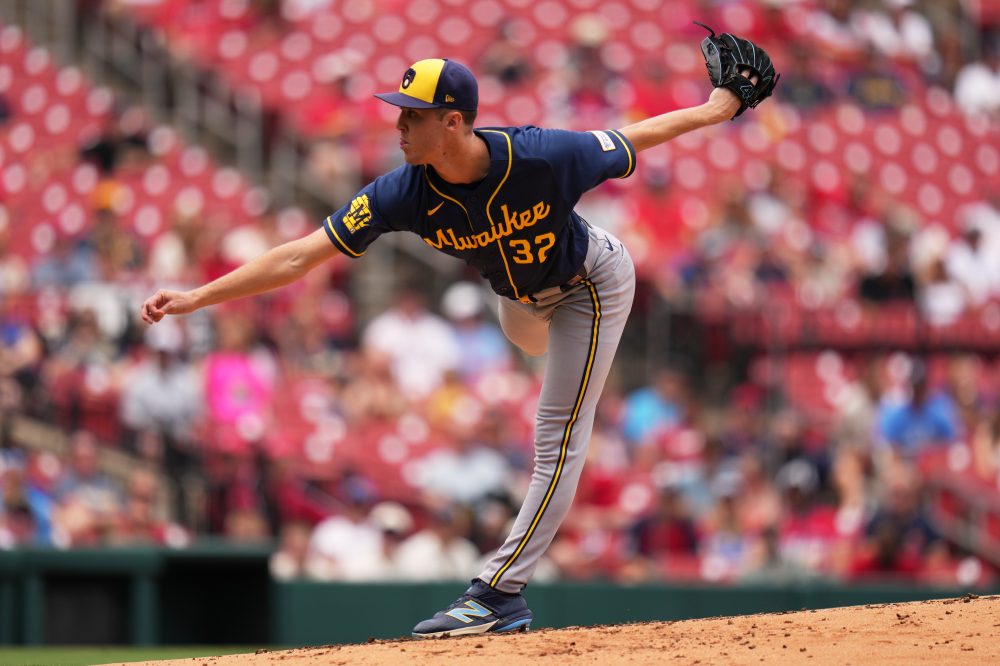
Six pitchers currently average 100 mph or more on their four-seamers. Leading the pack are two relievers: the Athletics’ Mason Miller at 101.3 mph and the Los Angeles Dodgers’ Edgardo Henriquez at 100.6 mph. Milwaukee starter Jacob Misiorowski, just 24 years old, is averaging 100.5 mph — up from 99.3 mph during his rookie campaign last year — and has thrown a major league-best 670 pitches at or above 100 mph. The Brewers held him out of his scheduled Sunday start due to arm fatigue.
Along with rising speeds, pitchers are also changing what they throw. Four-seamers now make up just 30.4% of all pitches, down from 31.8% last season and 35.8% in 2019. Sinkers have grown from 15.5% to 16.6% of pitches, cutters from 7.5% to 7.8%, and offspeed offerings from 13.6% to 14.3%.
New York Mets interim manager Andy Green, whose last significant playing time came in 2006, said the challenge facing today’s hitters goes beyond just raw speed. “It is exponentially harder to hit and I hit .200 in my career, so that should show you how well I would do in the game today,” he said. “The thing that I think gets me when I watch games is it’s not just one fastball anymore. It’s easy for us that played a couple of decades ago to malign the offensive players for not hitting from a batting average perspective what used to be hit, but there’s so much to contend with, so much information, so much awareness of what hitter handles what fastball shape. The game’s gotten harder, there’s no doubt about it.”
Despite the challenges, big league batters are hitting a collective .244 this season, just a hair below last year’s .245 mark and above the .243 average from 2024.
Chicago Cubs star Alex Bregman offered a straightforward take on surviving in today’s pitching environment: “At the end of the day, us as hitters have to find a good pitch to hit and put a good swing on it.”