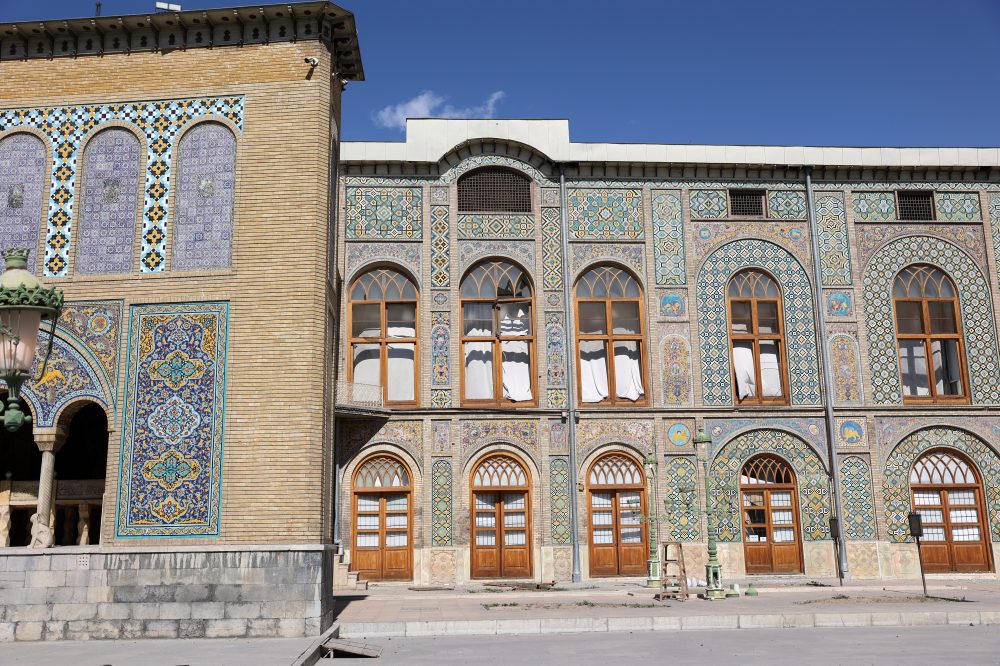

UNITED NATIONS (AP) — Recent military operations by American and Israeli forces have caused harm to no fewer than four Iranian cultural landmarks, including historic palaces and a centuries-old mosque, sparking widespread concern about how expanding conflicts threaten protected heritage sites crucial to Iranian culture and global history.
The rapid pace and scope of destruction has prompted Iran and Lebanon to urgently petition UNESCO, the United Nations’ cultural organization, this week for expanded protection of additional heritage locations.
UNESCO has confirmed verified harm to Tehran’s ornate Golestan Palace from the Qajar period, along with Isfahan’s 17th-century Chehel Sotoun palace and the Masjed-e Jāme, Iran’s most ancient Friday mosque. Additional confirmed destruction occurred near structures in the Khorramabad Valley, home to five ancient caves and a rock shelter containing evidence of human settlement from 63,000 B.C.
Video footage from March 3 obtained by the Associated Press showed Golestan Palace with broken glass from mirrored ceilings covering floors, alongside damaged archways, destroyed windows and scattered decorative elements beneath glass-mosaic walls.
UNESCO reported it had previously shared exact geographical locations of these heritage locations with all conflict participants “to take all feasible precautions to avoid damage.”
Cultural site destruction has extended beyond Iran throughout the Middle East and other regions, with UNESCO documenting harm to Israel’s White City, Lebanon’s Tyre, and additional locations.
Such collateral destruction of heritage sites has become commonplace in modern warfare for years, including battles between Russia and Ukraine and Israel and Hamas, where numerous locations have suffered damage or complete destruction.
“What is happening is clear to all: In these increasingly modern conflicts, it’s civilians who pay the price, it’s civilian infrastructure that pays the price, and we’ve all seen the destruction of priceless historical heritage,” U.N. spokesperson Stephane Dujarric said this week.
Human rights organizations share similar concerns, cautioning that Iran’s conflict has not only claimed over 1,000 lives but disrupted institutions and historic locations that communities depend upon.
“It causes harm to civilians because it damages or destroys a piece of their history that can be significant both to the world and also to a specific region or community,” said Bonnie Docherty, senior researcher in the arms division at Human Rights Watch. “It undermines the sort of shared identity of a local community, which can often be important for bringing people together.”
Arash Azizi, who spent his childhood in Iran before relocating to America as an adult, explained that his family’s limited travel budget meant exploring domestic historical locations. This experience, he says, shaped his understanding of cultural identity and heritage.
“At times where school kids are killed, when human life is at stake, when the stakes are very high, people might think, ‘What are a couple of broken tiles or broken glasses?’” the 38-year-old New York resident said.
“I think this is the wrong attitude,” he added. “We need a cultural context. We need to know who we are, and where we come from, and what does it all mean?”
For Shabnam Emdadi, a 35-year-old Iranian American also in New York, the destruction at Isfahan’s Safavid-era Chehel Sotoun Palace holds deep personal significance. She visited there with her father several years before his death.
“Those Iran trips with him were my most fond memories of him at his happiest, where he felt most at home and alive, and I’ll never forget them,” Emdadi said. “Which is why every day when I see the damage of these sites that are the core of my memories, I feel like I am also losing a piece of him.”
Responsibility for the destruction remains uncertain between U.S. or Israeli military actions. Pentagon officials declined to comment. Israeli Defense Forces stated they were “unfamiliar” with allegations of UNESCO site damage.
One advocacy organization highlighted U.S. Defense Secretary Pete Hegseth’s recent statement that America’s military approach would avoid “stupid rules of engagement.”
“That’s an extremely important statement because it’s those rules of engagement that embody international humanitarian law, which is not just the protection of cultural heritage, but the protection of all civilian populations and structures, including your hospitals, your schools, etc.,” said Patty Gerstenblith, president of the U.S. Committee of the Blue Shield, an international organization dedicated to protecting heritage in conflict, disaster and crisis.
The damaged locations represent part of nearly 30 Iranian sites receiving special protection through UNESCO’s World Heritage designation.
Additional famous landmarks receiving similar protection include China’s Great Wall, Egypt’s pyramids, India’s Taj Mahal and America’s Statue of Liberty.
UNESCO’s World Heritage Committee makes annual designations for sites deemed “of outstanding value to humanity” and intervenes when locations face destruction or damage threats. The program offers countries technical support and professional training for site preservation.
The Trump administration announced last July its intention to withdraw from UNESCO again as it reduces American participation in certain international organizations.
The White House referenced similar reasoning from 2018, claiming U.S. participation doesn’t serve national interests and accusing the organization of supporting anti-Israel rhetoric. The withdrawal becomes effective in December.