
Recent Middle East unrest has prompted investors to seek financial shelter, sparking fresh discussion about which investments truly provide security during uncertain times.
The decision has become more complex as conventional safe investments are acting erratically. Gold prices have fluctuated dramatically while the U.S. dollar – which lost favor over the past year – has made a comeback.
Here’s how popular safe-haven options are performing:
U.S. DOLLAR SHOWS STRENGTH
Among protective investments, the American dollar has likely delivered the strongest performance this week.
The dollar index, measuring the U.S. currency against six international counterparts, has risen 1.5%. The greenback has even strengthened against the Swiss franc and Japanese yen, currencies that usually excel during market uncertainty.
This performance stands out because the dollar weakened when stocks dropped during last April’s trade disputes, casting doubt on its protective qualities.
Flow data indicates demand centers on short-term dollar cash rather than other dollar-denominated investments.
America’s position as a net energy exporter means crises that push benchmark Brent crude oil above $80 per barrel should provide support.
“The dollar has some safe-haven characteristics, but it is context specific,” said James Lord, Morgan Stanley’s head of FX strategy.
However, this won’t always hold true, he noted, as U.S. policy uncertainty has weakened the currency’s protective appeal.
GOVERNMENT BONDS LOSE APPEAL
Government bonds have failed to draw the protective investment flows usually seen during geopolitical disruptions, with traders focusing more on inflation expectations than defensive characteristics.
Budget concerns, including Germany’s easing of debt restrictions and broader anxieties about increased government borrowing, have overshadowed safe-haven attraction.
German 10-year bond yields, the eurozone standard, have climbed 14 basis points this week.
“Germany is a flight-to-quality kind of investment, but you don’t really want to be playing around at the long end of the bull market if they’re raising more debt,” said Bryn Jones, Rathbones’ head of fixed income.
GOLD MAINTAINS CREDIBILITY
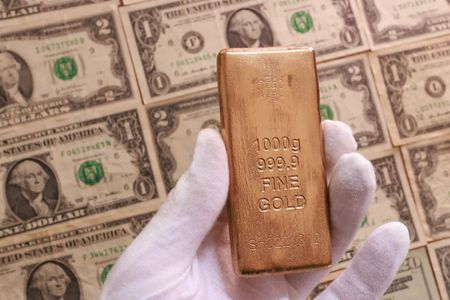
Gold’s reputation as a protective investment remains strong, evidenced by its 240% increase this decade.
The precious metal has shown volatility, dropping significantly Tuesday. Experts believe this occurred partly because investors sold well-performing assets to offset losses elsewhere, as Middle East conflict concerns damaged market confidence.
This shouldn’t undermine gold’s protective status, which stays solid given inflation concerns, geopolitical tensions, and high debt levels, analysts say.
State Street reported gold remains under-represented in portfolios, with gold exchange-traded fund allocations below 1% of global fund assets, under the 5-10% range they recommend for strategic allocation.
“As a base case, $6,000 is more likely than $4,000 this year, and we’re just above $5,000,” said Aakash Doshi, State Street Investment Management’s head of gold strategy. “That’s a clear point to make.”
TRADITIONAL CURRENCY REFUGES TESTED
The Swiss franc and Japanese yen, historically considered currency shelters, have declined 1.2% and 0.8% this week.
“The one that looks relatively attractive from a valuation perspective is still probably the Japanese yen. It stands out to me as one that can provide protection in this environment,” said Justin Onuekwusi, chief investment officer at St. James’s Place.
Political uncertainty has added risk to the yen’s outlook following reports that Japanese Prime Minister Sanae Takaichi has expressed concerns about additional interest rate increases.
Meanwhile, experts warn the franc’s potential gains may be limited, given the Swiss National Bank’s warning that it’s prepared to intervene against excessive strength.
“Elevated SNB intervention risks would likely diminish its haven attributes during the current shock,” said Goldman Sachs strategist Teresa Alves.
DEFENSIVE STOCKS DISAPPOINT
Stocks typically struggle during market stress, though certain defensive sectors like utilities or consumer staples usually see smaller losses.
This pattern hasn’t emerged this time.
The S&P utilities and consumer staples sectors have dropped 1% and 2.8% respectively this week, while the S&P 500 remains unchanged. In Europe, utilities fell 3% and consumer staples declined 4.5% compared to the STOXX 600’s 3% drop.
This partly reflects their previous strong performance. One major investment trend, at least before the conflict began, involved purchasing “hard assets” like infrastructure and industrial companies.
More generally, defensive value stocks have outperformed growth stocks, with some achieving strong results.
“When you’re investing in the classically defensive sectors at the level of current interest rates, you have to be much more disciplined about relative prices,” said James Bristow, portfolio manager at Templeton Global Investments.
“I own shares in Pepsi, for example, … (it) isn’t the highest quality company, but the starting point was very low … that’s a different margin of safety from if you’re buying shares in, say, Nestle.”