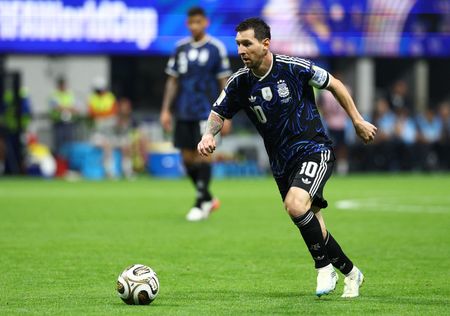

NEW YORK — Back in 2016, Lionel Messi stood at MetLife Stadium with tears in his eyes after Argentina fell short in the Copa America final. Devastated by the loss, he told the world he was done with international football, saying, “I’ve done all I can.”
At 29 years old, Messi had already earned more individual and club honors than nearly any player alive. But after coming up short in three Copa America championship matches and the 2014 World Cup final, it seemed like a major international title might never be his.
Of course, an entire nation refused to let him walk away. Argentina persuaded Messi to pull the jersey back on, and this Sunday he’ll return to that very same stadium — now called New York-New Jersey Stadium for this tournament — with a chance to win his second straight World Cup gold medal.
Debates about the greatest footballer ever will never truly be settled, but to find someone who shaped World Cup outcomes as powerfully as Messi has, you’d need to go back to Diego Maradona or Pele.
While Sunday’s opponents Spain rely on a strong collective identity, Messi’s role has been absolutely central to five straight years of success for Argentina, known as the Albiceleste.
His impact goes well beyond goals and assists. Messi serves as a symbol of national pride — a rallying point for a remarkably tough team that has repeatedly found ways to win when the odds were against them.
After Lautaro Martinez scored a stoppage-time winner from a Messi assist in the semifinal against England, Martinez captured the team’s spirit: “It’s all happiness, and it’s all thanks to this group which, in the face of adversity, keeps going and going and never gets tired. We have the best player in the world as our example.”
Beyond his brilliance with the ball, Messi has shown impressive physical endurance, playing every single minute of Argentina’s knockout-round matches at this World Cup — two of which extended into extra time.
Making predictions about the future of the little magician from Rosario has always been a risky bet, but by any measure, a fourth world title for Argentina on Sunday would stand as the defining achievement of an extraordinary career.
His 2022 World Cup victory, along with Copa America championships in 2021 and 2024, have filled his trophy shelf with international honors — even as his club career shifted to the comparatively lower-stakes world of Major League Soccer.
Messi is under contract with Inter Miami through the end of the 2028 MLS season and has given no hint that Sunday’s match will be his farewell in Argentina’s sky blue and white. He has worn that shirt 206 times over 21 years.
One thing, however, is beyond question: he has more than earned the right to decide that for himself.