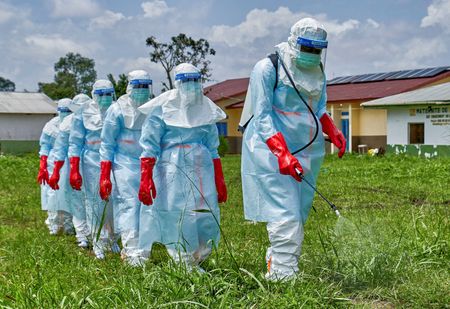

International health officials are working urgently to develop medical interventions for an ongoing Ebola outbreak in eastern Democratic Republic of Congo caused by the Bundibugyo strain of the virus.
The Bundibugyo variant differs from the more commonly seen Zaire strain, as no approved vaccines or treatments currently exist for this particular form of the disease.
Approximately 600 suspected cases and 139 suspected deaths have been documented in this outbreak, according to reports. The World Health Organization has cautioned that these figures may continue to climb. The Bundibugyo ebolavirus (BDBV) carries a mortality rate reaching up to 40%.
Researchers are evaluating a limited number of experimental vaccines and therapies, while international health officials investigate whether current Ebola medical interventions might provide protection – though this possibility is currently backed only by preliminary animal research.
The majority of potential treatments have not undergone human testing and would need emergency or compassionate-use approval for use in DRC.
VACCINES
A vaccine specifically targeting Bundibugyo, called rVSVΔG/BDBV-GP, employs the same technology found in Merck’s approved Ervebo vaccine for the Ebola Zaire strain. This vaccine demonstrated survival benefits in non-human primates during a 2023 proof-of-concept study.
A spokesperson for the University of Texas Medical Branch, whose researchers participated in the study, indicated that conversations are continuing to move the vaccine forward, though no final decisions have been made. The WHO has suggested a possible six-to-nine-month timeframe for producing an rVSV Bundibugyo vaccine.
A second potential vaccine candidate utilizing ChAdOx1 technology, the same platform used in the Oxford/AstraZeneca COVID-19 vaccine, is being produced by the Serum Institute of India.
The company began production through its “emergency response framework,” working with partners Coalition for Epidemic Preparedness Innovations and the University of Oxford, immediately after learning of the outbreak this month, according to a spokesperson.
Vaccine doses might be available within two to three months, the WHO reported, although animal studies remain to be completed, requiring additional testing.
CEPI, which supported some initial COVID-19 vaccine development and seeks to have vaccines ready within 100 days of an outbreak, confirmed it is discussing with both vaccine candidates how to accelerate development, which would likely involve conducting pre-clinical studies simultaneously with manufacturing additional doses.
ANTIBODY-BASED THERAPIES
Privately held Mapp Biopharmaceutical is creating a pan-ebolavirus antibody treatment using a combination of two human monoclonal antibodies, designated MBP134.
Originally researched for Sudan ebolavirus, the treatment proved safe and well-tolerated in preliminary trials. The U.S. Biomedical Advanced Research and Development Authority, known as BARDA, has supported its development.
The agency confirmed it is organizing shipments of the investigational treatment for potential use in high-risk Americans who have been exposed to the virus.
Mapp reported that MBP134 has demonstrated comparable effectiveness against all known ebolaviruses and that the company is collaborating with the World Health Organization and other authorities in responding to the Congo outbreak.
Human monoclonal antibodies taken from Bundibugyo survivors have also been investigated as possible treatments.
One potential treatment, BDBV289-N, showed effectiveness in a 2018 animal study. The research, performed by a team of scientists with backing from the U.S. National Institutes of Health, revealed the antibody provided up to 100% protection in infected monkeys, even when treatment began up to eight days following infection.
ANTIVIRAL DRUGS
Gilead Sciences’ antiviral medication, remdesivir, has demonstrated effectiveness against the Bundibugyo virus in laboratory research performed by scientists at the University of Texas Medical Branch. Some findings suggest it may have greater effectiveness against BDBV compared to the Zaire Ebola strain.
Gilead did not respond to a request for comment.
DIAGNOSTIC TESTS
The WHO had noted that restricted testing capabilities for the Bundibugyo strain was hampering the response to the outbreak. Several tests can identify the infection.
BioFire Defense, an affiliate of French diagnostic company bioMérieux, produces an FDA-cleared test – BioFire Global Fever Special Pathogens Panel – that can identify multiple Ebola species, including Bundibugyo.
A company spokesperson confirmed it is expanding production capacity and working with public health stakeholders and international contacts to evaluate potential requirements.
Germany-based company Altona Diagnostics’ test named RealStar Filovirus Screen RT-PCR Kit 1.0 is being utilized to detect the Bundibugyo outbreak in Congo. The company has increased production to support local testing facilities in Congo.