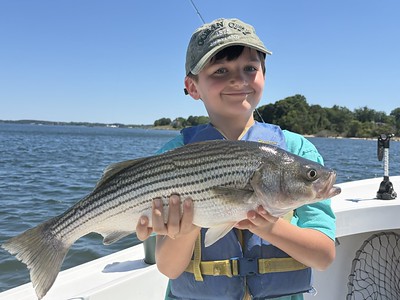

With Memorial Day weekend approaching and recent hot weather signaling summer’s arrival, more families and friends are heading out on the water to enjoy quality fishing time together.
Weekly Outlook: May 20 – May 26
Water temperatures are expected to drop slightly this week due to anticipated rainy weather across Maryland’s Bay region. Monitoring buoys indicate main Bay surface temperatures and river mouth areas have reached the low 70s. Smaller waterways have warmed to the low to mid 70s. However, protected streams and downwind locations on sunny days will heat up more quickly and often maintain temperatures in the low to mid 70s.
Most Maryland rivers and streams are anticipated to have below normal flow levels. Water clarity should remain typical for most Maryland sections of the Bay and tributaries. Above normal tidal movement is expected Wednesday and Thursday due to the May 16 new moon.
For current detailed fishing conditions in your Bay area, visit Eyes on the Bay’s Click Before You Cast.
Upper Chesapeake Bay
The Susquehanna River and Flats stay closed for striped bass targeting above the line from Abby Point to Worton Point until June 1. Below that boundary, south to the line from the south corner of the Hart-Miller Island dike to the end of Route 21 in Tolchester, only catch and release is permitted. South of the Hart-Miller Island/Route 21 Tolchester line allows striped bass fishing to the Virginia border. Fishermen may retain one striped bass daily within the 19-inch to 24-inch size range.
Fishermen in the Susquehanna River are landing large blue catfish and flathead catfish in the Conowingo Dam pool. Moving downstream from the Susquehanna and beyond the river mouth, the target shifts to a combination of blue catfish and channel catfish. Cut bait including gizzard shad, menhaden, white perch, or scented options all prove effective. Department of Natural Resources invasive fishes program manager, biologist Branson Williams, anticipates larger female blue catfish will begin spawning late this month through June around cavities and structure.
At the Susquehanna Flats, fishermen are experiencing excellent action for largemouth bass and Chesapeake Channa in the extensive grass beds covering the flats. Various topwater options including buzzbaits, chatterbaits, and frogs work well, as do weedless flukes and paddletails. Chesapeake Channa spawning occurs now through June into July in thick vegetation. Once they start defending fry schools, noisy topwater lures perceived as threats to the young fish effectively trigger parent strikes.
Fishing for both largemouth bass and Chesapeake Channa remains productive in many upper bay tidal rivers with brackish water. Extensive grass beds draw both species. The upper sections of the Bush, Gunpowder, Patapsco, Magothy, Sassafras, Bohemia and Chester rivers offer excellent fishing opportunities.
Striped bass are appearing in multiple upper bay locations this week. Fishermen report success casting paddletails and soft plastic jigs around Pooles Island, Love Point rocks, lower Patapsco and Baltimore Harbor waters, and the Magothy River mouth. Jigging along channel edges and drop-offs in these areas also produces results. Trolling channel edges with umbrella rigs provides another productive striped bass technique.
White perch are appearing in traditional late spring to early fall locations. Anglers find white perch over oyster bars, knolls and deep structure in the Bay and lower portions of regional tidal rivers. Bottom rigs with grass shrimp or bloodworm pieces are favored baits. During morning and evening periods, casting small spin-jigs, soft plastic jigs and spinners near shoreline structure offers enjoyable white perch fishing.
Middle Bay
Striped bass anglers have success anchoring up-current from Bay Bridge piers and drifting cut baits, soft crab and small live white perch back to pier foundations. Most striped bass activity occurs on the bridge’s east side. Other fishermen drift near piers while casting soft plastic jigs and paddletails to pier bases. Anglers on the Bay Bridge west side in shallower water report good white perch results.
Striped bass appear in numerous locations along Bay shores, Eastern Bay, and the Choptank and western shore tidal river mouths. Casting five-inch soft plastic jigs along channel edges has gained popularity. Shallower areas with shoreline structure produce good catches for anglers casting paddletails. The rocks at Poplar Island, Thomas Point and other preferred structure provide excellent morning and evening fishing.
Fishermen spot striped bass suspended along channel edges in the main Bay, Eastern Bay and Choptank mouth. Jigging with soft plastic jigs becomes very popular once fish are located. Trolling offers another option and excellent way to search for scattered fish. Umbrella rigs remain the most popular method for reaching fish depth. In shallower Eastern Bay channels or locations like the False Channel at the Choptank mouth, tandem rigged bucktails with twistertails or sassy shads work effectively.
White perch now occupy traditional summer habitat locations and will provide enjoyable fishing through summer months. Fishing from docks and piers with grass shrimp or bloodworm pieces on simple bottom rigs works well. During morning and evening hours, they gather along shorelines with attractive structure and respond to small lure casting.
Lower Bay
The lower Bay region offers exciting fishing this week, with newly arrived red drum and bluefish creating additional angler opportunities. Reports indicate the first spot and croakers have appeared in recent days. Striped bass and black drum fishing remains productive.
Red drum are appearing on the Bay’s eastern side in Tangier Sound, above the Middle Grounds, and near the Target Ship. They respond to soft crab baits dropped to them when located on depth finders, similar to black drum targeting methods. Red drum also strike large soft plastics when jigged after marking on depth finders, or trolling with large spoons for exciting catch and release action.
Jigging soft plastics along channel edges effectively catches striped bass and bluefish entering the region. Channel edges in the bay, lower Potomac and Patuxent rivers provide good locations for suspended striped bass. Bluefish reports come from the Bay near the Target Ship area, Patuxent mouth and off Point Lookout.
Shallow water striped bass fishing delivers exciting action this week from Tangier Sound to the Potomac and Patuxent rivers. During morning and evening periods, casting poppers and paddletails are popular shallow water techniques for striped bass, with potential speckled trout encounters.
White perch now inhabit regional tidal creeks and rivers. In deeper waters, bottom rigs with grass shrimp or bloodworms prove effective. Casting small soft plastic jigs, spin-jigs and spinners provides enjoyable shallow shoreline fishing during morning and evening hours.
Blue Crabs
Dedicated recreational crabbers are deploying trotlines and collapsible traps in bay tidal rivers. The lower Eastern Shore offers the best opportunities, though crabs are caught in middle and upper Bay regions. Catches range from several dozen to half a bushel or more. The 2026 Chesapeake Bay Winter Crab Dredge Survey results show promise for the crabbing season.
Freshwater Fishing
Anglers observe the spring trout stocking program’s final stages moving toward the western region where cooler temperatures better support trout survival. These stockings will also decrease as the spring trout stocking season concludes.
Due to warming water temperatures, some delayed harvest trout management waters in central and western regions will open for trout harvest from June 1 to September 30. Other Group 11 areas in the western region open for trout harvest from June 16 to September 30. This strategy allows catch-and-release during cold water months providing good trout survival, and keeping five trout daily when temperatures become too warm for good survival.
Upper Potomac River water flows remain very low and clear, creating challenging smallmouth bass fishing conditions. Long casts and light lines improve odds of fooling smallmouth bass. Forecast rain may increase river flows.
Many freshwater anglers focus on largemouth bass fishing now that spawning has ended in most Maryland areas. Bass feed aggressively, and water temperatures remain cool enough for all-day fishing success. Developing grass beds and emergent vegetation provide good focus areas for topwater and weedless lures. Waters outside grass beds work well for paddletails, crankbaits and spinnerbaits.
Crappie gather near structure including sunken brush, rocks, marina docks, fallen treetops and bridge piers. Drifting small minnows or marabou jigs under slip bobbers are popular targeting methods. Chain pickerel position near grass beds, often within them covering open water edges. Chesapeake Channa begin spawning in the thickest grass beds, potentially making them difficult to attract with buzzbaits, chatterbaits, or similar lures.
Atlantic Ocean and Coastal Bays
Surf anglers using large cut baits of mullet and menhaden catch and release striped bass above the slot, some large bluefish and a few inshore sharks. Those fishing with sand fleas or clams catch black drum, with recent red drum surf reports.
At the inlet and Route 50 Bridge area, anglers casting soft plastic jigs catch striped bass, though most require release for failing to reach the 28-inch minimum. Anglers drifting cut baits in the inlet area at night catch and release striped bass outside the 28-inch to 31-inch slot. Flounder remain available in the inlet area. The tautog season is closed until July 1.
Back bay channels leading from the inlet provide the destination for flounder drifting plans. Boat traffic remains manageable, even on weekends, though this will change as summer progresses.
Boats taking anglers to wreck and reef sites report good black sea bass catches. Limit catches are common with flounder and ling or red hake also possible. Farther offshore in the canyons, anglers find excellent dolphin numbers and some yellowfin tuna. Deep drop anglers discover good numbers of golden and blueline tilefish.