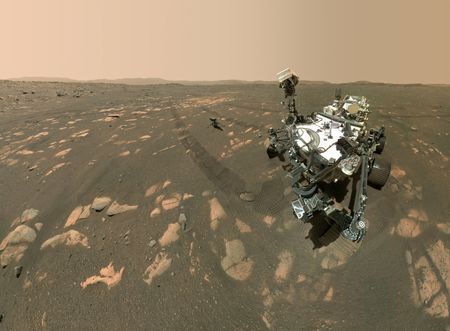

NASA’s Perseverance Rover is approaching a significant milestone as it continues its extended mission exploring the Red Planet’s surface. The robotic vehicle has covered 26.09 miles during more than five years of operation, nearly reaching the standard marathon distance of 26.22 miles.
Mission manager Robert Hogg expects the rover will surpass the marathon mark within the coming month as it continues its scientific work.
The automobile-sized explorer touched down on the Martian surface on February 18, 2021, originally scheduled for a mission lasting one Martian year, equivalent to approximately 687 Earth days.
“The rover continues in good health with at least a decade left in its power source. The duration of the mission will depend on choices NASA makes,” said Ken Farley, the rover’s deputy project scientist at Caltech, in statements shared with Reuters through NASA.
Equipped with advanced scientific equipment, Perseverance has conducted operations within and surrounding Jezero Crater, located in Mars’ northern hemisphere. Scientists believe this region was once submerged under water and contained an ancient lake system. The area features various water-related geological formations, including an ancient fan-shaped sedimentary structure where a river emptied into a lake over three billion years ago.
While Mars today appears cold and barren, the planet once maintained a denser atmosphere and warmer temperatures that supported liquid water on its surface. Researchers hope to discover whether Mars once supported life forms. Since water represents a crucial component for life, Jezero Crater’s watery history makes it an ideal location for investigation.
NASA announced Perseverance’s most significant finding last year – a sample extracted from within the crater consisting of reddish rock that formed billions of years ago from lake-bottom sediment, potentially containing indicators of ancient microscopic life. Scientists noted that minerals identified by the rover might indicate past microbial activity, though they could also result from non-biological processes.
“Further work evaluating whether these are truly evidence of Martian life requires analysis in terrestrial laboratories that contain the kinds of instrumentation necessary to make that determination,” Farley explained.
“Perseverance will continue to collect rock samples with the hope for return to Earth by a future robotic or crewed mission,” Farley added.
The rover has also collected information about organic compounds on Mars. Additional discoveries include documentation of electrical activity in the Martian atmosphere, detecting electrical charges commonly linked with spinning wind formations known as dust devils, and recording the first visible-light aurora observation on Mars, showing the sky glowing faintly in green.
During its initial years, Perseverance recorded the development cycle of the lake that occupied Jezero Crater approximately 3.7 billion years ago. The lake began as a shallow body of water, leaving salt-heavy sediments on the crater bottom, then expanded to a depth of at least 30 feet, with sandy materials flowing into the lake to create a delta formation, according to Farley.
The rover currently operates just beyond Jezero Crater’s boundaries, studying extremely old rock formations likely dating back more than four billion years. Since Mars and Earth both formed roughly 4.5 billion years ago, these rocks represent samples from the planet’s early period.
“Importantly this time period, and this surface environment, are very likely similar to those on Earth when life originated. Because rocks of this era were completely destroyed on Earth, Mars offers a key analog environment in which to investigate pre-biotic chemistry and possibly the origin of life,” Farley stated.
NASA operates a second rover on Mars called Curiosity, which arrived in 2012 at Gale Crater near the Martian equator and has traveled 22.93 miles. The rover with the greatest distance record on Mars was NASA’s Opportunity, which covered 28.06 miles during its mission from 2004 to 2019.
Perseverance carried a compact helicopter named Ingenuity that achieved the first powered and controlled aircraft flight on another world, successfully operating in Mars’ extremely thin atmosphere 72 times, traveling 10.5 miles and reaching heights of approximately 79 feet.
The varied environments both inside and outside Jezero Crater have provided valuable insights into Mars’ history.
“The fact that Perseverance could explore both a lake-river system and the early Martian crust, separated in time by perhaps half a billion years, means the Jezero site keeps on giving scientifically even after five years on the surface,” Farley concluded.