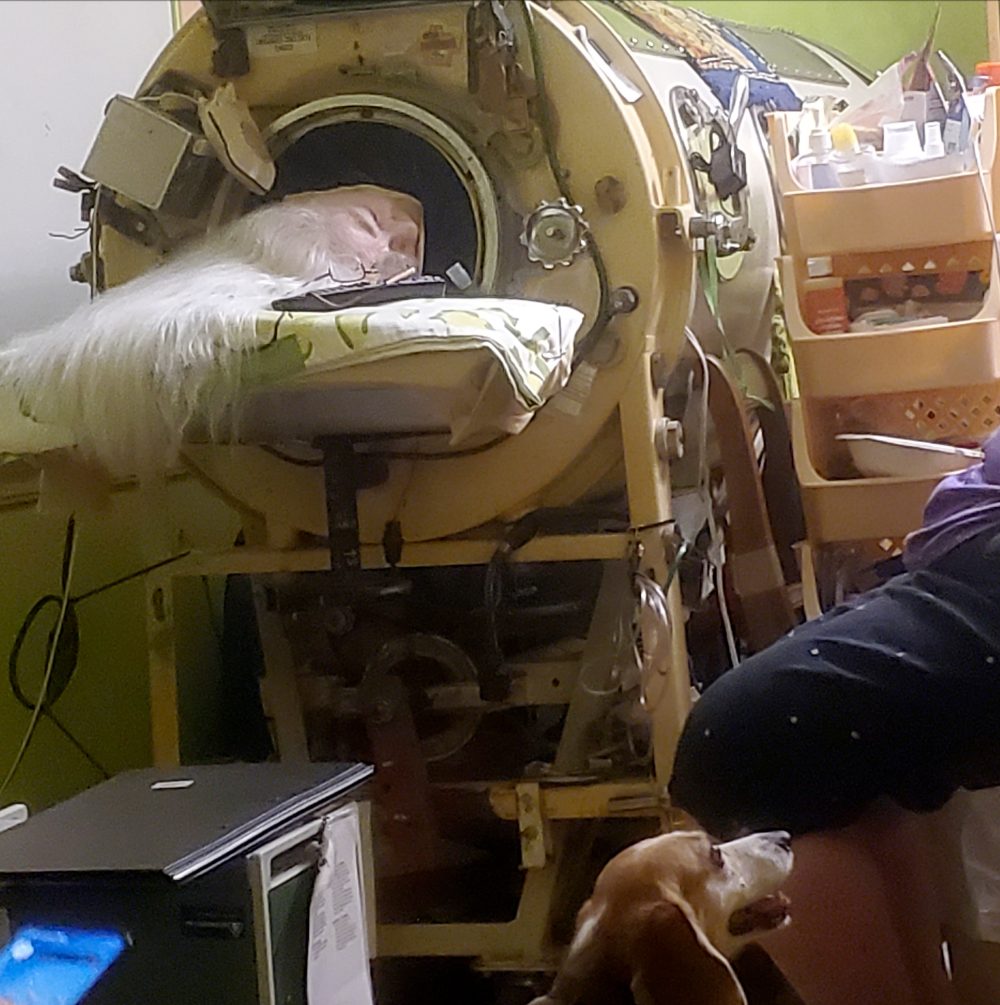

Martha Lillard was just five years old when polio changed the course of her life forever. Diagnosed with the disease as a young child, she spent decades relying on an iron lung to keep her breathing. She passed away on June 26 in Oklahoma at the age of 78 — the last known polio patient in the country who depended on that machine to survive, according to her younger sister.
“They told her she wasn’t supposed to live past 20 years old,” said her sister, Cindy McVey, speaking to The Associated Press. “She had the enthusiasm and the drive to continue living and make the best of her life.”
McVey, 75, said she doesn’t know the official cause of death but believes the effects of long-haul COVID-19 played a significant role.
The iron lung worked by encasing Lillard’s body inside a large cylinder, using changes in air pressure to force her lungs to inhale and exhale. Despite this extraordinary challenge, Lillard found ways to engage with the world around her. As a child, she attended grade school for two hours each day and received tutoring the rest of the time. At Shawnee High School, she participated in class through a phone intercom system that connected her to teachers and fellow students.
Family road trips to Missouri were made possible through a specially built trailer and her father’s persistent calls to hotels, checking whether doorways were wide enough for the iron lung. For a period of time, Lillard was even able to drive.
“To me, it was just normal,” McVey recalled.
Polio was once among the most dreaded diseases in America, capable of causing widespread paralysis, particularly in children. The introduction of vaccines beginning in 1955 transformed the situation dramatically. The federal Centers for Disease Control and Prevention reports that a national vaccination effort reduced annual U.S. cases to under 100 by the 1960s and fewer than 10 by the 1970s. By 1979, polio was declared eliminated in the United States.
As technology evolved, so did Lillard’s connection to the outside world. The internet gave her access to information on a wide range of subjects, including her own condition, which had paralyzed her right arm and left her only able to move her left arm side-to-side at her waist. Despite these limitations, she lived independently for many years and prepared her own meals.
The internet also led her to love. After the September 11, 2001, terrorist attacks, Lillard sought to better understand what had happened and entered an online chat room, where she connected with a man living in Egypt. The two communicated online for more than 20 years. In February, Lillard married Baha Salh after he was finally granted a visa to travel to Oklahoma.
“They were really soulmates,” McVey said. “He’s extremely brokenhearted.”
During the COVID-19 pandemic, Lillard contracted the virus twice. Even before that, her lung capacity had already fallen below 25 percent. In her final five years, she was unable to leave her home as breathing became increasingly difficult. For the last two years of her life, she spent nearly every hour of the day inside the iron lung, McVey said.
McVey described her sister as a deeply creative person who wrote poetry and composed songs. Lillard even wrote her own obituary, which has been posted online by a funeral home. In it, she described volunteering with the Humane Society and her love of animals. “She was an avid Beagle lover and assisted in animal rescue as a cross poster on Facebook,” Lillard wrote. She later added a note to her obituary stating she “died of long-haul Covid 19,” with McVey adding the date of her passing.
In recent years, the sisters had struggled to find someone who could repair the aging iron lung — one of several Lillard had used over her lifetime.
“But since she’s the last one, we don’t need that anymore,” McVey said through tears.