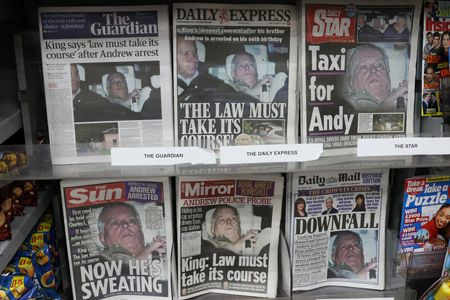

Prince Andrew, the younger sibling of King Charles, was taken into police custody this week amid accusations that he provided sensitive British government materials to the late Jeffrey Epstein, the disgraced American financier.
Investigators from Thames Valley Police spent an entire day Thursday interviewing the 66-year-old Andrew Mountbatten-Windsor about claims he transmitted classified documents to Epstein, who was later convicted as a sex offender, during his tenure as a trade representative.
Documents from U.S. files connected to Epstein indicate that Mountbatten-Windsor may have shared reports in 2010 regarding business prospects in locations he had toured while serving as the Special Representative for Trade and Investment.
The former prince, who celebrated his 66th birthday on Thursday, has consistently maintained his innocence regarding any connections to Epstein. Authorities released him from detention Thursday evening as their investigation moves forward.
The potential criminal charge Andrew faces is misconduct in public office, a serious offense rooted in centuries of judicial precedent rather than written statutes. This crime can result in a life sentence upon conviction.
Law enforcement officials have noted that this type of case involves “particular complexities” requiring thorough evaluation, though they declined to provide additional specifics.
Britain’s chief prosecutor Stephen Parkinson stated earlier this month that regulations surrounding misconduct in public office are “quite clear.”
However, legal experts note this charge has typically been applied to lower-level officials such as police officers and correctional staff. Research from the anti-corruption organization Spotlight on Corruption suggests prosecutors may find it challenging to pursue such complex cases against high-ranking individuals.
One notable example involved a former police officer who received a 10-month prison term in 2013 for providing information to The Sun newspaper and attempting to sell another story involving celebrity children to the now-closed News of the World.
The Law Commission proposed in 2020 to replace the current misconduct statute, and legislation to implement this change is currently under parliamentary review, though it would not apply retroactively.
Tom Frost, who teaches law at Loughborough University, explained that misconduct in public office “remains a difficult offence to prove in relation to senior executives or senior political figures.”
Prosecutors must first demonstrate that the accused held a public position and was “acting as, not simply whilst, a public official” when the alleged misconduct occurred.
Since Mountbatten-Windsor’s trade envoy position was voluntary without salary compensation – though he did receive travel expenses and lodging – establishing his status as a public official may prove more complex. However, Crown Prosecution Service guidelines indicate that payment is “not determinative” in such cases.
Additionally, prosecutors must prove the defendant intentionally engaged in misconduct “to such a degree as to amount to an abuse of the public’s trust.”
The Court of Appeal established in 2003 that this standard is demanding, requiring conduct that was “not merely negligent but … an affront to the standing of the public office held.”
The charge also requires proving the conduct lacked reasonable justification or excuse.
Given the intricate nature of misconduct in public office cases, investigators and prosecutors will likely need several weeks or months before deciding whether to file formal charges.
Mountbatten-Windsor, who has maintained his innocence regarding Epstein connections but has remained silent since additional documents became public, may face additional questioning sessions.
Should charges be filed, the former prince would initially appear before a magistrates’ court.
Cases involving misconduct in public office must be heard by a judge and jury, meaning Andrew’s trial would move to Crown Court, which handles the most severe criminal matters. His case would most likely be heard at the renowned Old Bailey courthouse in central London.
While Britain’s criminal court system currently faces significant scheduling delays, with some trials scheduled as late as 2030, a case involving the monarch’s brother would likely receive priority scheduling.