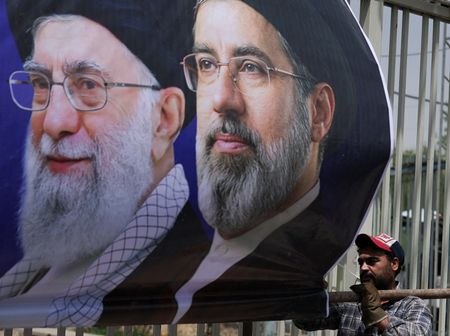

Since being named Iran’s supreme leader just one week after a strike killed his father at the end of February, Mojtaba Khamenei has been nowhere to be seen — and that disappearing act is becoming a serious problem for the Islamic Republic.
He was entirely absent from the main funeral ceremonies for his father, the late Ayatollah Ali Khamenei, offering not even a written statement. That silence has left Iranians guessing about who is truly steering the country during one of the most turbulent stretches in the Islamic Republic’s 47-year existence.
According to senior sources, Mojtaba Khamenei suffered facial injuries and other physical harm in the strike that killed his father. Those sources say he has continued to make decisions behind the scenes but has not yet recovered enough to appear before the public. He was elevated to the position with the support of the powerful Revolutionary Guards.
His invisibility has taken on greater urgency this week as hostilities with the United States flared up again, putting his leadership — and his physical condition — under an intense spotlight.
“I understand that, from a security standpoint, he should not appear in public. But the country is going through a very difficult time,” said Taghi, a 47-year-old shop owner in Isfahan who declined to share his last name. “There is a need for the Supreme Leader to be seen. Even if he has been injured, people need to see that there is a leader and that he is running the country.”
At Thursday’s burial, the late Khamenei’s three other sons led prayers over his coffin at Iran’s most sacred shrine — a carefully arranged scene that highlighted how family connections remain central to the Islamic Republic’s power structure. Those three brothers are not considered major political forces in Iran, though they have all risen to become senior clerics.
On Friday, Ali Khomeini — a grandson of the founder of Iran’s 1979 revolution — is set to speak on Mojtaba’s behalf at a mourning ceremony, a gesture that reflects how the clerical system uses family ties to project continuity.
Many had hoped Mojtaba Khamenei might finally surface — either in person, through a recorded message, or even in new photographs — when his father was laid to rest beneath the gold-domed shrine. That did not happen.
Senior Iranian sources have pointed to health and security concerns to explain why no new image or audio recording of the new leader has emerged since his March 8 appointment by a clerical assembly. Given that his father was killed in the opening strikes of an unannounced war launched by the U.S. and Israel, the security risks are considered very real.
As the holder of ultimate authority in Iran — political, military, religious, and revolutionary — he may also need to project a level of strength and capability that his ongoing recovery does not yet permit.
The most recent official update on his health came from President Masoud Pezeshkian, who stated in May that he had met with the leader and that his condition was improving.
While the Revolutionary Guards appear to be maintaining firm control of the country for now, questions are mounting about how long a theocratic state can function without its figurehead making any public appearances.
“How do you have a charismatic succession when the successor isn’t there? It’s going to be a problem for them even if they ride it out for the time being. It’s not sustainable in the long run,” said Ali Ansari, a professor of modern history at St Andrews University in Scotland.
The concern is spreading among ordinary Iranians. Reuters spoke with more than 20 people over recent weeks who expressed worry about the leader’s absence while discussing Iranian politics.
“The supreme leader’s absence, now that the war is over, will lead to growing uncertainty and disorder in the country, especially after the burial of the late leader,” said Mohammadreza, a 51-year-old teacher in Tehran.
The position of supreme leader carries a weight unlike nearly any other head of state. Iran’s official governing ideology holds that the officeholder serves as the earthly representative of Shi’ite Islam’s 12th imam, who vanished in the ninth century.
What Mojtaba Khamenei intends to do with that role remains an open question. Iran’s first supreme leader, Ayatollah Ruhollah Khomeini, was the charismatic architect of the 1979 revolution and the country’s most revered religious scholar — a figure whose commanding presence inspired absolute loyalty. His successor, Ali Khamenei, was a former president who was not initially regarded as a top religious authority. Yet over 37 years in power, he outmaneuvered rivals and, with the Revolutionary Guards at his side, extended his authority into nearly every corner of Iranian political life.
Mojtaba Khamenei similarly lacks strong religious credentials and, unlike his father, never built his own independent political standing. He spent his career managing his father’s vast office and its nationwide network of contacts while cultivating deep ties with the Revolutionary Guards.
His true views, capabilities, and leadership style remain largely unknown. What seems clear is that the Guards will continue to play a central role in how he governs — whenever he does govern visibly.
Iran continues to grapple with an ongoing conflict despite an intermittent ceasefire, an economy strangled by sanctions, and the threat of further mass unrest following the violent crackdown on protests in January. Through all of it, the man who holds the country’s highest office remains an enigma.