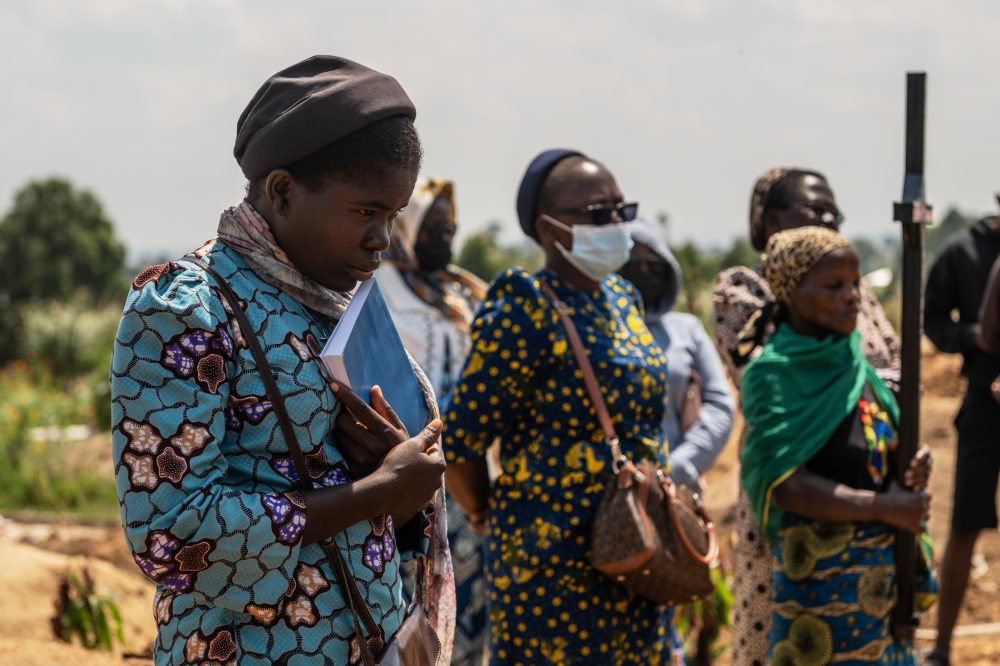

In Bunia, Congo, mourners came together Friday to say goodbye to a 6-month-old girl who lost her life to Ebola earlier this week — the third child from an orphanage in eastern Congo to die as authorities work to bring the latest outbreak under control.
Attendees kept their distance and carried a cross as masked and gloved health workers lowered the small coffin into the ground. A Catholic priest offered prayers over the infant’s body.
“It’s a feeling of sadness because we have lost one of our own, a daughter of the church,” said Father Innocent Ndogo. “As we have always said, the Lord gives, and the Lord takes away.”
The Ituri region has been the epicenter of the current outbreak, accounting for more than 90% of all reported cases. Efforts to control the spread have been hampered by tensions between residents and healthcare workers, with conflicts arising over burial practices and what has at times become a militarized response.
Friday’s burial made clear just how impersonal safe burial procedures can feel — only health workers in full protective equipment were permitted to touch the coffin or participate in the burial process.
The strain behind this outbreak, known as Bundibugyo, currently has no approved treatment or vaccine. Even healthcare workers on the front lines have reported shortages of basic protective equipment such as masks and gloves.
Africa’s Centres for Disease Control and Prevention reported Thursday that the outbreak has now reached 894 confirmed cases and has claimed more than 200 lives. That makes it three times more severe than a previous outbreak in Uganda in 2000. Officials estimate up to 35,000 people may have had potential contact with infected individuals. Still, the outbreak remains far smaller than the 2014 epidemic that killed more than 11,000 people.
Because the Bundibugyo strain was not screened for early in the outbreak — unlike the more common Zaire virus, which has an approved vaccine and was responsible for most of Congo’s previous 16 Ebola outbreaks — the disease was able to spread further before being identified.
Alex Lock, a Communications Officer at the International Federation of Red Cross and Red Crescent Societies, urged the public not to become numb to the tragedy.
“She was a baby. She had her whole life ahead of her. Unfortunately, she was taken by the disease, a disease that, as you know, is transmitted from one person to another,” Lock said.
While Ituri remains the primary hotspot, cases have also been confirmed in the North Kivu and South Kivu provinces. The outbreak has additionally crossed into Uganda, where 19 confirmed cases have been recorded and two people have died.