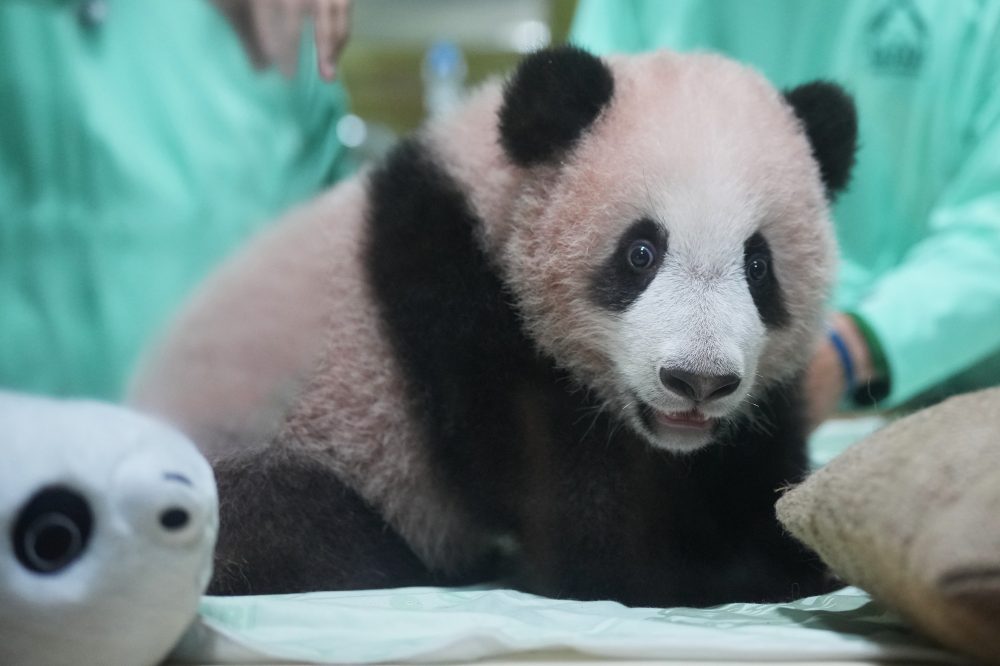

CISARUA, Indonesia — Indonesia’s inaugural giant panda birth has reached a major milestone as the healthy cub underwent medical evaluations Friday in preparation for meeting the public later this month.
The baby panda, officially named Satrio Wiratama but called “Rio,” demonstrated his developing abilities during the veterinary examination. At 169 days old, the cub has reached 10 kilograms (22 pounds), moves around independently, scales his mother’s body, and has begun consuming bamboo shoots.
Medical staff are closely observing Rio’s progress to evaluate his readiness for public interaction when he makes his anticipated appearance at Indonesian Safari Park, located outside Jakarta.
“What’s important to note is that all of Rio’s senses are active; he has the ability to understand the environment, assess the situation, adapt to more people, and hear sounds, even in certain levels of noise. We will train him gradually,” said Bongot Huaso Mulia, a veterinarian who monitors Rio’s progress.
According to Mulia, the young panda’s development exceeds typical timelines in certain areas, particularly regarding his dental growth.
Rio entered the world on Nov. 27, born to mother Hu Chun and father Cai Tao, both 15 years old. The adult pair came to Indonesia in 2017 as part of a decade-long conservation agreement with China. Their home is a specially constructed habitat at the park, situated approximately 70 kilometers (43 miles) from the capital in Cisarua, West Java province.
The parent pandas have captured significant public attention throughout Indonesia. Rio’s arrival has excited panda fans nationwide, with social media buzzing with requests to see the youngster soon.
The panda family resides in an elaborate three-story structure called the Panda Palace, positioned on elevated terrain encompassing roughly 5,000 square meters of land (1.2 acres). The facility features elevator access, rest quarters, medical equipment, and both interior and exterior recreational spaces.
Rio’s name represents the shared dedication between Indonesia and China toward safeguarding threatened wildlife species.
Giant pandas serve as China’s unofficial national symbol, and Beijing’s practice of lending these animals to international zoos has traditionally functioned as diplomatic “panda diplomacy.”
Reproduction challenges make giant panda births especially significant. Fewer than 1,900 giant pandas exist in their natural Chinese habitats across Sichuan, Shaanxi and Gansu provinces.
Rio’s birth resulted from artificial insemination procedures. Beyond adding another individual to the population, Rio contributes valuable genetic information for panda research efforts in both Indonesia and China, explained Aswin Sumampau, president director of the park.
“This is the moment we’ve all been waiting for, a small victory for us, as we’ve managed to breed a species that is extremely difficult to breed. Just imagine, for the past two years, no pandas were born at any ex-situ conservation facility worldwide. Taman Safari has managed to do that,” Sumampau said.