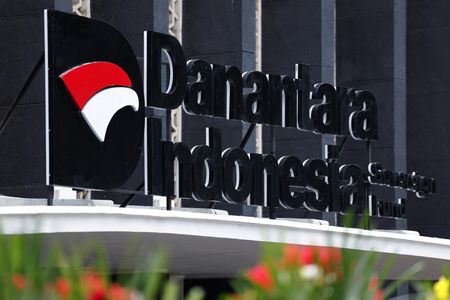

JAKARTA — Indonesia’s sovereign wealth fund Danantara is quickly becoming the centerpiece of President Prabowo Subianto’s nationalist economic agenda, but questions are mounting about whether the organization can actually deliver on its expanding list of responsibilities.
Last month, Prabowo stunned global markets with an announcement that Indonesia would begin centralizing exports of key commodities — starting with coal, palm oil, and ferroalloys. In a passionate address to parliament, he framed the move as essential government intervention to end what he described as decades of exploitation of the nation’s vast natural resources.
Rather than assigning this task to existing government agencies, Prabowo created a new unit within Danantara called Danantara Sumberdaya Indonesia, or DSI. The fund reports directly to the president, and the move signaled its growing importance in the country’s economic decision-making.
Yose Rizal Damuri, executive director and economist at the Center for Strategic and International Studies, offered a pointed critique of the arrangement. “It’s increasingly clear that all its functions are decided based on politics, whether for political purposes or to meet political promises,” he said. “Instead of improving state institutions, he created a new body and is giving it new roles.”
Within days of that announcement, another presidential decree established a development investment arm inside Danantara with access to state budget funding. Three people with knowledge of the internal discussions — who declined to be identified because they were not authorized to speak publicly — said this arm is expected to focus on projects considered nationally important, even if they generate limited commercial returns. One of those sources indicated it could play a role in a revived national car initiative, another of Prabowo’s policy pledges.
Danantara and the presidential palace did not respond to requests for comment.
The fund was launched in early 2025 with a mandate to oversee roughly $900 billion in state assets spread across 1,000 companies, using dividends to generate investment returns. It was originally billed as Indonesia’s answer to Singapore’s state investment company Temasek — commercially driven and free from political influence.
That original vision now appears to be evolving significantly. Economists writing in the Bulletin of Indonesian Economic Studies described Danantara as “at once a sovereign wealth fund, a development bank and a public service provider.” The fund has already been pulled into tariff negotiations with Washington and efforts to stabilize a domestic stock market downturn.
Its project portfolio is strikingly diverse, spanning investments in chicken farms, support for the president’s struggling free school meals program, and hotel development in Mecca for Indonesian pilgrims.
Sandra Sahelangi, a senior adviser at corporate consultancy Flint Global, said a fund with such a broad mandate could still maintain credibility — but only if it produces results and remains shielded from day-to-day political pressures. “The breadth by itself is not unprecedented, but it does sit on the outer edge of what international investors are accustomed to underwriting in a single entity,” she said, adding that investors would expect a clear boundary between commercial investments and policy-driven tasks.
Transparency remains a significant concern. Danantara has not yet released a financial report ahead of an end-of-June deadline, with fund officials citing the time needed to consolidate data across all its units. Tabita Diela, a researcher at the Center of Economic and Law Studies, said the absence of publicly available information makes it nearly impossible to evaluate the fund’s operational capabilities. Her organization and other think tanks have joined forces to create a monitoring platform for Danantara’s projects and funding in light of limited disclosure.
The gap between the fund’s growing responsibilities and its actual capacity was on clear display with the DSI commodity export announcement. Regulations issued after the president’s speech require DSI to handle commodity exports beginning next year — a task analysts say would demand major investments and new infrastructure. Yet at the time of the announcement, the unit had just one employee: its chief executive. A Danantara official confirmed on May 31 that DSI had begun recruiting staff with commodities expertise.
In meetings with industry associations, DSI has since walked back its initially ambitious role, citing significant capital requirements and business risks, according to meeting minutes reviewed by Reuters. Whether those assurances will lead to revised regulations remains unclear.
On the financing front, a Danantara unit raised $1.5 billion in its first U.S. dollar bond offering last week. The fund described the oversubscribed sale as evidence of strong investor confidence. However, a banking source familiar with the transaction offered a more tempered explanation — investors were drawn by the bonds’ higher returns compared to Indonesian government debt while carrying similar state-backed exposure, not necessarily as an endorsement of Danantara’s operational track record.
Prabowo, speaking at the World Economic Forum in January, insisted Danantara was built with strong oversight and meets the best international governance standards. At the fund’s first anniversary event on March 11, he warned officials he would not tolerate falsified data, overly optimistic updates, or manipulated reports.