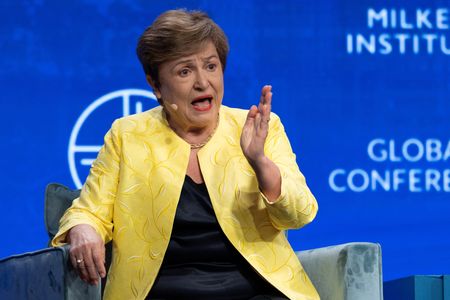

WASHINGTON — The head of the International Monetary Fund says the global economy is holding its own against the pressures created by the war in the Middle East, even as commodity prices have surged, inflation has climbed, and financial conditions have tightened. IMF Managing Director Kristalina Georgieva made the comments Monday, noting there are no signs yet of a worldwide economic slowdown.
Georgieva, who leads the international lending organization, expressed support for Sunday’s agreement between the United States and Iran to end hostilities and reopen the Strait of Hormuz. However, she cautioned in a newly published blog post that any further escalation in the conflict or disruptions to supply chains would pose a “clear risk to global growth.”
The IMF is scheduled to release a revised economic outlook on July 8. Back in April, the fund had laid out three possible scenarios for global economic output in 2026 and 2027. Its middle-ground “adverse scenario” projected growth slowing to 2.5% in 2026, with headline inflation reaching 5.4%.
Last month, Georgieva indicated that the adverse scenario was already unfolding. Her latest remarks, however, suggest the fund may now lean toward its more optimistic baseline projection — one that assumed the Iran conflict would be short-lived and forecast global growth of 3.1% in 2026.
The ceasefire framework represents the most significant step yet toward ending a war that began in February with joint U.S.-Israeli strikes on Iran. The conflict has since expanded into a broader regional confrontation, claiming thousands of lives, rattling global energy markets, and fueling fears of a worldwide recession.
“More than three months into the war in the Middle East, the global economy appears to be holding up. Commodity prices, inflation and expectations for it, and financial conditions have all been impacted — but not yet in ways that signal a global slowdown,” Georgieva wrote in her blog post.