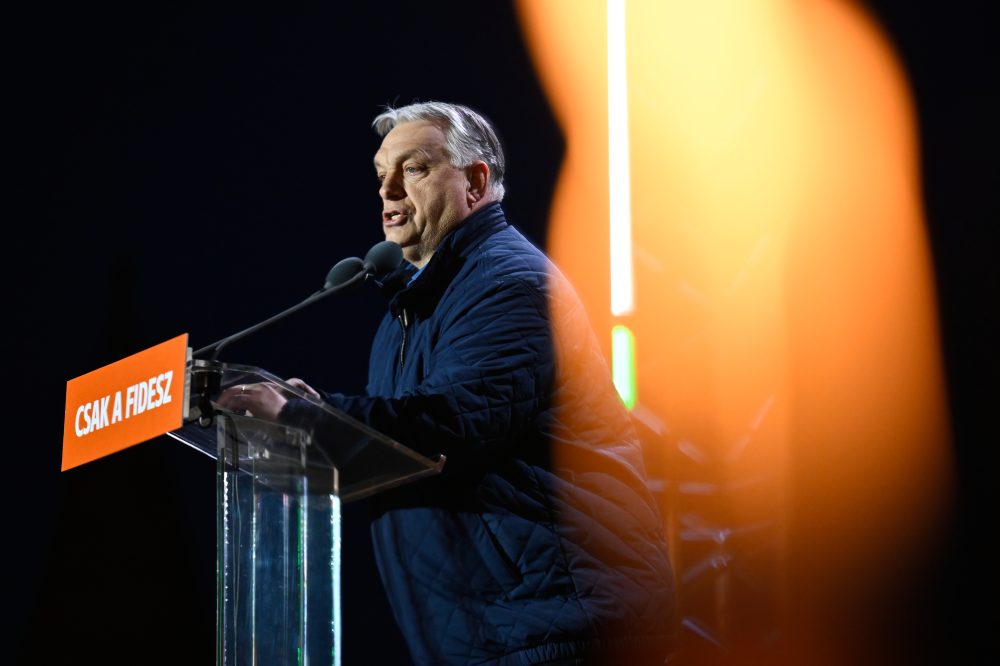

BUDAPEST, Hungary (AP) — Hungarian citizens headed to voting stations Sunday in what many consider Europe’s most significant electoral contest of the year, with the potential to remove populist Prime Minister Viktor Orbán from office after a decade and a half in power.
This represents a pivotal moment for Orbán, who holds the distinction of being the European Union’s most tenured current leader and one of its most vocal critics. His political journey has taken him from his early role as a liberal activist opposing Soviet influence to his current position as a Russia-aligned nationalist who has gained admiration from far-right movements globally.
Voting stations opened their doors at 6 a.m. local time and remained operational until 7 p.m. Both Orbán and his primary opponent, Péter Magyar, planned to submit their ballots during the morning hours.
International observers from across Europe and beyond monitored the electoral process closely, reflecting Orbán’s significant influence within global far-right populist movements.
Supporters within Trump’s “Make America Great Again” coalition view Orbán’s administration and his Fidesz party as exemplary models of conservative, anti-globalist governance in practice. Conversely, proponents of liberal democratic values and legal accountability view him with deep disapproval.
Throughout his 16-year tenure as prime minister, Orbán has implemented severe restrictions on minority protections and press freedoms, undermined numerous Hungarian institutions, and faced accusations of directing substantial funds toward his business allies’ accounts—claims he has rejected.
His leadership has also significantly damaged Hungary’s ties with the EU, as he appears to enjoy wielding his veto authority to obstruct crucial decisions within the 27-nation alliance. His recent blocking of a 90-billion euro ($104 billion) EU loan package for Ukraine led his European counterparts to accuse him of sabotaging essential assistance.
However, following four straight electoral victories that secured parliamentary supermajorities for his party, indicators suggest Orbán’s complete dominance over Hungarian politics may be approaching its conclusion.
Magyar has quickly emerged as Orbán’s most formidable political opponent. The 45-year-old head of the center-right Tisza party, which currently leads in independent polling, focused his campaign on concerns affecting everyday citizens, including Hungary’s struggling healthcare and transportation systems, along with what he characterizes as widespread governmental corruption.
As a former Fidesz insider, Magyar severed ties with the party in 2024 and promptly established Tisza. Following this split, he conducted an intensive nationwide tour, organizing rallies in communities of all sizes through a campaign effort that recently involved visiting as many as six municipalities per day.
During a conversation with The Associated Press this month, Magyar described the election as a “referendum” on whether Hungary will continue its alignment toward Russia under Orbán’s leadership or reclaim its position among Europe’s democratic nations.
Magyar and Tisza confront significant obstacles in their campaign. Orbán’s dominance over Hungary’s state media, which he has converted into a promotional platform for his party, combined with his control over large portions of private media outlets, provides him with substantial advantages in message distribution.
Fidesz’s unilateral modifications to Hungary’s voting system and redistricting of its 106 electoral areas will require Tisza to secure approximately 5% more votes than Orbán’s party to achieve a basic majority.
Furthermore, hundreds of thousands of ethnic Hungarians residing in adjacent nations possess voting rights in Hungarian elections and have historically supported Orbán’s party by overwhelming margins.
Pre-election discussions have also raised concerns about foreign interference and domestic electoral misconduct potentially compromising the results. Both Fidesz and Tisza have established systems for documenting voting irregularities while accusing their rivals of planning electoral violations.
Multiple media outlets, including The Washington Post, have reported that Russian intelligence agencies have developed plans to interfere in the election to benefit Orbán. The prime minister has countered by accusing neighboring Ukraine and Hungary’s EU partners of attempting to meddle in the vote to establish a “pro-Ukraine” administration.
These allegations contribute to why many EU officials who view Orbán as a threat to the bloc’s future are hoping for his defeat and expect a new Hungarian government under Magyar would prove more cooperative.
Meanwhile, across the Atlantic, Trump and his MAGA supporters strongly back another Orbán term. Trump has repeatedly expressed support for the Hungarian leader, and U.S. Vice President JD Vance conducted a two-day Hungarian visit last week designed to boost Orbán’s electoral prospects.