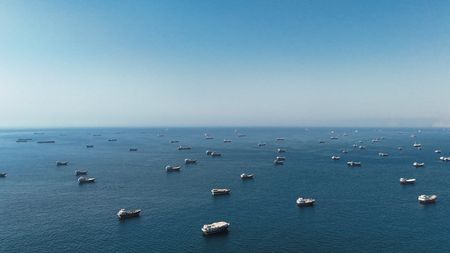

Maritime industry executives are warning that even if the U.S. and Iran reach an agreement to end hostilities and reopen the Strait of Hormuz, vessels currently trapped in the Gulf cannot safely depart without concrete safety guarantees.
The ongoing three-month conflict has left hundreds of ships and approximately 20,000 seafarers stranded in the region, with the Strait of Hormuz remaining mostly inaccessible. Recent fighting has put additional pressure on an already fragile ceasefire agreement.
Rene Kofod-Olsen, group CEO of V.Group, a major international ship management company overseeing roughly 800 vessels, revealed that his company has 13 ships currently stuck in the Gulf, with half being tankers. Speaking at the Posidonia shipping conference in Athens, he described the challenging situation facing the industry.
“You are in a situation where you supposedly have a ceasefire,” Kofod-Olsen explained during the maritime event. “But you still have kinetic activity,” he added, referencing ongoing drone and missile attacks.
According to Kofod-Olsen, restoring shipping traffic to normal levels—which previously saw an average of 125 vessels transiting through Hormuz each day—will require firm guarantees of safe passage backed by international involvement.
“I don’t believe that global shipping by definition will go through in a material way the Strait of Hormuz before those things are actually guaranteed,” Kofod-Olsen stated.
Industry leaders attending the Athens conference reported that while supply deliveries to crews in the Gulf continue and crew rotations within the region remain possible, the ongoing conflict is creating mounting challenges.
Alex Gregg-Smith, president for marine and offshore operations at Bureau Veritas, a leading ship safety certification company, explained the broader impact on the industry. “Ship owners are having to operate in irregular frameworks, which can be difficult or challenging for the industry, difficult and challenging for insurers as well,” Gregg-Smith told reporters.
“It’s putting pressure on the owners’ operations,” he added.
Dwain Hutchinson, managing director of the Bahamas maritime registry, reported that 14 vessels flying Bahamas flags, carrying more than 900 seafarers, remain in the Gulf. This count includes smaller offshore vessels that typically operate in the area under normal circumstances.
While prioritizing crew safety and welfare, the flag registry has not imposed restrictions on ships entering the region. “We think that’s an owner’s decision and we hope that they will review the risk and take a balanced decision for operation in the region,” Hutchinson explained.
Evangelos Marinakis, founder and chairman of Capital Maritime & Trading Corp, a major global tanker operator, shared his company’s experience during the TradeWinds ship owners’ forum in Athens. His organization “were lucky enough” to avoid having any vessels in the Gulf when the conflict began on February 28.
“In case something happens, a casualty, we wouldn’t be able to take such a risk,” Marinakis told the forum attendees.