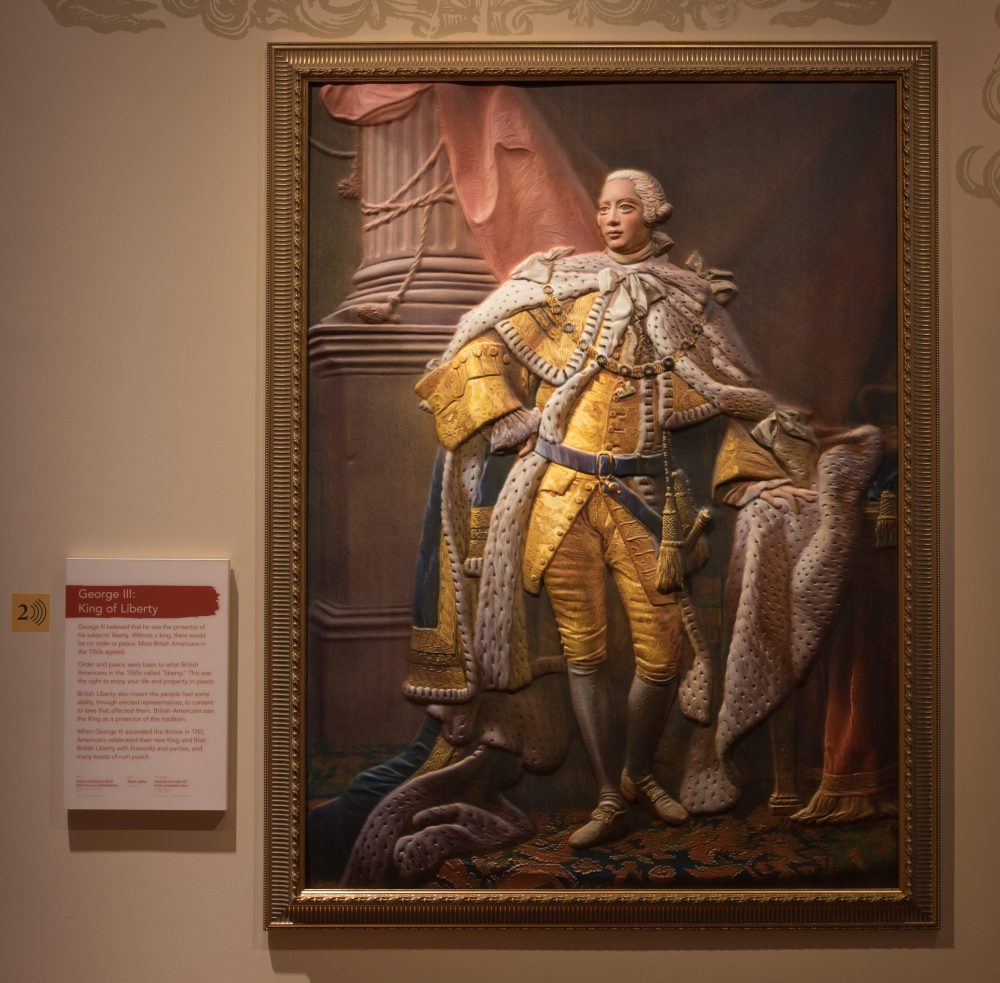

LONDON (AP) — King George III, long portrayed as the primary antagonist in America’s fight for independence, is getting a historical makeover as the nation approaches its 250th anniversary.
For generations, Americans have viewed him as the British monarch who lost the colonies. Many know him from his theatrical portrayals in popular culture, including the Broadway hit musical or the acclaimed 1990s stage production and movie “The Madness of King George.” Others recall him as the oppressive ruler featured in educational programming who imposed taxes without colonial consent.
However, the actual events leading to the Revolutionary War unfolded differently than commonly believed — a distinction that matters in today’s era of false information and disputed narratives. During George’s reign, Parliament held the authority to enact legislation and taxation, just as it does today. The 27 grievances listed against the monarch in the Declaration of Independence? British historian Andrew Roberts describes most as “wartime propaganda,” claiming all except two fall apart when examined closely.
Modern historians have reached a consensus: George showed no signs of mental illness during the Revolutionary period.
“Truth became the first casualty of the American War of Independence, as it is in most wars,” Roberts stated in his 2021 book “The Last King of America.” “The American Revolution is a testament not to George III’s tyranny, which was fictitious, but to Americans’ yearning for autonomy.”
America’s founding narrative centers on George III as the defeated antagonist, an unstable despot who mistreated colonial subjects. Academic experts started questioning this interpretation before the nation’s bicentennial, with the Prince of Wales penning a sharp counterargument in 1972.
“If the average schoolchild remembers anything about history after leaving school, he will remember that George III was mad,” wrote that prince, currently King Charles III, in an introduction to a book about his ancestor five generations removed. “If he is American as well then madness is often given as a reason for the ‘irrational’ behavior of the King toward the Colonists, making it necessary for them to declare independence.”
He concluded by expressing hope that “Americans will soon come to see the true George III without bias and traditionally held opinions.”
George ascended to the throne in 1760 following his grandfather’s death, becoming ruler at 22 of an empire spanning from England through North America to Asia. He viewed his role as more than England’s sovereign but as a paternal figure to his people — obligated to serve as their moral example. In both personal and national matters, he promoted discipline, honesty, and an Enlightenment-inspired interest in culture, literature, and science.
Like all subsequent British monarchs, George operated under constitutional constraints — wielding influence and choosing the prime minister while Cabinet officials and the House of Commons created laws and budgets. George’s responsibility was to approve Parliament’s decisions. Therefore, one could argue he simply supported what colonists perceived as Britain’s harsh and controlling measures, including the Stamp Act of 1765, the first direct colonial tax.
The future revolutionary leaders denounced this action and spread the rallying cry “No taxation without representation.” Britain maintained that Parliament members spoke for the colonies. Colonists countered that their elected colonial assemblies, which already taxed them, provided their representation. Following damaging colonial boycotts of British products, Parliament withdrew the Stamp Act in 1766 — but immediately passed another act asserting British Parliament’s authority to create colonial laws.
Over the following decade, relationships deteriorated. Parliament’s Tea Act passage in 1773 made matters worse, prompting revolutionaries to dump tea into Boston Harbor. This action dismayed George, who the following year supported Parliament’s measures to limit Massachusetts’ self-governance.
The Continental Congress convened and appealed to the king as “your majesty’s faithful subjects” for assistance. George sided with Parliament.
In April 1775, the famous “shot heard ’round the world” erupted from fighting between colonial militia and British forces at Lexington and Concord, beginning what the British commonly term the American War of Independence — known as the Revolutionary War.
Queen Elizabeth II made available the previously uncatalogued Georgian Papers, consisting of 280,000 documents from that era housed at Windsor Castle, later digitizing them online through a five-year initiative. This revealed a comprehensive reassessment of a monarch who maintained detailed records, correspondence, speeches, and notes — including timestamps — covering extensive administrative matters: agricultural production, plant studies, property management, household inventory and costs, plus careful monitoring of Parliamentary affairs.
The 2015 archive release also provided additional medical documentation, including physician instructions, treatment records, and behavioral observations during George’s illnesses. These materials raised new questions about the origins of what historians had termed “the king’s malady.”
Roberts concluded in 2021 that the long-held belief that George had porphyria, a physical metabolic condition, was incorrect. His examination of 100,000 Georgian documents combined with contemporary medical research indicated bipolar affective disorder Type 1 — characterized partly by at least one serious manic episode. George was documented to have experienced prolonged periods of mania beginning in 1788.
Examining the American Revolution in 2026 reveals little, if any, indication that George was “mad” during the war period. The upcoming semiquincentennial story presents George as a more complete individual than the despot described in the personal attacks scattered throughout the Declaration of Independence.
The Library of Congress exhibition bears the title “The Two Georges,” featuring the king and George Washington as “Parallel lives in an age of Revolution.”
The opening gallery at Philadelphia’s Museum of the American Revolution starts 15 years before the conflict, when Americans held deep respect for George III, displaying royal emblems on everything from drinking cups to fireplace backs and a royal coat of arms likely displayed in the city’s courthouse.
“We make the point that he was literally called ‘the king of liberty’ in popular culture,” explained R. Scott Stephenson, the museum’s president and CEO. “This was not a despot in anyone’s minds.”
On April 29, Elizabeth’s son, King Charles III, mentioned George III twice while speaking from the platform at America’s democratic center. He first supported the “Tale of Two Georges” concept, acknowledging that George III was his five-times great grandfather.
“King George never set foot in America,” he remarked playfully, “and, please rest assured, I am not here as part of some cunning rear-guard action.”
None of the contemporary patriots in attendance — elected Congressional members whose predecessors rejected George III’s authority — showed any disapproval or protest.
That evening, Charles referenced his lineage again at a White House state dinner celebrating America’s 250th anniversary. “As the direct descendant of King George III,” Charles declared, “I know this is a nation that never gives up.”
This applies to certain Americans and their preferred stories, Roberts suggests. When asked if his research influenced American thinking, he replied via email: “Nothing will dislodge the Americans from their desire to see GIII as an evil dictator.”