
There’s a new piece of gear showing up on boats across America, and it’s stirring up one of the biggest debates the fishing world has seen in years.
Forward-facing sonar — a high-tech system that can cost around $2,500 for a complete setup — is giving anglers the ability to see exactly where fish are swimming in real time, right on a screen mounted to their boat. And not everyone is happy about it.
“You’ve got people that are concerned about what’s going to happen to the sport of fishing,” said Gary Korsgaden, who has spent decades writing about the sport.
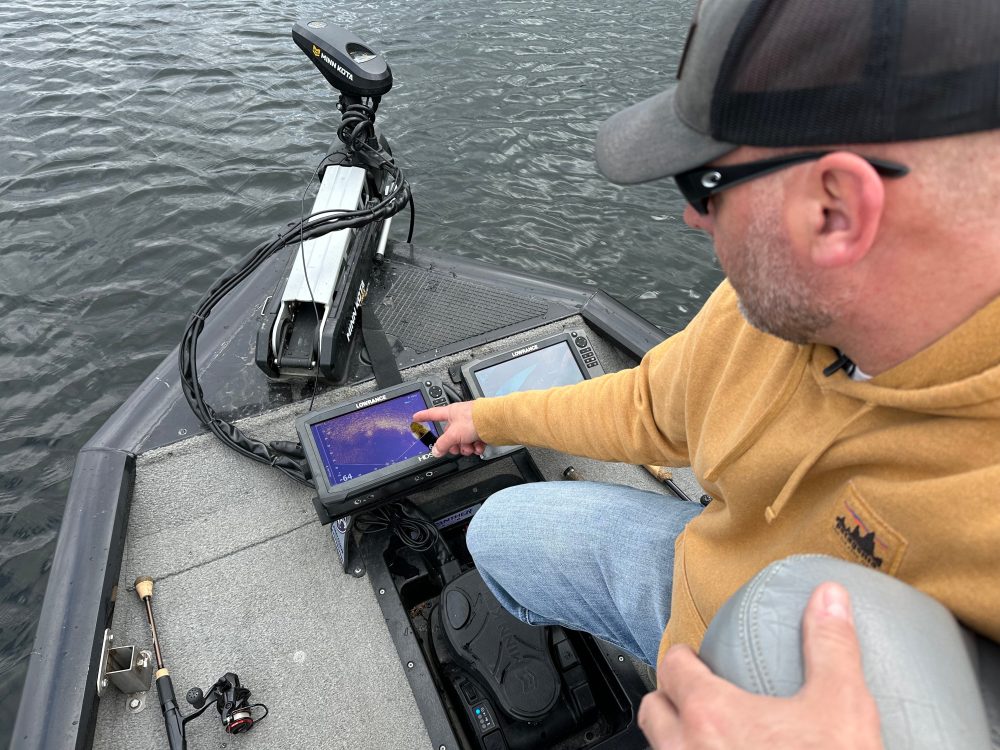
Traditional fish-finding sonar works by sending sound frequencies from the bow or rear of a boat down into the water. The time it takes those pings to bounce off the bottom and return creates a picture on a screen. The newer forward-facing version goes further — anglers can attach it to a trolling motor and scan the water in all directions to pinpoint a fish’s exact location at any moment.
“With forward-facing sonar, you can attach it to a trolling motor and you can look around the water under you and you could find exactly, pinpoint where that fish exactly is at any given time,” said Dave Dunn, a sales executive at Garmin, one of the companies that makes the technology.
Dunn added that users can even see their lures moving through the water, allowing them to cast directly toward a fish. He acknowledged the equipment does take some time to learn.
For Minnesota angler Terry Rehm, the technology has been a welcome addition. Between work and his kids’ busy schedules, Rehm said he doesn’t get much time on the water, and forward-facing sonar helps him make the most of every trip.
“It’s just nice to be able to hone in on them a little quicker and find them quicker and catch more fish when I’m out here,” Rehm said.
Fishing remains one of the most popular recreational activities in the United States, with tens of millions of people casting a line each year. But anglers fish for many different reasons — and those who value the peace and quiet of a day on the lake sometimes find it jarring to see fellow fishermen glued to their screens.
Despite the pushback, use of the technology is growing fast. Surveys in Minnesota show roughly 30% of anglers now use forward-facing sonar. On one lake surveyed last fall, that number climbed as high as 63%, according to Walleye Alliance spokesperson Nate Blasing.
The debate has spilled across social media, podcasts, online fishing forums, trade shows, and tournaments.
“It’s much like politics now. It tends to get personal. You can agree to disagree,” Blasing said.
Korsgaden said the online arguments can turn ugly quickly, noting that tournament anglers have removed him from their Facebook pages simply for bringing up the subject.
“I think the unfortunate reality is fishing has gotten to be more about, shall we say, success or numbers or quantity, that type of thing, instead of the actual enjoyment of the engagement and making decisions on your own,” Korsgaden said.
But is the technology actually wiping out fish populations? So far, the science suggests otherwise.
Researchers in Wisconsin ran a controlled experiment last year, splitting anglers into two groups — one using forward-facing sonar, one fishing without it — while targeting smallmouth bass. Midway through the summer, the groups switched methods.
Surprisingly, the group fishing without the technology actually had higher catch rates, though the sonar users tended to land slightly larger fish. Greg Sass, fisheries research team leader with the Wisconsin Department of Natural Resources’ Office of Applied Science, said sonar users spent more time searching for fish before casting, while the traditional anglers spent more time actively fishing.
Sass said he’s cautious about applying those results to all fish species and water types, but acknowledged the findings “would be counterintuitive to what I’m hearing in the bait shops or from other people that are on both sides of the fence with technology.” Additional studies are planned, including research focused on the muskie.
In Minnesota, a fisheries specialist with the state’s Department of Natural Resources said a statewide lake analysis found no “negative impacts” tied to the use of forward-facing sonar. Wildlife officers conducting surveys found that anglers using the technology caught similar numbers and varieties of fish compared to those using traditional methods.
“To some degree, it can get scapegoated a little bit, and people’s perceptions of what other people are doing is often different than what the reality is,” said Marc Bacigalupi, a regional fisheries supervisor with the Minnesota Department of Natural Resources.
Still, the department has proposed cutting the daily walleye limit from six fish down to four. Forward-facing sonar is one factor in that proposal, along with a surge in ice fishing, social media attention drawing crowds to popular spots, and lower limits in neighboring states.
For Daren Schneider, a lifelong angler from Bismarck, North Dakota, the technology has completely changed his understanding of fish behavior. He once believed walleye needed to be caught near the lake bottom — but watching them on sonar revealed they “do all kinds of things that you never thought a walleye would do.”
Schneider says the technology has deepened both his knowledge and his love of fishing.
“Fishing isn’t necessarily about catching fish and getting your limit or whatever,” he said. “It’s about being out there and making memories, and if it’s making memories with forward-facing sonar, why is that such a bad thing?”