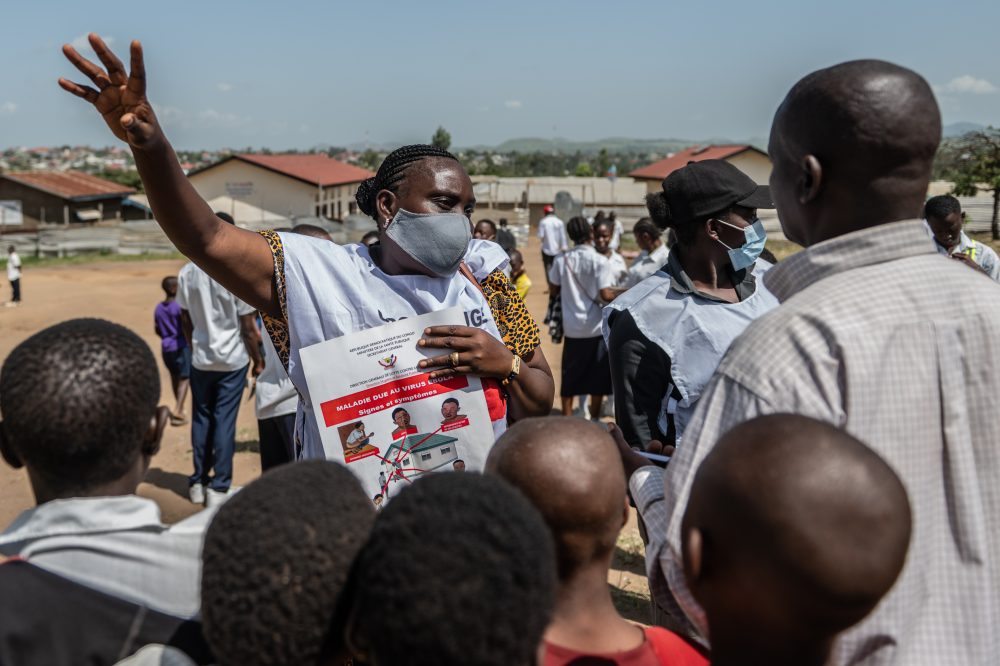

BUNIA, Congo (AP) — Healthcare workers battling a deadly Ebola outbreak in eastern Congo are confronting two serious threats: a dangerous virus strain without treatment options and violent attacks from distrustful community members.
Vanny Birungi, who volunteers with the Red Cross in the region, regularly encounters hostility while educating residents about the epidemic. She has been struck with rocks and subjected to verbal harassment in Bunia, the city at the center of the health crisis as suspected infections approach 1,000 cases.
“We continue to tell them that the disease is out there. Some accept, and others don’t,” Birungi said Monday while speaking with community groups in a working-class area under intense heat.
Medical responders face particular danger in this unstable area where local residents have endured years of violence from armed militias that have caused thousands of deaths and mass displacement in recent times.
Building confidence proves difficult among the traumatized community members who remain suspicious of strangers, including those working urgently to stop the rapidly expanding outbreak that health officials say went undetected for weeks. Disease monitoring capabilities have been weakened due to funding reductions from the U.S. and other donors.
“These people should stop bothering us. They just want to get rich. Let’s not forget that Ebola is a white man’s invention,” said Pierre Basola, a 56-year-old Bunia resident, who added: “Stop talking to me anyway.”
Medical facilities have suffered three separate attacks within the past week. On Sunday, hostile young men invaded a hospital caring for Ebola patients, compelling staff to evacuate patients while gunshots echoed nearby.
On Saturday, community members burned down a treatment tent operated by Doctors Without Borders in Mongbwalu that housed suspected and confirmed cases, causing more than a dozen potentially infected individuals to escape. On Thursday, relatives destroyed a facility in Rwampara after being prevented from collecting the remains of a man believed to have died from Ebola.
Community frustration grows as disease prevention protocols prevent families from performing traditional burial ceremonies for loved ones who die from an illness characterized by rapid onset, vomiting and bleeding.
The deadly virus transmits through direct contact with bodily fluids from infected or deceased patients, including perspiration, blood, waste or vomit. Medical professionals say healthcare workers and family caregivers face the greatest infection risk.
“Trust is almost as important as the health response, because if you get this massive distrust in the communities, they’re not going to go to the health centers,” said Heather Kerr, country director for the International Rescue Committee in Congo.
Regional warfare creates additional obstacles. Traveling from Bunia, the capital of Ituri province, to Mongbwalu requires aid organizations to navigate potential violence in an area located more than 1,000 kilometers (620 miles) from Congo’s capital, Kinshasa.
The epidemic now includes over 900 suspected cases and more than 220 suspected fatalities, according to World Health Organization director general Tedros Adhanom Ghebreyesus, who spoke Monday.
“We are now playing catch-up with a very fast-moving epidemic,” he said.
Mado Nditamba, a 70-year-old Bunia resident, reported witnessing students fleeing from aid workers.
“The last time Ebola came, it was not on the scale that we see today,” Nditamba said. “But this epidemic today is worse. We go to the doctors in the hospitals, but they also die. That’s what worries us. We don’t know what to do and we leave everything to God.”
Congo has experienced 17 Ebola outbreaks, and the WHO maintains the nation has response capabilities. However, initial testing during this outbreak focused on a more common Ebola variant, resulting in lost time. Health experts continue working to establish when this outbreak started.
Limited testing facilities exist for this Bundibugyo strain in a region where medical clinics rely on generators and a key airport serving humanitarian operations has remained under rebel control for more than a year.
Ground-level health workers have informed the AP they lack adequate preparation and protection. An undetermined number of responders have contracted the infection, with some fatalities reported.
A Congolese physician died Sunday in Rwampara, according to Rubens Dhedgia, who coordinates the regional Ebola response. In nearby Uganda, where a smaller number of cases has emerged after Congolese citizens crossed the border, at least three medical workers have been infected.
Most concerning, the International Federation of Red Cross and Red Crescent Societies reports three volunteers died in Mongbwalu after potentially handling bodies on March 27 during non-Ebola related duties.
If verified, this would substantially move back the outbreak timeline from the first confirmed death in late April in Bunia.
While at least one funeral director prepared coffins for sale along a Bunia roadway, health officials noted persistent disbelief among some regional residents who question the virus’s existence.
Action Aid, another international humanitarian organization involved in the response, documented significant skepticism and limited understanding among residents surveyed in mid-May in Ituri province shortly after the outbreak announcement.
“The only way to go, as far as this particular virus is concerned, is community engagement,” said Yakubu Mohammed Saani, country director for Action Aid in Congo.
Methods for improving community relations quickly remain unclear. Both the WHO and Africa Centers for Disease Control and Prevention suspect the outbreak exceeds currently reported case numbers.