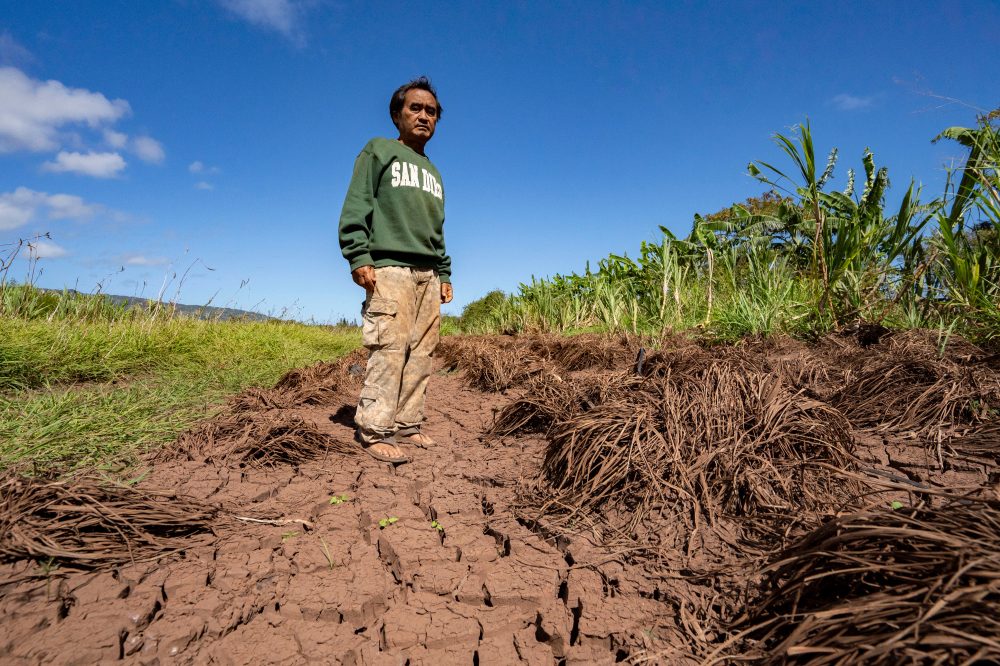

WAIALUA, Hawaii — The thick, rust-colored mud that buried Bok Kongphan’s Hawaiian farm has baked solid under the intense tropical heat. Tangled irrigation lines mark where his lemongrass, cucumber and okra plants once thrived.
His niece, Jeni Balanay, also saw her harvest destroyed — including choy sum, bitter melon, and tomato crops. The foliage on her newly planted banana, coconut and mango trees has turned yellow, signaling they likely won’t make it.
Throughout Oahu’s North Shore, known worldwide for its massive surfing waves, small agricultural operations that help feed the island are fighting to survive following consecutive March storms that caused the state’s most severe flooding in 20 years. Authorities are urging farmers to persevere, emphasizing that homegrown agriculture remains vital for this remote island chain.
“In some cases entire farms have been wiped out,” said Brian Miyamoto, executive director of the Hawaii Farm Bureau. “These are farmers who were just days or weeks away from harvesting and now they have to start over.”
Information gathered by agricultural advocates shows more than 600 of Hawaii’s 6,500 farming operations documented close to $40 million in losses, affecting crops, animals and equipment. However, Miyamoto said the farm bureau believes the true scope of devastation reaches much wider — $50 million across nearly 2,000 farms.
During most of the late 1800s and 1900s, large-scale plantation farming controlled Hawaii’s agricultural landscape, with corporations like Dole and companies established by missionary families cultivating vast sugarcane and pineapple fields for overseas markets. These enterprises attracted numerous immigrants, mainly from Asia and Portugal.
This massive single-crop system declined by the 1990s due to global competition, prompting officials to encourage smaller operations — some, like Kongphan’s, covering just a few acres — growing diverse crops for local stores and farmers markets.
Global supply chain problems during the COVID-19 pandemic highlighted the value of local food production in Hawaii, leading the state to increase farm support in recent years. This assistance includes infrastructure funding, farm-to-school initiatives and loans for those rejected by traditional banks.
Yet challenges persist. Unlike many mainland counterparts, Hawaii’s farms are often too small and varied to afford or qualify for crop insurance.
Many farmers are immigrants who were barely surviving financially before the storms hit, Miyamoto observed.
Most Hawaii farms generate under $10,000 yearly, according to the U.S. Department of Agriculture. The flooding, combined with strong winds and power failures, killed or harmed livestock while destroying equipment, vehicles and infrastructure.
Without insurance coverage, Kongphan, who immigrated from Thailand, has been seeking government assistance and determining how to level earth displaced by floodwaters. His niece has been helping him and other Thai farmers work through the application process. Available support includes federal disaster aid, one-time $1,500 emergency payments and long-term state loans, plus a charity fund that collected approximately $850,000 following the floods. Many farmers have also created online fundraising campaigns.
Speaking through Balanay’s interpretation, Kongphan described the floods as “very devastating,” but confirmed he will continue working the 5-acre plot he’s rented for five years, growing vegetables sold at farmers markets, swap meets, and shops and stands in Honolulu’s Chinatown.
Kongphan indicated a faint, thigh-high mark on a plywood wall showing the water level inside his home, constructed from a shipping container. A donated tent now sits inside, though he typically sleeps outdoors.
Swarms of flies buzzed around as he lifted a mud-covered generator he hopes to repair. A Toyota Yaris nearby was coated inside and outside with the same dried muck.
Balanay, who learned agriculture from her mother following the family’s move to Hawaii, questions whether she wants to continue farming. She remembered the rushing water reaching her waist within seconds and destroying her crops during the night.
“Will it happen again?” she asked. “When you look at the land and it’s all destroyed, you want to give up.”
This flooding represents the latest challenge for Hawaii’s agricultural community, following wildfires, pests and volcanic tephra — ash and debris from an active Big Island volcano, according to the state’s chief agriculture official, Sharon Hurd.
“These are the farms that we really need to get started again,” Hurd said. “We cannot have them give up.”
Officials have been running soil safety tests to reassure farmers while providing seeds and seedlings, she explained.
Several farmers haven’t been able to attend farmers markets, a crucial income source. Those who do attend have reduced inventory, Miyamoto noted.
Farmer Kula Uliʻi said her family now brings about one-fourth of their typical harvest. Rather than 200 pounds of tomatoes at weekend farmers markets, they might sell 60 pounds.
They lost seedlings scheduled for planting this month and expect months of reduced harvests, she explained. She’s uncertain about her farm’s grocery store contracts, given their inability to meet demand.
Even the taro, which normally grows well in water, was ruined after being covered in flood contaminants, she said.
“It’s all gone,” Uliʻi said. “We can’t use any of it.”