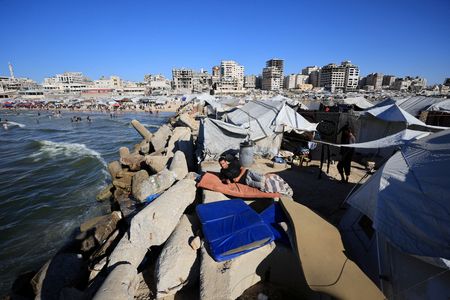

GAZA CITY — As temperatures climb across the Gaza Strip, displaced Palestinians are abandoning their stifling tents and heading to the Mediterranean shoreline to bathe and wash their clothing — even though the water is thick with sewage and waste.
Nearly the entire population of Gaza has been uprooted over two years of fighting between Israel and Hamas. Most people are now packed into a narrow coastal corridor, living in makeshift tents or damaged buildings with little access to basic necessities.
“The only outlet in the Gaza Strip, from north to south, is the sea,” said Wadie al-Ras, a 36-year-old displaced Palestinian standing along the Gaza City shoreline. “The tents we have been staying in since the war are a torment.”
Before the war erupted in October 2023, Gaza City’s sandy beach was a popular gathering place for residents. Today, it serves as the only escape from cramped, bug-infested shelters where disease runs rampant.
Morning temperatures in Gaza hover between 28 and 31 degrees Celsius, and inside the tents, conditions feel far more extreme.
But the sea provides little real relief. The water is heavily contaminated with sewage and garbage, a direct consequence of the collapse of the infrastructure that once supported a population of more than two million people.
“The seawater is not clean. There’s sewage in it, filled with dirt,” said Shehab al-Suwaireki, a 36-year-old displaced father of six.
With no reliable access to fresh water, however, families feel they have no real alternative.
“We go in and wash (clothes) and bathe then we get out,” Suwaireki added. “In any case, germs are getting to our bodies.”
Husni Muhanna, a spokesperson for the Gaza municipality, explained that Israeli bombardment has knocked out many water pumps, while sewage stations, pumping facilities, and water treatment plants have all sustained severe damage.
“Residents resort to the beach despite all the dangers,” Muhanna said.
The conflict began when Hamas-led militants launched an attack on Israel from Gaza on October 7, killing 1,200 people and taking 251 hostages. Israel responded with a sweeping military offensive that has killed at least 73,000 Palestinians, according to health officials in the Hamas-governed territory.
Despite a truce reached in October 2025, Israel has continued conducting deadly strikes in Gaza, saying the operations are aimed at preventing imminent attacks by Hamas and other armed groups. Hamas has so far rejected demands to disarm in exchange for an Israeli troop withdrawal.
Aid and basic supplies remain critically scarce throughout the territory.
Nahed Hamouda, a 56-year-old father of four who was displaced from Jabalia, north of Gaza City, described the tents as feeling “like an oven.”
“There’s no electricity, no fan, no water, even the food is inedible,” he said, fanning himself with a piece of cardboard as he spoke.