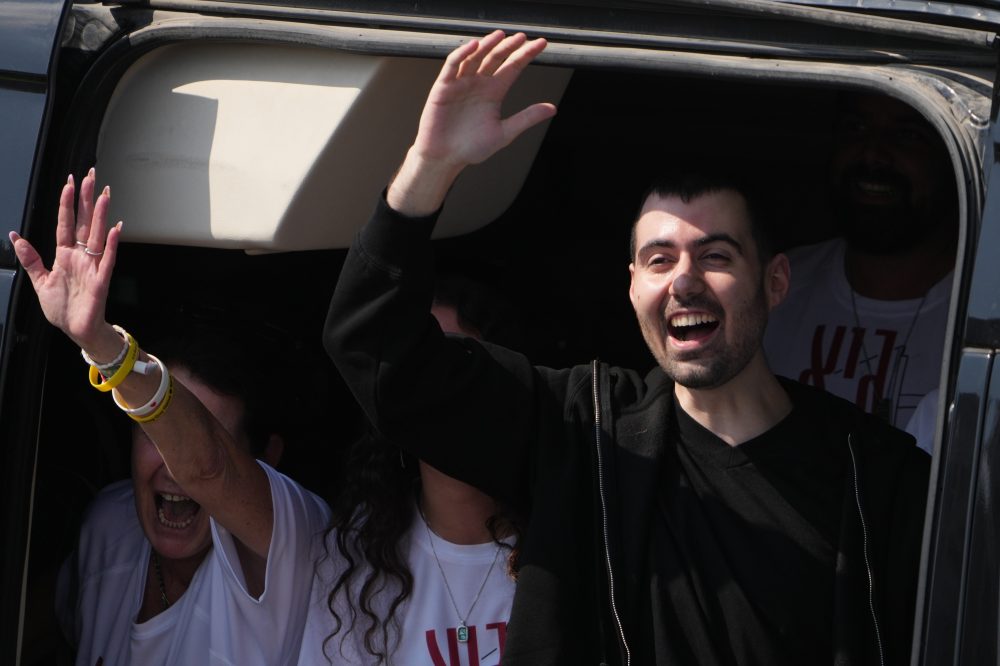

JERUSALEM — A young Israeli man who endured sexual abuse during two years of captivity in Gaza is now speaking out, hoping his story will give strength to other survivors of similar trauma — including those in active conflict zones — ahead of the International Day for the Elimination of Sexual Violence in Conflict.
Guy Gilboa-Dalal, 25, was among the approximately 250 people taken hostage when Palestinian militants carried out the Hamas-led attacks on Israel on Oct. 7, 2023. He remained in captivity for two years before being released.
During a conversation Sunday in Jerusalem with Israel’s first lady Michal Herzog, Gilboa-Dalal explained his motivation for going public. “I feel like I have a mission to spread to the world, to use my voice and empower other victims of sexual assaults,” he said. “I want people who have been through those experiences to know that they’re not alone.”
The Associated Press notes that it does not typically name individuals who report sexual assault unless they have chosen to come forward on their own.
The United Nations reports that sexual violence tied to armed conflict is increasing globally, with documented cases more than doubling in 2025. Both state and non-state actors are increasingly using it as a weapon of war, a means of torture, and a tool of political repression.
The issue has become deeply politicized in Israel and the Palestinian territories since the Oct. 7 attacks. Human rights organizations and the U.N. have investigated allegations of widespread rape during the initial Hamas assault. More recently, the U.N. said it has verified multiple incidents of conflict-related sexual violence — “including as a form of torture” — carried out by Israeli military and security forces against Palestinian men and women in Gaza and the West Bank, allegations Israel denies.
For the first time this year, the U.N. added Israel’s armed and security forces to a list of parties “credibly suspected of committing or being responsible for patterns of rape or other forms of sexual violence in situations of armed conflict.” Hamas had already appeared on that list.
In 2024, the U.N.’s special representative on sexual violence in conflict, Pramila Patten, stated she “found clear and convincing information” that some hostages were subjected to rape and “sexualized torture.” However, a more recent U.N. report said it was “not able to verify” public claims made by former hostages about abuse by their Palestinian captors, citing what it described as Israel’s refusal to allow U.N. investigators access to conduct their own inquiries.
Gilboa-Dalal addressed that finding directly during Sunday’s conversation, expressing frustration with the U.N. “They have no right to say what happened or what didn’t happen, I was there, not them,” he said.
He is among at least six released hostages who have publicly described experiencing sexual assault while held captive. Gilboa-Dalal first went public with his account in an interview with Israeli media last November, roughly a month after his release.
He described two separate incidents of abuse that occurred more than a year into his captivity. At the time, he said he was physically depleted — having spent most of his imprisonment in a cramped underground cell shared with three other hostages, where they were either starved or given spoiled food and denied the ability to move freely or bathe. He said he was naked and blindfolded during both assaults, and that his captor threatened to kill him if he ever disclosed what had happened, beating him and pressing a knife to his throat and a gun to his head.
“He could do whatever he wanted. I was so weak, and he was so strong,” Gilboa-Dalal said. He added that because the hostages were under constant watch, he did not tell his fellow captives what had happened until just before one of them was released during a temporary ceasefire in February 2025.
Today, Gilboa-Dalal says he is focused on healing and reconnecting with his family. He is also working on a book and an anime script based on his experiences.
He expressed concern that other survivors of sexual violence may be struggling in silence, burdened by self-blame. “They may think, ‘maybe it’s my fault maybe I could have done something different,’” he said. “But it wasn’t my fault and it wasn’t any of the victims’ fault.”