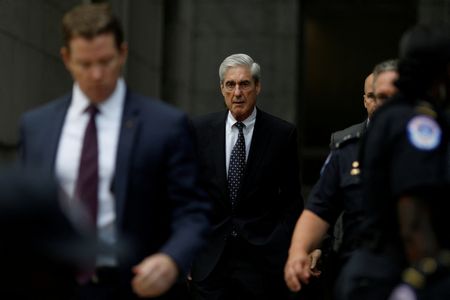

Former FBI Director Robert Mueller, the decorated law enforcement veteran who investigated Russian meddling in the 2016 presidential election, has passed away at age 81, according to reports from multiple news organizations Saturday.
News outlets including MS NOW and The New York Times confirmed Mueller’s death through a family statement, though no specific cause was provided. The Times had previously reported that Mueller was battling Parkinson’s disease.
A Vietnam War hero who received the Bronze Star and Purple Heart, Mueller stepped down as FBI director in 2013 after serving 12 years in the role. He was called back to government service four years later when Deputy Attorney General Rod Rosenstein appointed him as special counsel to investigate Russian election interference following President Trump’s dismissal of FBI Director James Comey.
Mueller’s extensive 22-month investigation resulted in charges against 34 individuals, including multiple Trump associates, Russian intelligence operatives, and three Russian organizations. The probe led to several guilty pleas and convictions, though Mueller chose not to pursue criminal charges against the sitting president, leaving many Democrats frustrated.
Former President Trump responded to news of Mueller’s death on his Truth Social platform Saturday, writing: “Good, I’m glad he’s dead. He can no longer hurt innocent people!”
Throughout his distinguished career, Mueller maintained a reserved, professional demeanor that contrasted sharply with Trump’s confrontational style. Colleagues sometimes referred to him as “Bobby Three Sticks” due to his full name, Robert Mueller III, though this nickname didn’t reflect his serious, methodical approach to law enforcement.
Mueller’s comprehensive investigation, documented in a 448-page report released in 2019, exposed what he and intelligence officials characterized as an extensive Russian operation involving cyberattacks and disinformation campaigns designed to create division in America, damage Hillary Clinton’s candidacy, and support Trump’s presidential bid. Russian officials denied any election interference.
During his 2019 testimony before Congress, Mueller stated: “First, our investigation found that the Russian government interfered in our election in sweeping and systematic fashion.”
He continued: “Second, the investigation did not establish that members of the Trump campaign conspired with the Russian government in its election interference activities. We did not address ‘collusion,’ which is not a legal term. Rather, we focused on whether the evidence was sufficient to charge any member of the campaign with taking part in a criminal conspiracy. It was not.”
When examining potential obstruction of justice charges against Trump, Mueller reviewed multiple incidents, including the president’s attempts to remove the special counsel and restrict the investigation’s scope, as well as efforts to conceal a 2016 Trump Tower meeting between campaign officials and Russian representatives. Notably, Mueller refrained from clearing the president of wrongdoing, contrary to Trump’s assertions.
“Based on Justice Department policy and principles of fairness, we decided we would not make a determination as to whether the president committed a crime,” Mueller explained to lawmakers.
“The president was not exculpated for the acts that he allegedly committed,” he emphasized.
The investigation revealed what Mueller’s report described as “numerous links” between Russian officials and Trump’s campaign team, noting that the campaign “expected it would benefit electorally from information stolen and released through Russian efforts,” referring to hacked Democratic Party communications.
Despite being a longtime Republican, Mueller endured constant criticism from Trump and his supporters who questioned his credibility and sought to undermine the investigation. Trump regularly used social media and public appearances to attack Mueller, calling the probe a politically motivated “rigged witch hunt” and claiming Mueller had gone “rogue.”
“It’s all a big hoax,” Trump declared in 2019.
Mueller firmly rejected this characterization during congressional testimony, responding: “Absolutely, it was not a hoax,” while pointing to the numerous criminal charges that resulted from his investigation.
Several high-profile Trump associates faced consequences from Mueller’s work. Campaign chairman Paul Manafort was found guilty in 2018 on eight financial crimes and admitted guilt to two additional charges, receiving a seven-and-a-half-year prison term. Political operative Roger Stone was convicted in 2019 on seven counts including lying to Congress and witness intimidation, earning a sentence of more than three years. National Security Advisor Michael Flynn pleaded guilty to lying to federal investigators. Trump later pardoned all three men.
President George W. Bush selected Mueller to head the FBI, and he assumed the position just one week before the September 11, 2001 terrorist attacks that killed approximately 3,000 Americans. President Obama subsequently extended Mueller’s tenure, making him the longest-serving FBI director since J. Edgar Hoover’s 48-year leadership.
Mueller earned recognition for transforming the FBI following congressional and independent commission findings that the bureau and CIA had failed to share crucial information that might have prevented the 9/11 attacks. He restructured the agency to prioritize national security alongside traditional law enforcement, increasing counterterrorism resources and enhancing collaboration with other federal agencies.
In 2004, Mueller demonstrated his principles when he and then-Deputy Attorney General James Comey threatened to resign over a Bush administration domestic surveillance program that the Justice Department considered unconstitutional. The two officials rushed to a Washington hospital to prevent White House staff from pressuring the hospitalized Attorney General John Ashcroft, who was recovering from gallbladder surgery, to approve the controversial program.
Comey later replaced Mueller as FBI director in 2013, only to be dismissed by Trump years later.
Born to a wealthy New York family, Mueller was raised near Philadelphia and graduated from Princeton University before earning a master’s degree at New York University. He served three years as a Marine Corps officer, commanding a rifle unit in Vietnam and earning military decorations including the Bronze Star and Purple Heart.
After obtaining his law degree from the University of Virginia, Mueller became a federal prosecutor and eventually led the Justice Department’s criminal division, overseeing major cases including the prosecution of crime boss John J. Gotti and the investigation into the Pan Am Flight 103 bombing over Scotland, before Bush selected him to direct the FBI.
Former Massachusetts Governor William Weld, who served as U.S. attorney in Boston before Mueller, told The New York Times in 2013: “He really hates the bad guys.”
Mueller is survived by his wife Ann and their two daughters.