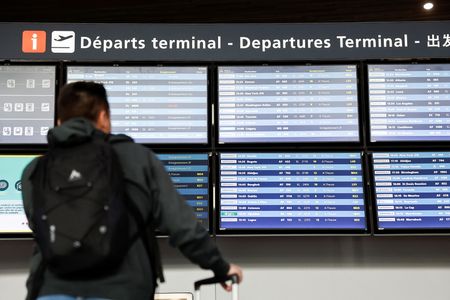

Travelers flying between Asia and Europe are facing dramatically higher ticket prices and limited availability after major Middle Eastern airports shut down due to the ongoing U.S.-Israel conflict with Iran.
Dubai International Airport, which typically processes more than 1,000 daily flights and ranks as the world’s busiest international hub, has now been closed for four straight days as of Tuesday. Other major Gulf region airports have also suspended operations, creating severe capacity shortages on popular travel corridors including Australia to Europe, where Emirates and Qatar Airways typically dominate the market.
The crisis has overwhelmed travel agencies with desperate customers seeking alternatives. Australia’s Flight Centre Travel Group reports call volumes to their retail locations and emergency help lines have jumped 75% since the situation began, with staff working continuously to assist stranded passengers, according to Global Managing Director Andrew Stark.
“Australians are very resilient and are already rebooking flights to the UK/Europe via alternative routes via China, Singapore, and other Asian hubs, as well as North America via hubs such as Houston,” Stark explained.
Airlines providing direct Asia-Europe service can navigate around the restricted Middle Eastern airspace by routing northward through the Caucasus region and Afghanistan, or taking southern paths through Egypt, Saudi Arabia, and Oman. However, these longer flight paths increase both travel time and fuel consumption, pushing up operational costs just as oil prices have surged, potentially leading to permanently higher ticket prices.
“Right now the whole of the Middle East is out of bounds, which is a high price for some airlines,” stated Subhas Menon, who leads the Association of Asia Pacific Airlines. “If then Europe can only be served at a high cost, airline profitability will be undermined. At the end of the day, the price to pay is connectivity.”
Aviation analysts suggest carriers offering direct flights or connections through unaffected hubs – such as Hong Kong’s Cathay Pacific Airways, Singapore Airlines, and Turkish Airlines – could benefit in the short term as passengers abandon Gulf-based airlines.
Website searches conducted by Reuters on Tuesday revealed extremely limited near-term availability and inflated pricing for Asia-to-London flights. Cathay Pacific’s Hong Kong-London route showed no economy seats available until March 11, with one-way tickets starting at HK$21,158 ($2,705.28) on that date, compared to more typical HK$5,054 pricing later in the month.
Qantas Airways has no economy-class availability on Sydney-London flights via its standard Perth and Singapore connections until March 17, when tickets cost A$3,129 ($2,220.03) one-way. For immediate travel, the airline offers expensive alternatives with unusual stopovers in cities like Los Angeles and Johannesburg.
Thailand’s Transport Minister Phiphat Ratchakitprakarn noted that Thai Airways is seeing completely booked Europe-bound flights as European vacationers choose direct routing instead of Middle Eastern connections. Bangkok-London searches showed sold-out conditions through late next week, with economy tickets priced at 71,190 baht ($2,265) on March 15, dropping to 27,045 baht by March 18.
Taiwan’s EVA Airways reported booking surges for European destinations as both Asian and European travelers hunt for alternative routing solutions. Chinese airline websites displayed dramatically elevated fares on China-UK routes, with economy seats virtually unavailable for immediate departure.
Typically, round-trip economy tickets from Beijing to London cost less than 10,000 yuan ($1,452.71), but Air China’s only Wednesday option is business class at 50,490 yuan one-way.